Software Composition Analysis: 6 Misunderstandings That Leave You Exposed
Software composition analysis identifies known weaknesses in third-party code, but it cannot detect logical flaws or runtime configuration errors within those components.

Software composition analysis scans your dependencies for known vulnerabilities using public databases. It does not fix code, it does not find zero-day exploits, and it ignores how you configure the library. You must combine it with patch management and security misconfigurations checks to reduce risk effectively. It is a starting point, not a finish line.
Misreading: A clean scan means the software is secure
Software composition analysis tools report on the presence of known vulnerabilities in open-source libraries. They compare your dependency tree against databases like the National Vulnerability Database. When the tool reports zero findings, many teams assume the application is safe from external attacks. This assumption is dangerous because SCA cannot see inside the code logic. It cannot detect buffer overflows that have not yet been cataloged. It cannot find business logic errors or injection flaws in your own code.
Imagine a developer uses a popular authentication library. The library has no known CVEs. The SCA tool reports a clean bill of health. However, the developer misconfigures the library to accept weak tokens. The application is vulnerable, but the SCA tool remains silent. You must treat SCA as a baseline check, not a security guarantee. Combine it with dynamic testing and manual review to catch what the scanner misses.
Correct reading: A clean SCA scan only confirms that your dependencies do not contain known, cataloged vulnerabilities. It does not verify the security of your code, your configuration, or your deployment environment.
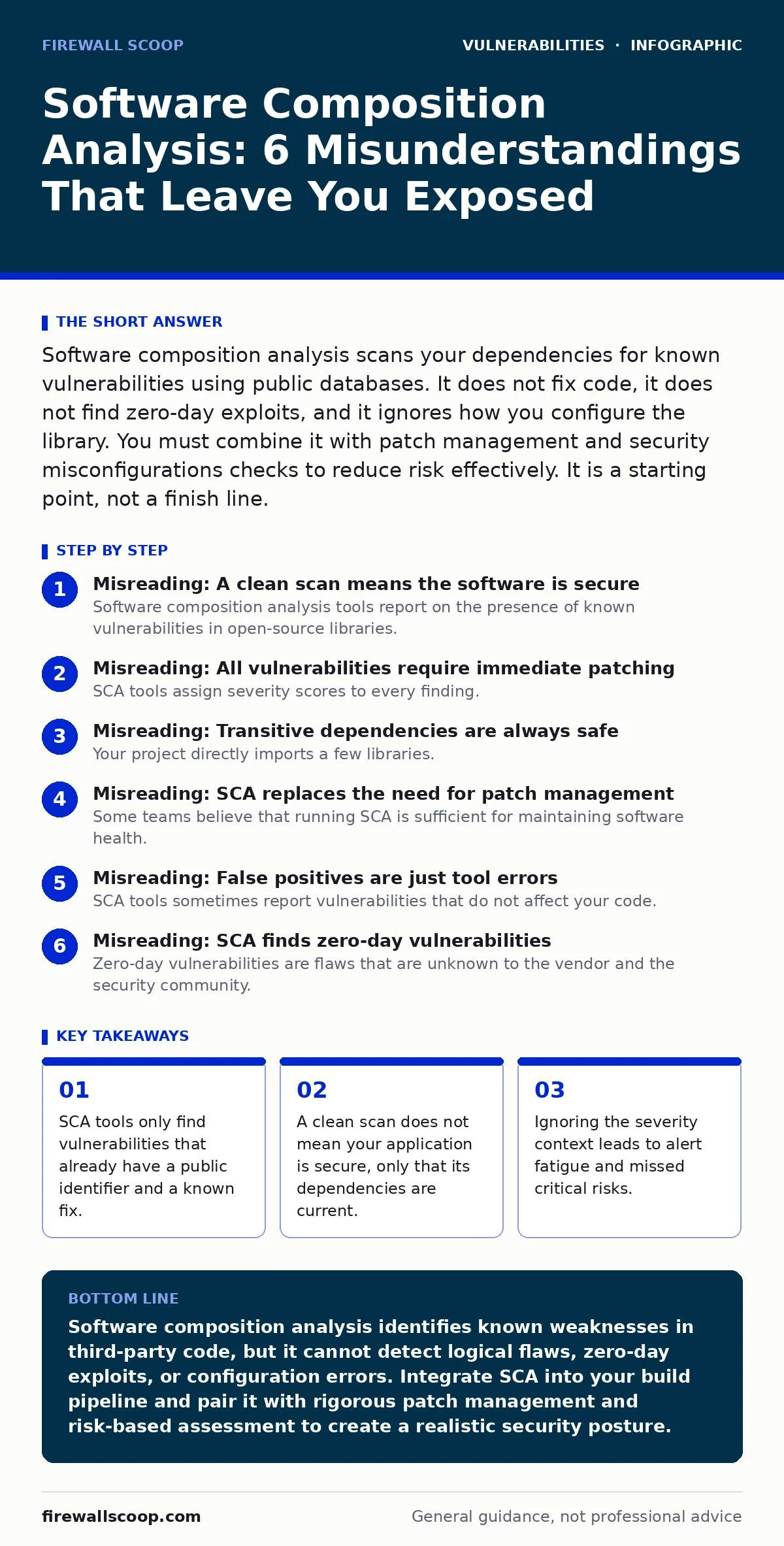
Misreading: All vulnerabilities require immediate patching
SCA tools assign severity scores to every finding. These scores often come from standardized frameworks that calculate potential impact. Teams frequently treat every high-severity finding as an emergency. They rush to update libraries, breaking builds and delaying releases. This reaction ignores the actual risk to your specific application. A vulnerability might require user interaction to exploit. Your application might not expose the affected function to the internet.
Suppose a library has a critical remote code execution flaw. Your application uses only one small utility function from that library. The vulnerable code path is never executed. Patching the library might introduce new bugs or break compatibility. In this case, the risk is low. You should document the acceptance of risk rather than forcing an immediate update. This approach prevents burnout and keeps development moving.
Correct reading: Not every high-severity finding poses an immediate threat. You must evaluate whether the vulnerable code is reachable and exploitable in your specific context before deciding to patch.
Misreading: Transitive dependencies are always safe
Your project directly imports a few libraries. These libraries import other libraries, which import more. These indirect imports are called transitive dependencies. Many teams believe that if they vet the direct dependencies, the rest are safe. They trust the maintainers of the primary libraries to choose secure components. This trust is misplaced. A primary library might pull in a small utility that has a known vulnerability.
Imagine a popular web framework includes a minor logging library. The logging library has a flaw that allows log injection. Your direct scan might miss this if it only checks top-level packages. SCA tools must trace the entire dependency tree. If your tool stops at direct dependencies, you leave blind spots. You must ensure your scanning process includes all nested layers.
Correct reading: You are responsible for the security of every library in your dependency tree, including those you did not explicitly choose. Transitive dependencies often carry hidden risks that direct scans miss.
Misreading: SCA replaces the need for patch management
Some teams believe that running SCA is sufficient for maintaining software health. They scan, see the list, and do nothing else. They assume the visibility provided by the tool is the solution. This view confuses identification with remediation. SCA tells you what is broken. It does not fix it. You still need a process to apply updates. You still need to test those updates.
Consider a scenario where a critical vulnerability is disclosed. Your SCA tool flags it instantly. If you have no patch management strategy, you cannot apply the fix quickly. You might lack the testing environment to verify the update. You might not have the authority to change the build process. SCA provides the data. Patch management provides the action. Without both, your vulnerabilities remain open.
Correct reading: SCA is a detection mechanism. It must be paired with a disciplined patch management process to actually reduce risk. Visibility without action provides no security benefit.
Misreading: False positives are just tool errors
SCA tools sometimes report vulnerabilities that do not affect your code. These are false positives. Teams often dismiss them as tool errors. They mark them as "won't fix" and move on. This reaction can be dangerous. Some false positives are actually true risks that the tool misunderstood. Others are true negatives where the tool incorrectly flagged safe code. Dismissing them without analysis wastes time and creates risk.
Suppose a tool flags a library for a SQL injection flaw. The library uses parameterized queries by default. Your code uses the library correctly. The finding is a false positive. However, if you dismiss it without checking, you might miss a case where your code overrides the safe default. You must investigate each finding. Determine if the vulnerable code path is reachable. Document your decision. This discipline builds trust in the tool's output.
Correct reading: Treat false positives as opportunities to refine your understanding of the code, not as noise to ignore. Validate every finding to ensure you are not missing a subtle risk.
See also: WordPress Page Builder Vulnerabilities: What to Know · How Security Bulletins Work: The Hidden Mechanics of Patch Intelligence
Misreading: SCA finds zero-day vulnerabilities
Zero-day vulnerabilities are flaws that are unknown to the vendor and the security community. They have no public identifier. They have no patch. SCA tools work by matching your code against known databases. They cannot find what they do not know exists. Many teams expect SCA to catch these hidden threats. This expectation sets them up for failure.
Imagine a researcher discovers a new flaw in a widely used image processing library. There is no CVE yet. Your SCA tool scans your project and reports no issues. You assume you are safe. An attacker exploits the new flaw before anyone publishes a fix. SCA cannot help here. You need other defenses. You need input validation. You need runtime protection. You need to limit the attack surface.
Correct reading: SCA is effective only against known vulnerabilities. It cannot detect zero-day exploits, logical flaws, or configuration errors. You must layer other security controls to protect against unknown threats.
Misreading: Severity scores tell the whole story
SCA tools use standardized scores to rank vulnerabilities. These scores consider factors like ease of exploitation and impact. Teams often sort by score and fix the highest numbers first. This approach ignores context. A high-score vulnerability in a library used only internally is less risky than a low-score vulnerability in a public-facing API.
Suppose a library has a low-severity information disclosure flaw. It exposes a version number. An attacker could use this to identify other weaknesses. If this library is exposed to the internet, the risk is higher. If it is used only in a closed internal tool, the risk is lower. You must adjust your prioritization based on your environment. Use risk-based vulnerability management to tailor your response.
Correct reading: Severity scores are a starting point, not a final verdict. You must adjust prioritization based on how the library is used and who can access it.
Misreading: SCA handles firmware and embedded systems
SCA tools are designed for application software. They analyze source code and binary dependencies. They are not built for firmware or embedded systems. These systems often have unique constraints. They use custom libraries. They have limited resources. Standard SCA tools may fail to parse these binaries. They may miss critical flaws.
Imagine an IoT device with a custom operating system. It uses a modified version of a common library. The SCA tool cannot recognize the modification. It reports the library as safe. The modification introduces a backdoor. You need specialized tools for firmware. You need to analyze the binary directly. You need to understand the hardware constraints.
Correct reading: SCA is not a universal solution. For firmware and embedded systems, use specialized analysis tools and manual review. Do not assume application SCA tools work on all software types.
Key takeaways
- SCA tools only find vulnerabilities that already have a public identifier and a known fix.
- A clean scan does not mean your application is secure, only that its dependencies are current.
- Ignoring the severity context leads to alert fatigue and missed critical risks.
Software composition analysis identifies known weaknesses in third-party code, but it cannot detect logical flaws, zero-day exploits, or configuration errors. Integrate SCA into your build pipeline and pair it with rigorous patch management and risk-based assessment to create a realistic security posture.
Frequently asked questions
Does SCA scan my own source code for bugs?
No, SCA focuses on third-party libraries and open-source dependencies. It does not analyze your custom code for logic errors or injection flaws. You need static application security testing for that.
How often should I run SCA scans?
Run scans on every code change and every dependency update. Integrate the tool into your continuous integration pipeline to catch new vulnerabilities before they reach production.
Can I ignore low-severity findings?
You can deprioritize them, but do not ignore them without analysis. Low-severity issues can sometimes be chained to create high-impact attacks. Document your decision to defer remediation.
Does SCA work for proprietary libraries?
SCA works best with open-source libraries that have public identifiers. It cannot scan proprietary code unless the vendor provides vulnerability data. You must rely on vendor security bulletins for proprietary components.
How this guide was produced: written by the Firewall Scoop editorial team with AI assistance, checked against the public references listed below, and reviewed when the facts change. See our editorial policy or report an error.