Risk-Based Vulnerability Management: Fix What Actually Matters
Treating every flaw as equally dangerous wastes resources on harmless issues while leaving critical entry points open to attackers.

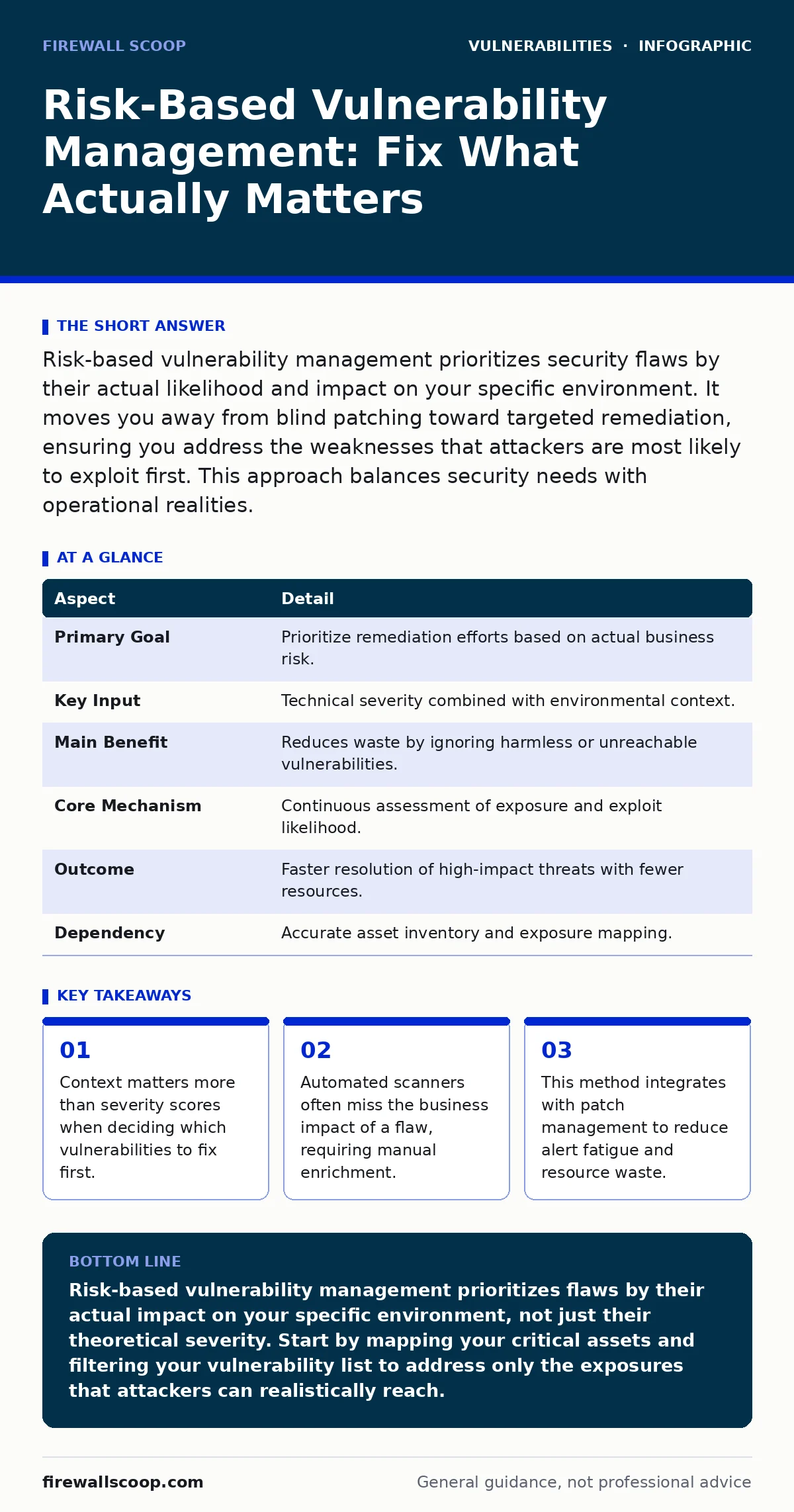
Risk-based vulnerability management prioritizes security flaws by their actual likelihood and impact on your specific environment. It moves you away from blind patching toward targeted remediation, ensuring you address the weaknesses that attackers are most likely to exploit first. This approach balances security needs with operational realities.
The Broken Car Analogy
Imagine you own a fleet of delivery vans. One van has a flat tire, another has a loose mirror, and a third has a cracked windshield. A traditional approach demands you fix all three immediately, regardless of where the vans are driving. If the van with the flat tire is parked in a garage, it poses no immediate risk. If the van with the cracked windshield is driving at night through heavy rain, it is a disaster waiting to happen.
Risk-based vulnerability management applies this logic to software. It asks not just "is there a flaw?" but "does this flaw matter right now?" You stop treating a cosmetic bug in an internal tool the same as a remote code execution flaw in a public-facing server. This shift saves time and reduces stress.
What Risk-Based Vulnerability Management Is
At its core, risk-based vulnerability management is a strategy that prioritizes security flaws based on their actual risk to your organization. It combines technical data about a vulnerability with contextual data about your environment. You are not just looking at a severity score; you are looking at exposure, exploitability, and asset value.
This method solves the problem of alert fatigue. Security teams drown in thousands of findings from scanners. Most of these findings are low priority. By filtering for risk, you focus your limited resources on the few issues that could cause real harm. It turns a chaotic list of bugs into a manageable action plan.
| Aspect | Detail |
|---|---|
| Primary Goal | Prioritize remediation efforts based on actual business risk. |
| Key Input | Technical severity combined with environmental context. |
| Main Benefit | Reduces waste by ignoring harmless or unreachable vulnerabilities. |
| Core Mechanism | Continuous assessment of exposure and exploit likelihood. |
| Outcome | Faster resolution of high-impact threats with fewer resources. |
| Dependency | Accurate asset inventory and exposure mapping. |
The Three Pillars of Risk Calculation
To calculate risk, you need three distinct pieces of information. The first is the vulnerability itself. This includes its severity rating, such as the Common Vulnerability Scoring System score. This tells you how severe the flaw is in a theoretical vacuum. It does not tell you if it affects your specific setup.
The second pillar is asset context. Is the vulnerable system exposed to the internet? Does it hold sensitive customer data? Is it a legacy system that no one uses? A critical flaw on an isolated, air-gapped printer is far less risky than a moderate flaw on a public web server. You must map vulnerabilities to assets to understand true exposure.
The third pillar is threat intelligence. Are attackers actively exploiting this flaw? Is there a known exploit kit circulating? If a vulnerability has a high severity score but no known exploit and cannot be reached, its risk is low. If attackers are writing scripts for it, its risk skyrockets. This dynamic data changes the priority daily.
How It Fits With Other Defences
Risk-based vulnerability management does not replace other security measures; it guides them. It works hand-in-hand with patch management. Instead of applying every patch immediately, you use risk data to decide which patches to deploy first. This prevents system outages caused by rushing untested updates.
It also complements software composition analysis. When you scan open-source libraries, you find hundreds of dependencies with known flaws. Risk-based management helps you ignore those in unused code paths. It works alongside security misconfigurations reviews by highlighting which misconfigured services are exposed to attackers.
You might also consider this approach when handling firmware updates. Not all firmware patches are urgent. Some fix minor bugs, while others address critical remote access flaws. Risk-based logic helps you schedule these updates without disrupting critical operations. It ensures your efforts align with the rest of your security stack.
Common Misconceptions to Avoid
Many teams believe that risk-based vulnerability management means ignoring low-severity issues. This is wrong. It means deferring them. A low-severity issue might become high-risk if the asset it resides on changes its role. You must continuously monitor the context, not just the flaw.
Another mistake is relying solely on automated tools. Scanners provide raw data, but they lack business context. They do not know which server is critical to revenue. Human analysis is required to enrich the data. Without this step, you are just automating guesswork.
See also: WordPress Page Builder Vulnerabilities: What to Know · How Security Bulletins Work: The Hidden Mechanics of Patch Intelligence
The Hidden Cost of Context
The biggest challenge in implementing this approach is gathering accurate context. You need a complete and accurate asset inventory. If you do not know you have a device, you cannot assess its risk. Shadow IT devices often slip through the cracks, creating blind spots.
Updating this context is labor-intensive. Assets change roles, networks reconfigure, and applications move to the cloud. If your context data is stale, your risk calculations are wrong. This hidden cost of maintenance is often underestimated. You must invest in automation to keep your asset map current.
What People Usually Get Wrong
Teams often confuse severity with risk. They see a "Critical" label and panic. They ignore the fact that the vulnerability might be in a component that is not installed or not exposed. This leads to wasted effort on low-impact issues while high-impact, moderate-severity flaws go unpatched.
Another error is treating risk as a one-time calculation. Risk is dynamic. A vulnerability that is safe today might become dangerous tomorrow if an attacker releases an exploit. You must continuously re-evaluate your prioritization list. Static reports are useless in a changing threat environment.
Moving Beyond Basic Patching
To truly benefit from this approach, you must integrate it into your development lifecycle. Developers need to know which libraries to avoid based on risk, not just presence of flaws. This reduces the burden on security teams later. It shifts security left, catching issues before they reach production.
You should also review your security bulletins with a critical eye. Not every advisory requires immediate action. Use risk-based logic to determine if the advice applies to your stack. This selective approach ensures you respond to real threats without burning out your team. It creates a sustainable security posture that focuses on what matters.
The Path Forward
Implementing risk-based vulnerability management requires a shift in mindset. You move from compliance-driven patching to risk-driven decision-making. This means accepting some risk in order to manage it effectively. You cannot fix everything, so you must fix the right things.
Start by mapping your critical assets. Identify what matters most to your business. Then, prioritize vulnerabilities on those assets. As your data improves, your prioritization becomes sharper. This leads to a stronger security posture with less effort. You stop fighting every bug and start defending what counts.
Key takeaways
- Context matters more than severity scores when deciding which vulnerabilities to fix first.
- Automated scanners often miss the business impact of a flaw, requiring manual enrichment.
- This method integrates with patch management to reduce alert fatigue and resource waste.
- It helps organizations ignore low-risk issues that have no real path to exploitation.
Risk-based vulnerability management prioritizes flaws by their actual impact on your specific environment, not just their theoretical severity. Start by mapping your critical assets and filtering your vulnerability list to address only the exposures that attackers can realistically reach.
Frequently asked questions
How does this differ from traditional vulnerability management?
Traditional management treats all vulnerabilities as equal based on severity scores. Risk-based management adds context like asset value and exposure to prioritize actual business risk.
Do I still need to patch low-severity vulnerabilities?
Yes, but not immediately. You defer them until they become relevant or as part of routine maintenance. This ensures you focus on high-impact threats first.
How do I handle race condition vulnerabilities in this model?
Treat them like any other flaw. Assess the asset's exposure and the likelihood of exploitation. If the asset is critical and exposed, prioritize the fix regardless of the technical complexity.
Can automated tools fully implement this approach?
No. Tools can provide data, but they lack business context. Human analysis is required to determine asset value and adjust priorities based on real-world threat activity.
How this guide was produced: written by the Firewall Scoop editorial team with AI assistance, checked against the public references listed below, and reviewed when the facts change. See our editorial policy or report an error.