National Vulnerability Database: Meaning, Structure, and Daily Use
The National Vulnerability Database serves as the centralized catalog for security flaws, providing the unique identifiers that drive automated patching workflows across the industry.

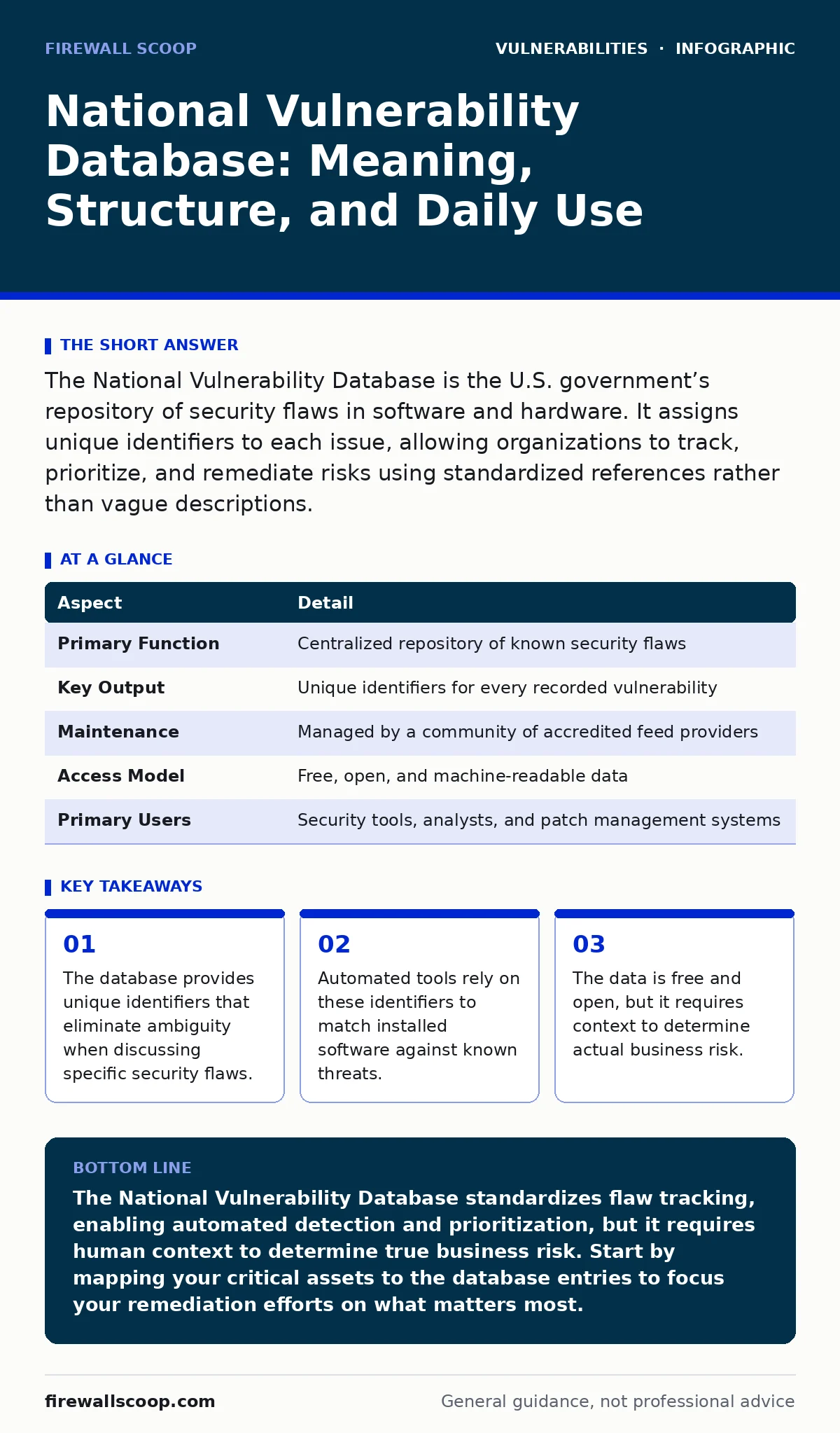
The National Vulnerability Database is the U.S. government’s repository of security flaws in software and hardware. It assigns unique identifiers to each issue, allowing organizations to track, prioritize, and remediate risks using standardized references rather than vague descriptions.
The Universal Translator for Security Flaws
Imagine you are trying to fix a leak in a complex plumbing system. You could describe the leak as "a drip near the kitchen sink," but a repair crew needs a specific part number to bring the right tool. In cybersecurity, the National Vulnerability Database acts as that part number system. It translates the chaotic reality of broken code into a structured list that machines and humans can process.
Without this central catalog, every organization would define security flaws differently. One team might call a buffer overflow "memory error 404," while another calls it "stack corruption." This ambiguity slows down remediation. The database standardizes these definitions so that a vendor, a researcher, and a defender all speak the same language.
| Aspect | Detail |
|---|---|
| Primary Function | Centralized repository of known security flaws |
| Key Output | Unique identifiers for every recorded vulnerability |
| Maintenance | Managed by a community of accredited feed providers |
| Access Model | Free, open, and machine-readable data |
| Primary Users | Security tools, analysts, and patch management systems |
Where the Data Comes From
The term "National Vulnerability Database" refers to the specific U.S. government repository, but the data inside it is global. Researchers, vendors, and security firms discover flaws every day. They report these findings to accredited feed providers. These providers validate the information, assign a unique identifier, and submit it to the main database.
This process creates a single source of truth. When a new flaw is discovered, it gets a permanent label. This label never changes, even if the details of the flaw are updated later. This permanence is vital for long-term tracking. You can reference a flaw from five years ago with the same identifier used today.
The database does not discover flaws itself. It aggregates them. This distinction matters because it means the database is only as good as the reports it receives. If a flaw is not reported to a feed provider, it does not appear in the database. This creates a blind spot for zero-day vulnerabilities that have not yet been disclosed publicly.
How It Drives Daily Operations
You use this database every time you run a vulnerability scanner. These tools compare the software running on your servers against the list of known flaws. If a match is found, the scanner reports the unique identifier. You then look up that identifier to understand the severity and the fix.
This workflow is the backbone of risk-based vulnerability management. Instead of patching everything at once, you prioritize based on the data in the database. You focus on flaws that are actively being exploited or that affect your most critical systems. This approach saves time and reduces the risk of breaking stable systems with unnecessary updates.
Automated systems also use this data. Configuration management tools can pull the latest list of flaws and automatically apply patches to compliant systems. This reduces the manual effort required to keep infrastructure secure. However, automation requires accurate data. If the database contains incorrect information, your automated systems will make bad decisions.
The Hidden Cost of Standardization
Standardization brings clarity, but it also creates a dependency. Many organizations treat the database as the final word on risk. They assume that if a flaw is in the database, it is dangerous, and if it is not, it is safe. This binary thinking is a mistake.
The database describes the technical nature of a flaw, not its business impact. A flaw might be technically severe but impossible to exploit in your specific environment. Conversely, a low-severity flaw might be trivial to exploit if it affects a public-facing system. You must add your own context to the raw data.
This is where security bulletins become important. Vendors often provide additional context that the database does not capture. They might explain which configurations are affected and which are not. Reading these bulletins alongside the database entries gives you a more accurate picture of your risk.
What People Usually Get Wrong
Many readers assume the database is a real-time alert system. It is not. There is often a delay between the discovery of a flaw and its entry into the database. During this window, you may be exposed to a threat that is not yet recorded. This delay is inherent to the validation process.
Another common error is ignoring the version details. Flaws often affect specific versions of software. Patching a newer version that is not affected is wasted effort. It can also introduce new bugs. You must verify that the flaw applies to your exact software version before taking action.
Some teams also overlook the difference between a vulnerability and a misconfiguration. The database tracks flaws in code. It does not track errors in setup. For instance, directory listing exposure is often a configuration error, not a code flaw. You cannot find this in the vulnerability database. You need separate scanning tools to detect security misconfigurations.
See also: WordPress Page Builder Vulnerabilities: What to Know · How Security Bulletins Work: The Hidden Mechanics of Patch Intelligence
Beyond Software: Firmware and Hardware
The database is not limited to operating systems and applications. It also tracks flaws in firmware and hardware. Firmware vulnerabilities are particularly tricky because they are embedded in devices like routers, IoT sensors, and servers. These flaws are harder to patch than software bugs.
When a firmware flaw is discovered, the fix often requires a firmware update. This process can be risky. A failed update can brick a device, rendering it unusable. You must test updates in a isolated environment before deploying them to production. This caution is necessary because hardware cannot be easily reverted like software.
The database helps you track these hardware flaws over time. It allows you to see if a device has known issues that require physical replacement. This information is valuable for procurement decisions. You can choose devices with a better security track record based on the historical data in the database.
Integrating with Other Analysis Tools
To get a full picture of your security posture, you must combine database data with other sources. Software composition analysis tools scan your code for open-source libraries. They check these libraries against the database to find known flaws. This helps you identify risks in your supply chain.
However, the database does not tell you if a flaw is exploitable in your specific code path. Some flaws require a specific sequence of events to trigger. This is where understanding race condition vulnerabilities becomes relevant. These flaws depend on timing, which the database cannot predict. You need manual review or advanced testing to confirm these risks.
The Human Element in Automated Systems
Despite the automation, human judgment remains necessary. The database provides data, but it does not provide strategy. You must decide how to respond to each flaw. Some flaws require immediate patching. Others can be mitigated with network controls or monitoring.
This decision-making process is where experience matters. You need to understand your environment, your threats, and your business goals. The database is a tool, not a strategy. It supports your decisions, but it does not make them for you.
By using the database effectively, you can build a more resilient security program. You can track trends, measure progress, and justify security investments. The data is free and open, but its value depends on how you use it.
Key takeaways
- The database provides unique identifiers that eliminate ambiguity when discussing specific security flaws.
- Automated tools rely on these identifiers to match installed software against known threats.
- The data is free and open, but it requires context to determine actual business risk.
The National Vulnerability Database standardizes flaw tracking, enabling automated detection and prioritization, but it requires human context to determine true business risk. Start by mapping your critical assets to the database entries to focus your remediation efforts on what matters most.
Frequently asked questions
Is the National Vulnerability Database free to use?
Yes, the data is publicly available and free to access. You can query it directly or use tools that integrate with its feeds.
How often is the database updated?
Updates occur continuously as new flaws are reported and validated. Most feed providers update their data daily or more frequently.
Can I report a flaw directly to the database?
No, you must report flaws to an accredited feed provider. They validate the information and submit it to the main database.
Does the database include zero-day vulnerabilities?
Only after they are discovered and reported. Zero-days are unknown flaws, so they are not in the database until they become known.
How this guide was produced: written by the Firewall Scoop editorial team with AI assistance, checked against the public references listed below, and reviewed when the facts change. See our editorial policy or report an error.