What Causes a Buffer Overflow Vulnerability: The Memory Logic Breakdown
A buffer overflow occurs when code writes data beyond a memory block's boundary, corrupting adjacent instructions and allowing attackers to hijack execution flow.

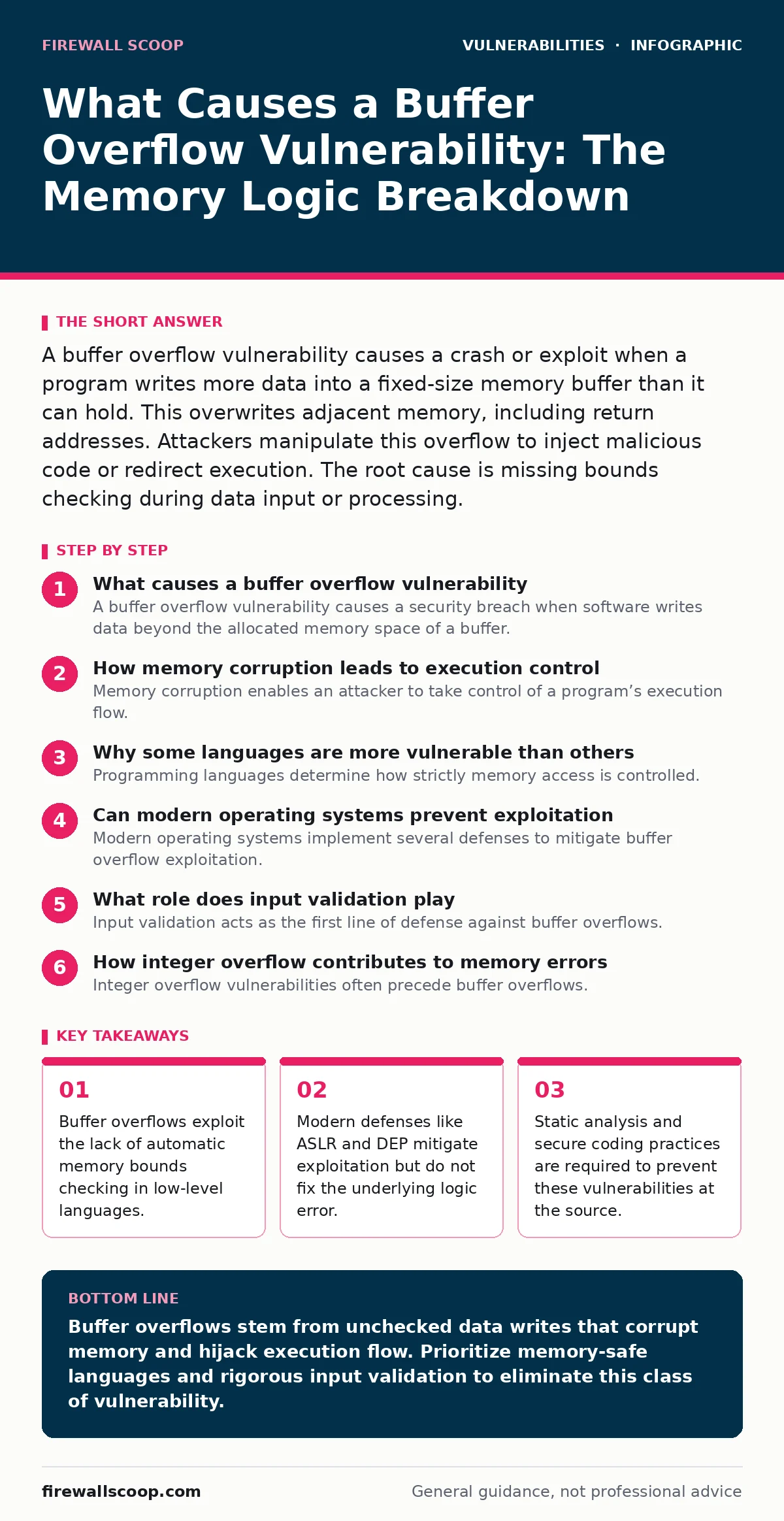
A buffer overflow vulnerability causes a crash or exploit when a program writes more data into a fixed-size memory buffer than it can hold. This overwrites adjacent memory, including return addresses. Attackers manipulate this overflow to inject malicious code or redirect execution. The root cause is missing bounds checking during data input or processing.
What causes a buffer overflow vulnerability
A buffer overflow vulnerability causes a security breach when software writes data beyond the allocated memory space of a buffer. A buffer is a temporary holding area in memory for data. When input exceeds this limit, it spills into neighboring memory locations. This spillover overwrites critical data structures, such as function return addresses. The program then executes code from the attacker’s input instead of its intended path. This mechanism bypasses normal security controls.
How memory corruption leads to execution control
Memory corruption enables an attacker to take control of a program’s execution flow. When a function finishes, it uses a return address stored on the stack to know where to resume. A buffer overflow overwrites this return address. The attacker places their own address there. When the function returns, the CPU jumps to the attacker’s code. This technique allows remote code execution. It turns a simple data error into a full system compromise.
Why some languages are more vulnerable than others
Programming languages determine how strictly memory access is controlled. Languages like C and C++ do not automatically check array bounds. Developers must manually ensure data fits within allocated space. This manual requirement introduces human error. Higher-level languages like Java or Python manage memory automatically. They raise exceptions when boundaries are exceeded. This automatic protection prevents most buffer overflows. However, performance trade-offs exist. Low-level control offers speed but sacrifices safety.
| Language Feature | Memory Safety | Performance Impact | Overflow Risk |
|---|---|---|---|
| Manual Management | Low | High | High |
| Automatic GC | High | Moderate | Low |
| Bounds Checking | High | Moderate | Low |
| Pointer Arithmetic | Low | High | High |
Can modern operating systems prevent exploitation
Modern operating systems implement several defenses to mitigate buffer overflow exploitation. Address Space Layout Randomization randomizes memory locations. This makes it difficult for attackers to predict where to place their code. Data Execution Prevention marks certain memory areas as non-executable. Even if an attacker injects code, the CPU refuses to run it. These measures raise the difficulty bar. They do not eliminate the vulnerability. A skilled attacker can use return-oriented programming to bypass these defenses.
What role does input validation play
Input validation acts as the first line of defense against buffer overflows. Software must verify the length and type of all incoming data. If an application expects a username of 50 characters, it must reject longer inputs. This check must occur before the data enters the buffer. Trusting external input without verification invites corruption. Developers must assume all input is hostile. Validation logic must be consistent across all entry points.
How integer overflow contributes to memory errors
Integer overflow vulnerabilities often precede buffer overflows. An integer overflow occurs when a calculation exceeds the maximum value a variable can hold. The value wraps around to a negative number or zero. If this value is used to allocate memory, the system allocates a tiny buffer. The application then writes large data into this tiny space. This causes a buffer overflow. Checking for integer overflow before memory allocation is critical. See our guide on integer overflow vulnerabilities for deeper details.
How to detect these flaws in code
Detection requires combining static analysis with dynamic testing. Static analysis tools scan source code for unsafe functions. They identify places where bounds are not checked. Dynamic testing involves running the program with malformed inputs. Fuzzing sends random data to find crashes. These crashes often indicate buffer overflows. Reviewing code for legacy functions is also effective. Functions that do not take size arguments are high-risk targets.
What steps prevent recurrence in development
Preventing recurrence requires integrating security into the development lifecycle. Teams should adopt memory-safe languages where possible. When using C or C++, enforce strict coding standards. Use static application security testing in continuous integration pipelines. Perform regular code reviews focused on memory handling. Update dependencies to fix known issues. Refer to security bulletins for specific patches. Implement patch management processes to deploy fixes quickly.
Why legacy systems remain at high risk
Legacy systems remain at high risk due to outdated development practices. Older code often lacks modern security features. Maintaining these systems is costly and complex. Developers may not have the skills to refactor legacy C code. These systems often run without modern OS protections. They expose directory listing exposure if configured poorly. Regular security audits are necessary. Isolation helps limit damage if a breach occurs.
How to respond to a suspected overflow
Responding to a suspected buffer overflow requires immediate containment. Isolate the affected system from the network. Preserve logs for forensic analysis. Identify the vulnerable component. Apply the relevant patch from the National Vulnerability Database. Verify the fix in a staging environment. Monitor for further exploitation attempts. Review access controls to limit lateral movement. Document the incident for future training.
Key takeaways
- Buffer overflows exploit the lack of automatic memory bounds checking in low-level languages.
- Modern defenses like ASLR and DEP mitigate exploitation but do not fix the underlying logic error.
- Static analysis and secure coding practices are required to prevent these vulnerabilities at the source.
Buffer overflows stem from unchecked data writes that corrupt memory and hijack execution flow. Prioritize memory-safe languages and rigorous input validation to eliminate this class of vulnerability.
Frequently asked questions
Does using HTTPS prevent buffer overflow attacks?
No, HTTPS encrypts data in transit but does not validate data length or structure. The application must still check input bounds before processing.
Are buffer overflows only a server-side problem?
No, client-side applications can also suffer from buffer overflows. Malicious files or network packets can trigger overflows in local software.
How do I check if my software has this flaw?
Use static analysis tools to scan your codebase. Run dynamic fuzzing tests to identify crashes. Review third-party components for known issues.
Can a buffer overflow delete my files?
Yes, if an attacker gains code execution, they can run any command. This includes deleting files, installing malware, or stealing data.
How this guide was produced: written by the Firewall Scoop editorial team with AI assistance, checked against the public references listed below, and reviewed when the facts change. See our editorial policy or report an error.