Integer Overflow Vulnerabilities: Risks and Protection for Small Businesses
Integer overflow vulnerabilities allow attackers to bypass security checks by wrapping numbers around to negative values, enabling unauthorized memory access.

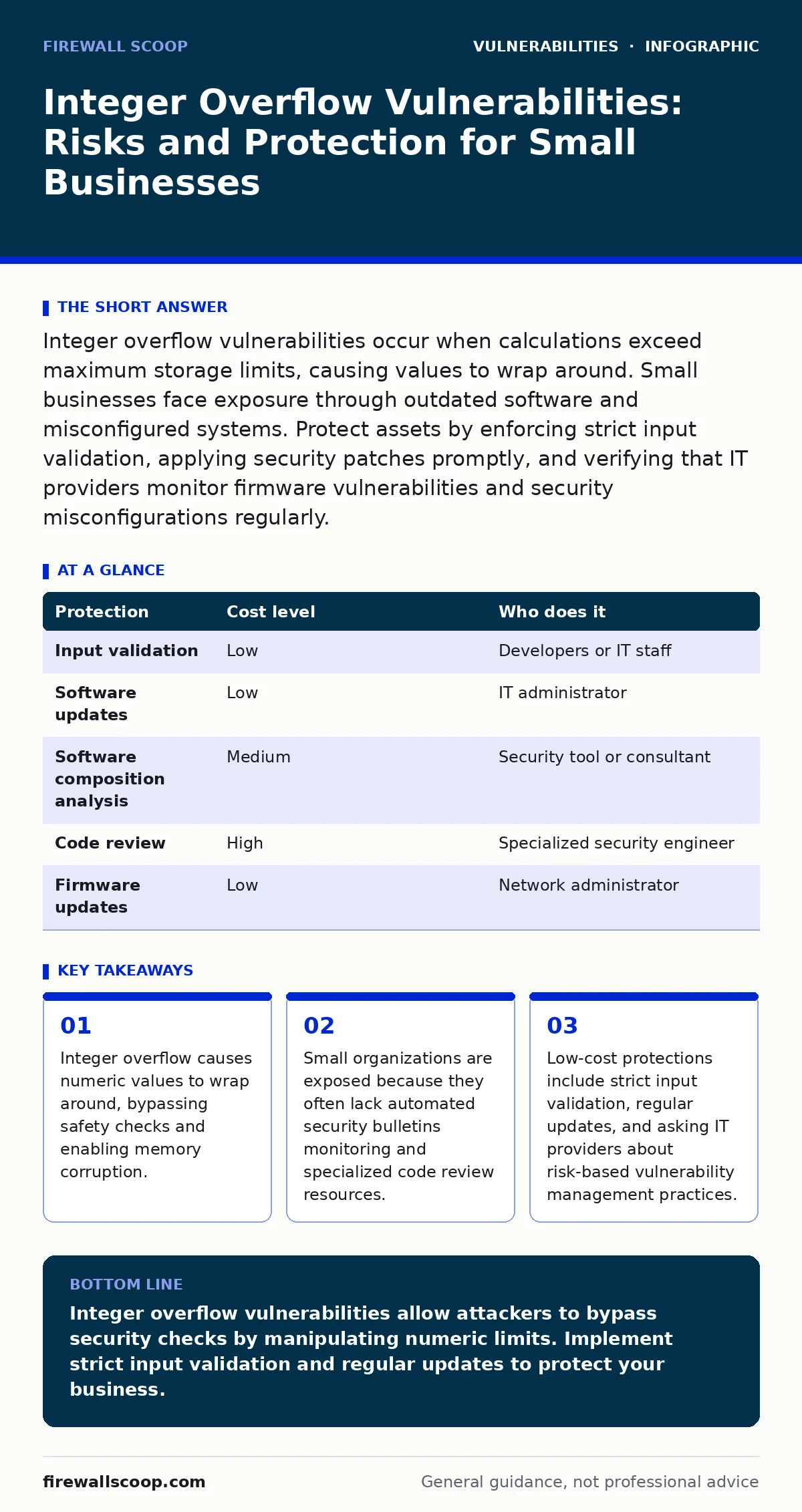
Integer overflow vulnerabilities occur when calculations exceed maximum storage limits, causing values to wrap around. Small businesses face exposure through outdated software and misconfigured systems. Protect assets by enforcing strict input validation, applying security patches promptly, and verifying that IT providers monitor firmware vulnerabilities and security misconfigurations regularly.
How Integer Overflow Vulnerabilities Work
Integer overflow vulnerabilities happen when a program performs a mathematical calculation that exceeds the maximum value the variable can hold. Computers store integers in fixed-size containers, such as 32-bit or 64-bit slots. When a calculation produces a result larger than this limit, the value wraps around to the beginning of the range. This often results in a negative number or a small positive number instead of the expected large value.
Security checks rely on these numbers being correct. If a length check expects a positive value but receives a wrapped negative number, the check fails silently. The program then allocates insufficient memory for the data. When the program writes data into this undersized buffer, it overwrites adjacent memory. This behavior mirrors buffer overflow vulnerabilities, but the root cause is the arithmetic error rather than unchecked input length.
You must understand that this is not a theoretical risk. Many standard libraries and legacy systems assume inputs stay within reasonable bounds. When they do not, the underlying logic breaks. The consequence is not just a crash. It is often a pathway for an attacker to execute arbitrary code or escalate privileges.
Why Small Organisations Remain Exposed
Small businesses often assume that their size makes them invisible to attackers. This assumption is incorrect. Automated scanning tools target large ranges of IP addresses regardless of the organization size. Small teams lack the dedicated security staff to review code for these subtle arithmetic errors. They rely on third-party software and open-source components that may contain hidden flaws.
The exposure increases when organizations neglect security misconfigurations. Default settings often leave debug modes enabled or disable strict input validation. Without a structured approach to risk-based vulnerability management, small teams patch obvious issues but miss complex logic errors. They also often ignore firmware vulnerabilities in network devices, which can provide an entry point before the application layer is even reached.
Another hidden cost is the reliance on generic IT support. Generalist technicians may not recognize that a strange application crash is due to an integer issue. They might restart the server and move on, leaving the vulnerability open. This creates a false sense of security while the underlying weakness remains active and exploitable.
Low-Cost Protections for Limited Budgets
You do not need expensive security suites to mitigate these risks. The most effective protection is strict input validation. Every piece of data entering your system must be checked for type, length, and range. Reject any value that falls outside the expected parameters before it reaches the calculation logic. This stops the overflow before it occurs.
Implementing software composition analysis helps identify vulnerable third-party libraries. This process scans your dependencies for known issues, including integer overflow flaws in common code modules. Many open-source tools provide this functionality at no cost. You must integrate this scanning into your development workflow, not just as a one-time check.
Regular application of security bulletins is another low-cost measure. Vendors release patches for known integer issues. Delaying these updates leaves your systems exposed. Automate the update process where possible, but always test patches in a staging environment first. This prevents a patch from breaking critical business logic while closing the security gap.
| Protection | Cost level | Who does it |
|---|---|---|
| Input validation | Low | Developers or IT staff |
| Software updates | Low | IT administrator |
| Software composition analysis | Medium | Security tool or consultant |
| Code review | High | Specialized security engineer |
| Firmware updates | Low | Network administrator |
What to Ask Your IT Provider
Your IT provider is your first line of defense. You must verify that they understand these specific risks. Ask them how they monitor for emerging threats. A generic promise of "security monitoring" is not enough. You need to know if they track specific vulnerability classes like integer overflows in your critical applications.
Inquire about their patch management process. Do they prioritize patches based on severity and exposure? Or do they apply them in bulk regardless of risk? A provider that uses risk-based vulnerability management will prioritize fixing high-severity issues in exposed systems. This approach is more effective than random patching.
Ask if they review configuration settings regularly. Security misconfigurations are a common entry point. Ensure they check for disabled security features or default credentials. Also, ask if they monitor WordPress page builder vulnerabilities if your website uses such plugins. These components often have complex logic that can harbor integer issues.
- Does your provider perform regular code audits for logic errors?
- How do you handle firmware vulnerabilities in our network devices?
- Can you demonstrate your process for applying security bulletins?
- Do you test patches before deploying them to production?
- How do you detect and respond to abnormal application behavior?
The Hidden Cost of Ignoring Logic Errors
Ignoring integer overflow vulnerabilities creates a hidden technical debt. Each unpatched flaw is a potential backdoor. Attackers often chain multiple vulnerabilities to gain access. An integer overflow might be the first step, leading to a buffer overflow, which then allows remote code execution.
The cost of a breach far exceeds the cost of prevention. You face data loss, regulatory fines, and reputational damage. Small businesses often lack the insurance coverage to handle major incidents. Prevention is not just a technical task. It is a business survival strategy.
You must also consider the cost of downtime. When an application crashes due to an overflow, business operations stop. Customers cannot place orders. Employees cannot access data. The financial impact of hours of downtime can be significant. Regular testing and validation prevent these unexpected outages.
Building a Resilient Security Posture
Security is not a one-time fix. It is an ongoing process. You must integrate security into every stage of your software lifecycle. This includes design, development, testing, and deployment. Use static analysis tools to catch potential integer issues early. These tools can flag suspicious arithmetic operations before they reach production.
Train your staff to recognize the signs of a potential issue. Unusual application behavior, such as crashes with large inputs, should be investigated immediately. Do not dismiss these as minor bugs. They may indicate a serious vulnerability. Encourage a culture of security awareness where everyone plays a role.
Regularly review your security policies. Update them to reflect new threats and technologies. Engage with your IT provider to ensure they are using the latest detection methods. Stay informed about security bulletins and industry trends. Knowledge is your best defense against evolving threats.
Final Steps for Immediate Protection
Start by auditing your critical applications. Identify where user input is processed and where arithmetic operations occur. Implement strict input validation on these points. This simple step blocks the majority of integer overflow attempts.
Next, review your update procedures. Ensure that all software and firmware are up to date. Automate updates where possible, but maintain a testing protocol. This balances speed with stability.
Finally, engage your IT provider. Ask the questions listed above. Verify their expertise and processes. A proactive partner can help you stay ahead of threats. Do not wait for an incident to take action. Protect your business today.
Key takeaways
- Integer overflow causes numeric values to wrap around, bypassing safety checks and enabling memory corruption.
- Small organizations are exposed because they often lack automated security bulletins monitoring and specialized code review resources.
- Low-cost protections include strict input validation, regular updates, and asking IT providers about risk-based vulnerability management practices.
Integer overflow vulnerabilities allow attackers to bypass security checks by manipulating numeric limits. Implement strict input validation and regular updates to protect your business.
Frequently asked questions
What is the difference between integer overflow and buffer overflow?
Integer overflow is an arithmetic error where a number exceeds its storage limit and wraps around. Buffer overflow is a memory error where data exceeds its allocated space. Integer overflow can cause buffer overflow by miscalculating memory size.
Can modern programming languages prevent integer overflow?
Most modern languages have safeguards, but they are not foolproof. Improper logic or use of unsafe libraries can still lead to issues. Always validate inputs and use safe arithmetic functions.
How do I know if my software has this vulnerability?
Look for crashes with large inputs or unexpected behavior during calculations. Use static analysis tools to scan your code for risky arithmetic operations. Regular code reviews also help identify potential flaws.
Is patching enough to protect against these risks?
Patching fixes known issues, but new vulnerabilities emerge constantly. Combine patching with input validation, regular updates, and security monitoring. A layered approach provides better protection than relying on patches alone.
How this guide was produced: written by the Firewall Scoop editorial team with AI assistance, checked against the public references listed below, and reviewed when the facts change. See our editorial policy or report an error.