National Cyber Emergency Declarations: Small Business Action Plan
Emergency declarations shift legal liability and funding access, forcing small firms to align with federal standards immediately or face compliance gaps.

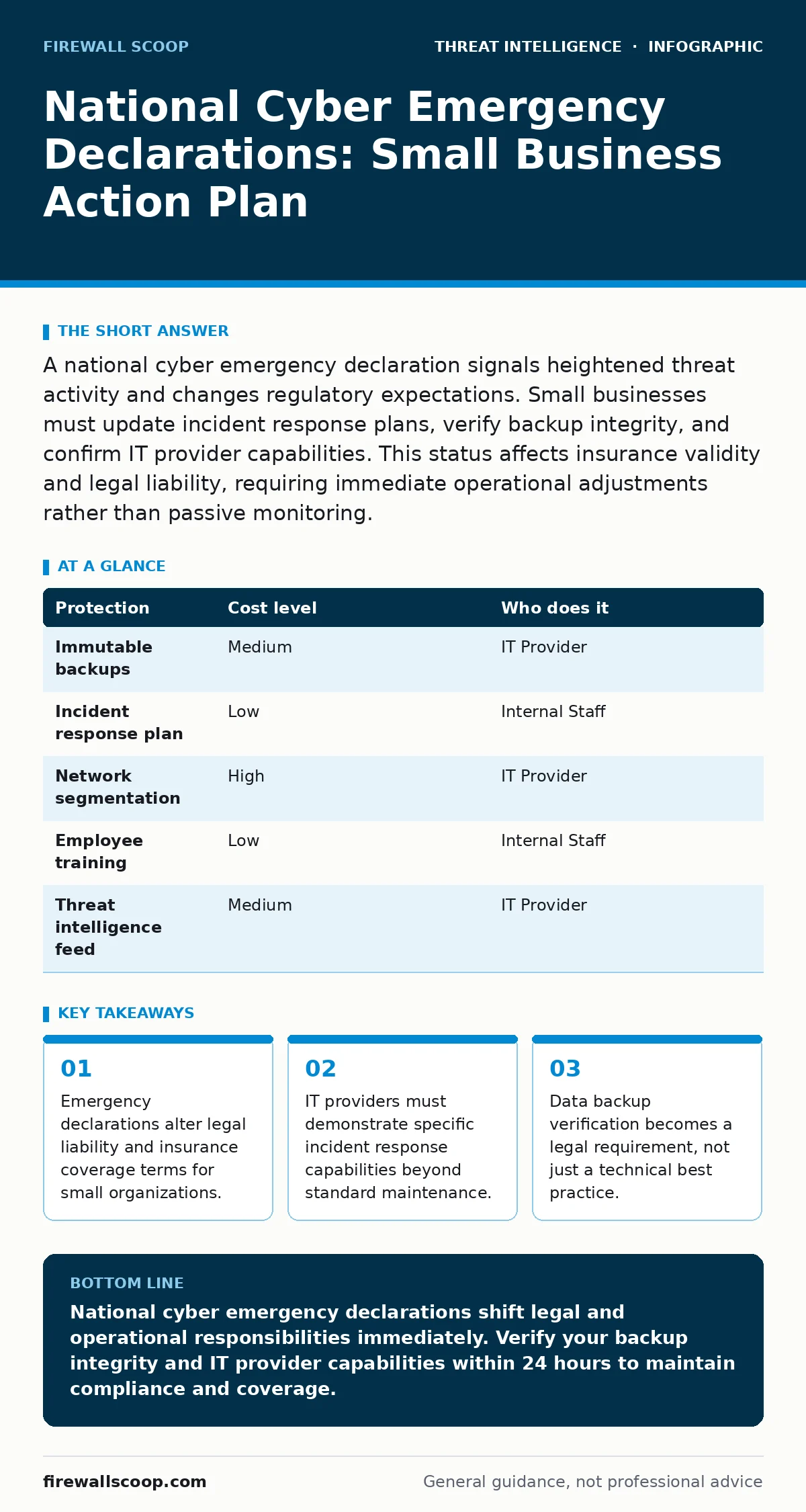
A national cyber emergency declaration signals heightened threat activity and changes regulatory expectations. Small businesses must update incident response plans, verify backup integrity, and confirm IT provider capabilities. This status affects insurance validity and legal liability, requiring immediate operational adjustments rather than passive monitoring.
Why Emergency Declarations Matter at Small Scale
A national cyber emergency declaration changes the operational baseline for all organizations. You might assume these declarations only affect large corporations or government agencies. That assumption is incorrect. Small businesses often handle sensitive data that attackers target specifically because defenses are weaker. The declaration signals that threat actors are escalating their tactics.
It also changes the legal landscape. Insurance policies often include clauses that require adherence to heightened security standards during declared emergencies. Failure to adapt can void coverage. You must treat the declaration as a trigger for immediate procedural review. The cost of inaction exceeds the cost of preparation.
Practical Steps for Immediate Implementation
You need to execute 3 specific checks within 24 hours of a declaration. First, verify that your data backups are immutable. An immutable backup cannot be altered or deleted by unauthorized users. This protects against ransomware that encrypts standard backups. Second, review your incident response plan. Ensure it includes contact information for legal counsel and insurance providers. Third, disable any unnecessary remote access points. Attackers exploit open ports to gain initial entry. Closing these ports reduces your attack surface. Do not wait for a breach to validate these steps. Proactive closure of access points prevents lateral movement before it begins.
Evaluating Your IT Provider’s Response
Your IT provider should anticipate the declaration. You must ask specific questions to verify their preparedness. Do not accept vague assurances about "enhanced monitoring." Ask for concrete evidence of their incident response capabilities. The following table outlines the protection levels, associated costs, and responsible parties.
| Protection | Cost level | Who does it |
|---|---|---|
| Immutable backups | Medium | IT Provider |
| Incident response plan | Low | Internal Staff |
| Network segmentation | High | IT Provider |
| Employee training | Low | Internal Staff |
| Threat intelligence feed | Medium | IT Provider |
You need to know who acts when a breach occurs. Clarify these roles before an emergency happens.
Questions to Ask Your IT Provider
Use this list to audit your provider’s readiness. Each question targets a specific vulnerability.
- How do you detect attacker persistence techniques that survive system reboots?
- What is your average time to identify a breach during an emergency?
- Do you offer deception technology to detect unauthorized access attempts?
- How do you verify the integrity of backups after a ransomware event?
- What is your process for reporting incidents to regulatory bodies?
- Do you perform regular attack path analysis to identify weak points?
- How do you handle user and entity behavior analytics to spot anomalies?
These questions reveal whether your provider is reactive or proactive. A competent provider will have documented answers for each item.
Understanding Legal and Insurance Implications
Emergency declarations often trigger specific legal requirements. You must understand how these affect your business. Insurance carriers may require proof of specific security controls. These controls might include multi-factor authentication or network segmentation. Failure to implement these controls can lead to claim denials. You should review your insurance policy immediately. Look for clauses related to "national emergencies" or "heightened threat levels." Consult with a legal expert if the language is unclear. Ignoring these clauses risks financial ruin after a breach. Legal compliance is as important as technical security.
See also: DFIR Training for Small Business Threat Readiness · Container Escape Response: Containment, Recovery, and Prevention Steps
The Hidden Cost of Complacency
Many small businesses ignore emergency declarations. They assume the threat is distant. This complacency creates hidden costs. Attackers know that small businesses are slow to react. They exploit this delay to establish footholds. Once inside, they use lateral movement to access critical systems. The longer they remain undetected, the more damage they cause. Detecting lateral movement requires advanced monitoring tools. Basic antivirus software is insufficient. You must invest in detection capabilities that track internal network traffic. This investment prevents small breaches from becoming catastrophic failures.
Long-Term Strategic Adjustments
A national cyber emergency declaration is not a one-time event. You must adjust your long-term strategy. Incorporate lessons learned into your regular operations. Update your security policies to reflect heightened threat levels. Train employees on new procedures. Regular training reduces the risk of human error. Human error remains a primary vector for breaches. You should also consider implementing honeypots to detect unauthorized access. Honeypots are decoy systems that attract attackers. They provide early warning of intrusion attempts. This strategy buys time for your security team to respond.
Integrating Advanced Detection Methods
Basic security measures are no longer sufficient. You need to integrate advanced detection methods. User and entity behavior analytics helps identify unusual activity. This technology learns normal behavior patterns and flags deviations. It is effective against insider threats and compromised accounts.
You should also consider deception technology. This approach places fake assets in your network. Attackers targeting these assets trigger alerts. This method provides high-fidelity alerts with low false positives. It complements traditional monitoring tools. Combining these methods creates a layered defense. Layered defense increases the difficulty for attackers.
Preparing for Future Declarations
Emergency declarations will likely become more frequent. You must prepare for this reality. Build a culture of security awareness. Encourage employees to report suspicious activity. Create a streamlined process for incident reporting. Speed is critical during an emergency. Delays allow attackers to escalate their access. You should also maintain a list of trusted vendors. These vendors can provide emergency support. Verify their capabilities regularly. Do not wait for an emergency to find help. Proactive preparation ensures business continuity.
Final Checklist for Small Businesses
Use this checklist to verify your readiness. Each item addresses a specific risk.
- Immutable backups are verified and tested.
- Incident response plan includes legal and insurance contacts.
- Unnecessary remote access points are disabled.
- IT provider has demonstrated incident response capabilities.
- Insurance policy clauses are reviewed and understood.
- Advanced detection tools are implemented and monitored.
- Employee training includes emergency procedures.
- Trusted vendor list is current and verified.
Completing this checklist reduces your risk profile. It ensures you are prepared for any threat. Security is an ongoing process. Continuous improvement is key to resilience.
Key takeaways
- Emergency declarations alter legal liability and insurance coverage terms for small organizations.
- IT providers must demonstrate specific incident response capabilities beyond standard maintenance.
- Data backup verification becomes a legal requirement, not just a technical best practice.
National cyber emergency declarations shift legal and operational responsibilities immediately. Verify your backup integrity and IT provider capabilities within 24 hours to maintain compliance and coverage.
Frequently asked questions
Does a national cyber emergency declaration automatically increase insurance premiums?
Not automatically. Premiums depend on your adherence to required security controls. Implementing these controls can mitigate rate increases.
How long does a national cyber emergency declaration last?
Duration varies by declaration. You must monitor official channels for updates. Prepare for extended periods of heightened threat.
Can small businesses afford advanced detection tools?
Many tools offer scalable pricing. The cost of a breach far exceeds the cost of detection. Prioritize tools that address your specific risks.
What if my IT provider cannot answer my questions?
Consider changing providers. A provider who cannot answer these questions lacks the necessary expertise. Your security depends on their competence.
How this guide was produced: written by the Firewall Scoop editorial team with AI assistance, checked against the public references listed below, and reviewed when the facts change. See our editorial policy or report an error.