How Deception Technology Works: Mechanisms, Limits, and Detection
Deception technology turns your entire network into a trap by placing high-fidelity fake assets that attackers mistake for real targets, triggering immediate alerts on interaction.

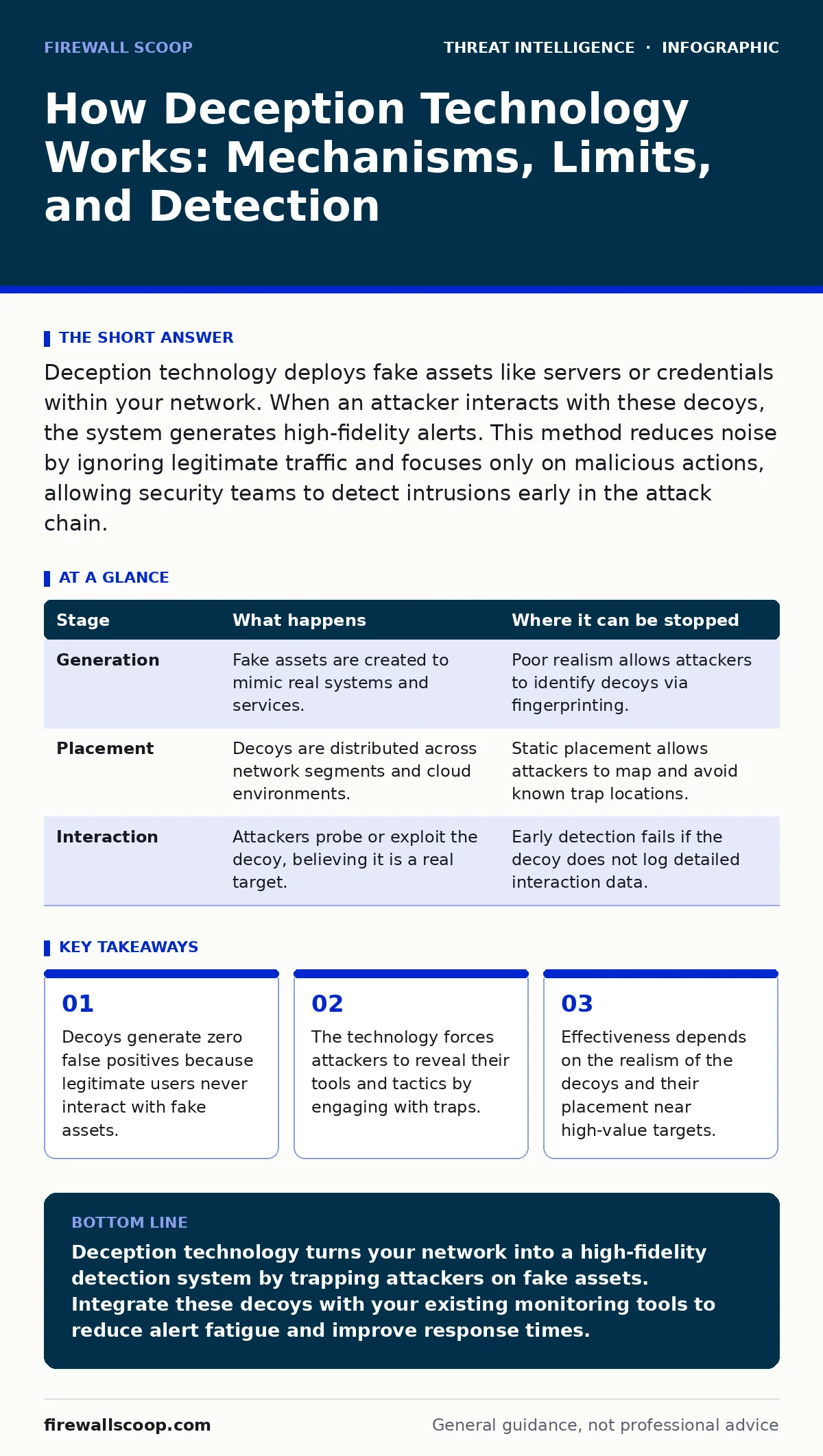
Deception technology deploys fake assets like servers or credentials within your network. When an attacker interacts with these decoys, the system generates high-fidelity alerts. This method reduces noise by ignoring legitimate traffic and focuses only on malicious actions, allowing security teams to detect intrusions early in the attack chain.
The Core Mechanism of Network Deception
Deception technology operates on a simple premise: if you cannot protect every asset, you can trap those who try to breach your defenses. Instead of relying solely on perimeter walls, you plant fake assets throughout your environment. These decoys mimic real systems, services, or credentials. When an attacker touches them, you know immediately.
This approach shifts the burden of proof. In traditional security, you must prove traffic is malicious. With deception, any interaction with a decoy is, by definition, malicious. Legitimate users and applications have no reason to contact these fake resources. This creates a clear signal amidst the noise of normal network activity.
The technology works by creating a layer of abstraction between the decoy and the underlying infrastructure. You deploy lightweight agents or virtual instances that look like valuable targets. They respond to probes and queries just like real systems would. However, they contain no real data and perform no real functions. Their sole purpose is to attract attention and log interactions.
### Stage 1: Decoy Generation and Placement
The first step involves creating convincing replicas of your actual infrastructure. You do not need to copy every server. Instead, you identify high-value targets that attackers are likely to seek. These might include database servers, domain controllers, or systems holding sensitive intellectual property.
You generate decoys that mirror the operating system, open ports, and services of these targets. The decoy must respond to standard network probes in a way that matches the real system. If a real server responds to a ping with a specific time-to-live value, the decoy must do the same. Inconsistencies can cause experienced attackers to suspect a trap.
Placement is strategic. You do not hide decoys in isolated segments. You place them where attackers are likely to move during lateral movement. This might be near the perimeter, within internal subnets, or adjacent to critical assets. The goal is to intersect the attacker’s path. If the decoy is invisible to the attacker, it serves no purpose.
| Stage | What happens | Where it can be stopped |
|---|---|---|
| Generation | Fake assets are created to mimic real systems and services. | Poor realism allows attackers to identify decoys via fingerprinting. |
| Placement | Decoys are distributed across network segments and cloud environments. | Static placement allows attackers to map and avoid known trap locations. |
| Interaction | Attackers probe or exploit the decoy, believing it is a real target. | Early detection fails if the decoy does not log detailed interaction data. |
### Stage 2: Luring and Interaction
Once placed, the decoys wait for engagement. Attackers use scanning tools to discover live hosts and open ports. The decoys respond to these scans, appearing as valid targets. This is the luring phase. The attacker sees a potential entry point and decides to investigate further.
As the attacker interacts with the decoy, the system logs every action. This includes port scans, service enumeration, and login attempts. The decoy may even allow a superficial connection to maintain the illusion. For example, a fake web server might return a plausible HTTP header. A fake database might accept a connection but return empty results.
This stage is critical for gathering intelligence. You are not just detecting an intrusion; you are observing the attacker’s methodology. The tools they use, the commands they run, and the paths they take provide context. This data is far more valuable than a simple alert. It tells you who is attacking and how.
### Stage 3: Alerting and Analysis
When an interaction occurs, the deception system triggers an alert. Because legitimate traffic never touches decoys, this alert has a high confidence level. There are no false positives from normal user activity. This allows security teams to respond immediately without the delay of triage.
The alert contains detailed context. It shows the source of the attack, the tools used, and the specific actions taken. This information feeds into your broader security operations. You can correlate this data with other signals to build a complete picture of the incident.
This stage also involves analyzing the attacker’s behavior. Are they automated scripts or manual operators? What is their objective? This analysis informs your response strategy. You might choose to isolate the attacker, feed them false information, or simply block their access. The choice depends on your risk tolerance and operational goals.
### Stage 4: Response and Containment
The final stage is action. Based on the alert, you take steps to contain the threat. This might involve blocking the attacker’s IP address at the firewall. You might also disable compromised credentials if the attacker used them to access the decoy.
Deception technology often integrates with other security tools. It can send alerts to your threat intelligence platforms for broader context. It might trigger automated responses through your security orchestration systems. This integration ensures that the detection leads to effective action.
However, deception is not a containment tool on its own. It detects and alerts. You still need robust incident response procedures. The technology gives you the time and information to respond effectively. It does not replace the need for skilled analysts and clear playbooks.
See also: Attacker Reconnaissance Prevention Checklist for Systems · What Is Intrusion Prevention: How IPS Stops Attacks Before They Land
The Limits of Deception Technology
Deception technology has significant limitations. It does not prevent initial compromise. If an attacker bypasses your perimeter and enters your network, they may not encounter a decoy immediately. The technology is most effective during lateral movement and post-exploitation phases.
It also requires careful management. Decoys must be updated to reflect changes in your real infrastructure. If your real servers change their configurations, the decoys must match. Outdated decoys can become obvious to attackers. They may also create administrative overhead if not automated.
Furthermore, deception does not protect data at rest. If an attacker accesses a real server and exfiltrates data, the decoy does not stop this. It only alerts you to the intrusion. You still need encryption, access controls, and monitoring to protect your actual assets. Deception complements these controls; it does not replace them.
Integration with Broader Security Strategies
Deception works best when integrated with other security disciplines. It provides high-fidelity data that enhances user and entity behavior analytics. By comparing normal user patterns with attacker interactions on decoys, you can refine your detection models. This improves your ability to identify subtle anomalies.
It also supports security metrics by providing clear evidence of attack activity. You can measure the time to detect and respond to intrusions. This data helps justify security investments and demonstrates the effectiveness of your controls.
For deeper understanding of attacker tactics, you can map decoy interactions to the MITRE ATT&CK Navigator. This framework helps you visualize the techniques attackers use. By seeing which techniques trigger your decoys, you can identify gaps in your defense. This allows you to prioritize improvements based on real-world evidence.
Strategic Considerations for Implementation
Implementing deception technology requires a strategic approach. Start by identifying your most valuable assets. Create decoys for these targets first. This ensures you are protecting what matters most. As you gain experience, expand the scope of your deception program.
Automate the generation and placement of decoys. Manual management is error-prone and difficult to scale. Automation ensures that decoys are always up-to-date and properly distributed. It also reduces the administrative burden on your security team.
Finally, train your analysts to interpret deception alerts. They need to understand the context and significance of each interaction. This training ensures that alerts lead to effective responses. Without proper training, even the best deception technology can become just another source of noise.
Key takeaways
- Decoys generate zero false positives because legitimate users never interact with fake assets.
- The technology forces attackers to reveal their tools and tactics by engaging with traps.
- Effectiveness depends on the realism of the decoys and their placement near high-value targets.
Deception technology turns your network into a high-fidelity detection system by trapping attackers on fake assets. Integrate these decoys with your existing monitoring tools to reduce alert fatigue and improve response times.
Frequently asked questions
Does deception technology replace firewalls?
No, deception does not block traffic at the perimeter. It detects intrusions that have already occurred or are attempting lateral movement. It complements firewalls by providing deeper visibility into internal network activity.
Can attackers detect deception technology?
Experienced attackers may identify decoys through careful fingerprinting. If decoys do not perfectly mimic real systems, attackers might recognize inconsistencies. High-quality, dynamic decoys are harder to distinguish from real assets.
Is deception technology effective against automated attacks?
Yes, automated scripts often interact with decoys without realizing they are fake. This triggers alerts and allows security teams to detect and block the automated activity early in the attack chain.
How does deception differ from honeypots?
Traditional **honeypots** are isolated systems designed to attract attackers. Deception technology integrates decoys directly into the production network, making them appear as part of the legitimate infrastructure. This makes them more realistic and harder to avoid.
How this guide was produced: written by the Firewall Scoop editorial team with AI assistance, checked against the public references listed below, and reviewed when the facts change. See our editorial policy or report an error.