Honeypots for Security: Real Benefits, Hidden Costs, and Limits
Honeypots generate high-fidelity data by design because every interaction is unauthorized, eliminating the noise that drowns out signals in standard logging.

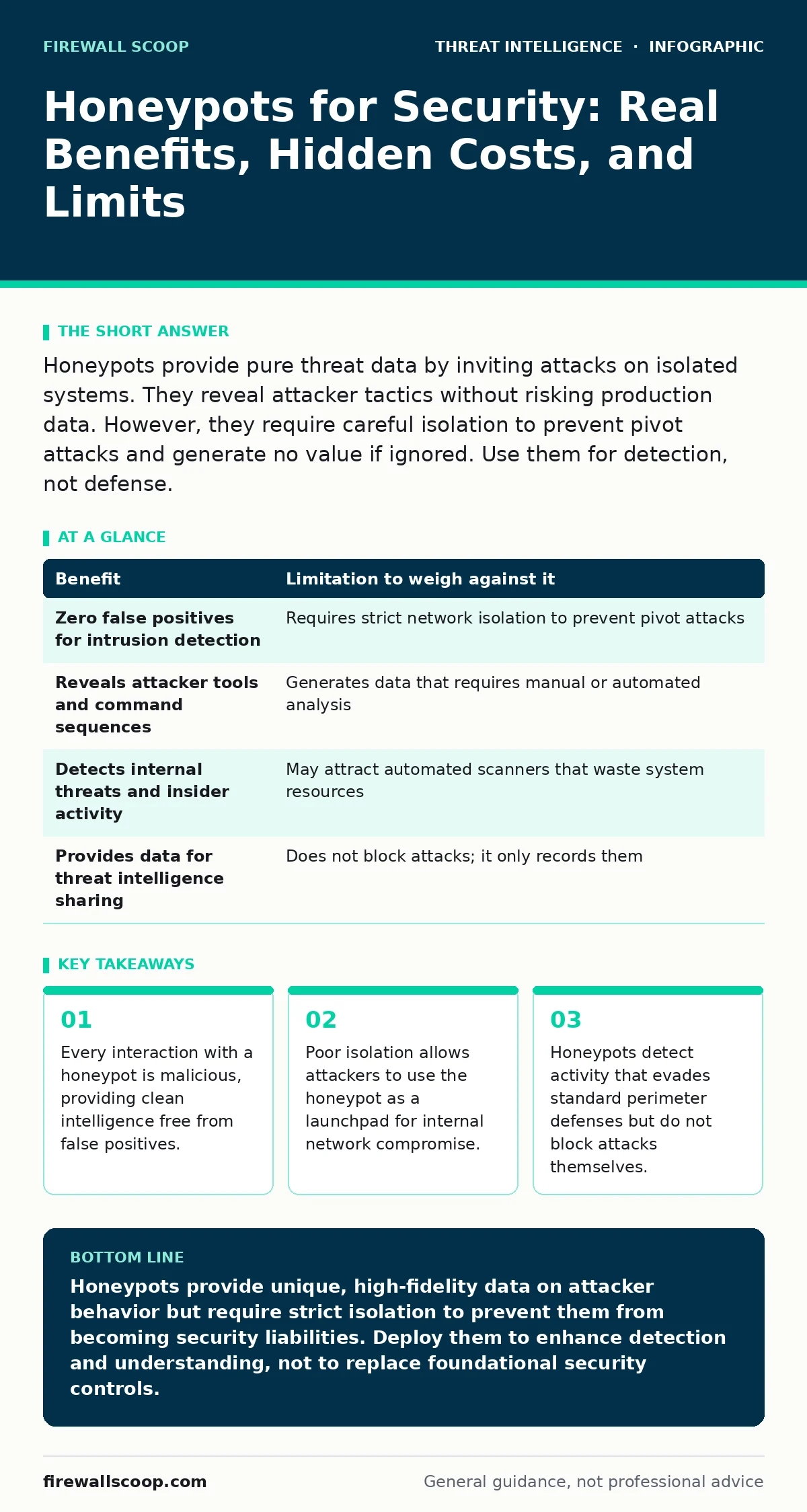
Honeypots provide pure threat data by inviting attacks on isolated systems. They reveal attacker tactics without risking production data. However, they require careful isolation to prevent pivot attacks and generate no value if ignored. Use them for detection, not defense.
The Signal in the Noise
Standard security logs are noisy. They record legitimate user logins, system updates, and routine application traffic. Finding a malicious action within this stream is difficult. Honeypots solve this by creating systems that serve no legitimate business purpose. Any interaction with these systems is, by definition, unauthorized.
This distinction provides a unique advantage. You gain high-fidelity data. When a scanner probes a honeypot, you see the exact command structure, the timing, and the tools used. This data is cleaner than what you capture on a production server where valid and invalid traffic mix.
How Deception Creates Value
The primary benefit is early detection. Attackers often scan networks to find vulnerable services. A honeypot mimics a vulnerable service, such as an SSH server or a database interface. When an attacker connects, they believe they have found a target. In reality, they have stepped into a trap.
This mechanism allows you to observe behavior before damage occurs. You can record the commands an attacker types. You can analyze the malware they attempt to install. This behavioral data helps you understand the threat actor's intent. It also feeds into broader frameworks like deception technology, which uses similar principles on a larger scale.
The Risk of Poor Isolation
The greatest limitation is the risk of compromise. If a honeypot is not properly isolated, an attacker can use it to pivot into your real network. The honeypot becomes a foothold. From there, the attacker scans your internal segments, looking for genuine vulnerabilities.
Isolation requires strict network segmentation. The honeypot should reside in a separate VLAN or subnet with no route to critical assets. Firewalls must block all outbound traffic from the honeypot except for logging purposes. If you fail to enforce these boundaries, the honeypot becomes a liability rather than an asset.
Another limitation is resource consumption. Honeypots generate logs. Analyzing these logs requires time and expertise. If you lack the bandwidth to review the data, the honeypot provides no value. It simply accumulates noise that you never act upon.
Benefits Versus Costs
You must weigh the intelligence gained against the operational overhead. The table below contrasts the primary benefits with the limitations you must manage.
| Benefit | Limitation to weigh against it |
|---|---|
| Zero false positives for intrusion detection | Requires strict network isolation to prevent pivot attacks |
| Reveals attacker tools and command sequences | Generates data that requires manual or automated analysis |
| Detects internal threats and insider activity | May attract automated scanners that waste system resources |
| Provides data for threat intelligence sharing | Does not block attacks; it only records them |
When It Is Worth It
Deploy honeypots when you need to understand attacker behavior. They are valuable for testing your detection capabilities. If your security monitoring team needs realistic attack data to tune their alerts, honeypots provide it. They help you validate whether your user and entity behavior analytics systems can distinguish between normal and anomalous activity.
They are also useful for identifying internal threats. An employee attempting to access a system they have no reason to touch triggers an alert. This is harder to detect with standard logging because legitimate access patterns vary. A honeypot creates a clear boundary. Crossing it is always suspicious.
Imagine you are investigating a potential breach. You suspect lateral movement within your network. A low-interaction honeypot can help you identify the source of the scans. It pinpoints the compromised host that is acting as a pivot. This accelerates your incident response.
See also: Implement Threat Intelligence Platforms: A Step-by-Step Guide · How Deception Technology Works: Mechanisms, Limits, and Detection
When It Is Not
Do not use honeypots as a replacement for basic hygiene. They do not patch vulnerabilities. They do not enforce access controls. If your network lacks fundamental security measures, a honeypot will not save you. It might even distract you from fixing critical gaps.
Avoid honeypots if you cannot maintain them. A honeypot that is not monitored is a blind spot. Attackers may detect the honeypot and modify their tools to avoid it. This leaves you with stale data that no longer reflects current tactics. Maintenance includes updating the honeypot software and reviewing logs regularly.
Also, consider the complexity of your environment. If you have a small, simple network, the overhead may not justify the benefit. For deeper insight into how attackers move through complex environments, review attack path analysis to understand your specific risks. Honeypots are one tool in that analysis, not the entire strategy.
Beyond Simple Traps
Modern honeypots are more than just fake servers. They can include canary tokens, which are digital tripwires placed in files or documents. When a token is accessed, it sends an alert. This extends the deception model beyond network services to data protection.
You can also correlate honeypot data with the MITRE ATT&CK Navigator to map observed behaviors to known techniques. This helps you prioritize defenses based on what attackers are actually doing. It transforms raw logs into strategic intelligence. However, this requires expertise. If you lack the skills to perform this mapping, the data remains unused.
Integration with Defense
Honeypots fit into a layered defense strategy. They do not sit at the perimeter to block traffic. They sit behind the perimeter to detect intrusions that bypass other controls. Think of them as tripwires in a minefield. They alert you to movement, but they do not stop the enemy.
To maximize value, integrate honeypot alerts with your security information and event management system. This allows you to correlate honeypot activity with other logs. For instance, if a honeypot detects a scan, check if the source IP has accessed other systems. This context turns a single alert into a narrative.
Key takeaways
- Every interaction with a honeypot is malicious, providing clean intelligence free from false positives.
- Poor isolation allows attackers to use the honeypot as a launchpad for internal network compromise.
- Honeypots detect activity that evades standard perimeter defenses but do not block attacks themselves.
Honeypots provide unique, high-fidelity data on attacker behavior but require strict isolation to prevent them from becoming security liabilities. Deploy them to enhance detection and understanding, not to replace foundational security controls.
Frequently asked questions
Do honeypots block hackers?
No, honeypots do not block attacks. They are detection and intelligence tools that record malicious activity. They must be paired with other controls that actually prevent or mitigate harm.
Can a honeypot infect my network?
Only if it is poorly isolated. If an attacker compromises the honeypot and it has network access to your production systems, they can use it as a pivot point. Proper segmentation prevents this.
What is the difference between a honeypot and a canary token?
A honeypot is a system or service that mimics a real asset to attract attackers. A canary token is a small, digital tripwire placed in files or emails to detect unauthorized access or exfiltration.
Do I need special software to run a honeypot?
You need software that mimics vulnerable services and logs interactions. Many open-source options exist, but they require configuration and maintenance to be effective and safe.
How this guide was produced: written by the Firewall Scoop editorial team with AI assistance, checked against the public references listed below, and reviewed when the facts change. See our editorial policy or report an error.