Attack Path Analysis: How to Find Hidden Security Gaps
Most breaches occur through chains of weak links, not single vulnerabilities, making path mapping more effective than isolated patching.

Attack path analysis maps every possible route an adversary could take from an initial foothold to critical data. It combines asset relationships and vulnerability data to reveal hidden risks. You use this method to prioritize remediation efforts that break the most dangerous chains of compromise.
Understanding Attack Path Analysis
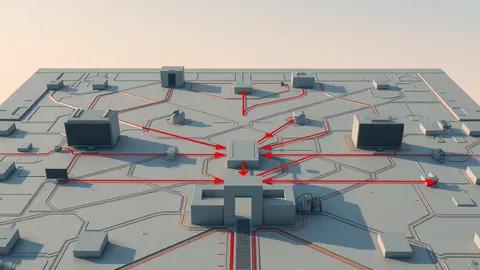
Attack path analysis is the process of mapping all possible sequences of actions an adversary could take to reach a high-value target within your environment. It moves beyond listing individual weaknesses to showing how those weaknesses connect. Imagine a castle with many small cracks in the outer wall. Individually, each crack is harmless. Together, they allow a climber to reach the inner keep. This method identifies those specific climbing routes.
Traditional security tools report vulnerabilities in isolation. They tell you that a server has an outdated operating system. They rarely tell you that this server trusts a workstation used by an intern, which itself has a weak password. Attack path analysis bridges this gap. It uses graph theory to model relationships between assets. Each asset is a node. Each connection or trust relationship is an edge. The analysis calculates the shortest or most likely paths from external entry points to crown jewels.
| Aspect | Detail |
|---|---|
| Primary Goal | Identify sequences of vulnerabilities leading to critical assets |
| Core Method | Graph-based modeling of network topology and trust relationships |
| Key Input | Asset inventory, vulnerability data, and network connectivity maps |
| Output | Ranked list of attack paths with risk scores |
| Benefit | Prioritizes remediation based on actual exploitability, not just severity |
| Limitation | Requires accurate and up-to-date data about system relationships |
How Attack Path Analysis Works
The process begins with data collection. You need a complete inventory of assets. This includes servers, workstations, cloud instances, and even IoT devices. You also need vulnerability data for each asset. Finally, you need connectivity data. This shows which systems can talk to which other systems. Security tools ingest this data and build a graph.
The engine then simulates movement. It looks for known exploit techniques. It checks if a user has permissions to access a specific database. It evaluates if a compromised workstation can pivot to a domain controller. The tool calculates the probability of success for each step. It combines these probabilities to score entire paths. Paths with high probability and low difficulty receive higher risk scores. This scoring helps you focus on the most likely breaches.
Who Is Affected by These Findings
Attack path analysis affects organizations with complex environments. Large enterprises with many departments often have fragmented security controls. Each department manages its own systems. This creates blind spots. Attack path analysis reveals how these silos connect. It shows how a breach in marketing can spread to finance.
Small businesses are also affected. They often lack dedicated security staff. They rely on default configurations. These defaults create predictable paths for attackers. Analysis helps small teams understand their unique risk profile. It prevents them from wasting time on low-impact fixes.
Cloud environments face specific challenges. Cloud resources are dynamic. Instances spin up and down. Permissions change frequently. Static maps become outdated quickly. Attack path analysis tools must handle this volatility. They must continuously update the graph. Failure to do so leaves gaps in the visibility.
What to Do About Identified Paths
You cannot fix every vulnerability immediately. Resources are limited. Attack path analysis provides a prioritization strategy. Focus on breaking the highest-risk paths first. Often, fixing a single high-impact node neutralizes multiple paths. This is more efficient than patching every low-severity flaw.
Review access controls. Many paths exist because of excessive permissions. Apply the principle of least privilege. Remove unnecessary access. Segregate networks. Place critical assets in isolated zones. This forces attackers to find new, harder paths.
Monitor for anomalies. Use user and entity behavior analytics to detect unusual activity. If a user accesses a system they never touch, it might be a pivot point. Investigate these events immediately. Combine behavioral data with path analysis. This gives you both context and real-time alerts.
Common Mistakes in Path Analysis
Many teams make the same errors. They treat the initial scan as a one-time event. Networks change. New vulnerabilities appear. Paths shift. You must run analysis regularly. A stale map provides false confidence.
Another mistake is ignoring the human element. Attackers often use social engineering. They trick users into revealing credentials. Standard path analysis focuses on technical flaws. It may miss the human link. You must include user behavior in your model. Consider how phishing compromises fit into the graph.
Teams also over-rely on automated scores. The tool gives a number. It does not understand business context. A path to a test server might score high technically. But it holds no real data. Human judgment must override the algorithm. Adjust scores based on actual asset value.
See also: DFIR Training for Small Business Threat Readiness · Threat Hunting Best Practices: 7 Methods to Find Hidden Threats
Integrating With Other Security Measures
Attack path analysis works best when combined with other tools. It feeds into security metrics by providing a clearer view of risk. Instead of counting vulnerabilities, you count broken paths. This metric is more meaningful.
It also complements network traffic analysis. Traffic analysis shows what is happening now. Path analysis shows what could happen. Together, they provide a full picture. Use traffic data to validate the paths identified by the analysis. If the tool predicts a path, check if traffic supports that connection.
Consider deception technology as a deterrent. Place fake assets along high-risk paths. When an attacker steps on a honeypot, you get an alert. This gives you time to respond. It also helps you verify that your path analysis is accurate. If attackers are using paths you missed, you need to update your model.
The Hidden Costs of Inaction
Ignoring attack paths leads to unexpected breaches. Attackers do not follow the easiest path. They follow the path of least resistance. This is often different from what security teams assume. They may target a legacy system that everyone forgot about.
The cost is not just financial. It is reputational. A breach erodes trust. It takes years to rebuild. Proactive analysis prevents these surprises. It shifts security from reactive to proactive. You stop guessing where the next attack will come from. You know the likely routes. You can prepare defenses specifically for those routes.
Conclusion of Analysis Efforts
Attack path analysis transforms how you view security. It moves you from a list of problems to a map of risks. You see the connections. You understand the context. You prioritize effectively. This method requires accurate data and regular updates. It is not a set-and-forget solution.
You must integrate this analysis into your daily operations. Use it to guide patching. Use it to adjust access controls. Use it to inform your incident response plans. By understanding the paths, you control the narrative. You stay one step ahead of the adversary.
Key takeaways
- Mapping paths reveals that low-severity flaws become critical when chained with other weaknesses.
- Static vulnerability scanning misses the context of how systems interact and trust each other.
- Breaking one link in a high-risk path often neutralizes dozens of potential breach scenarios.
Map the connections between vulnerabilities to find the true risk, not just the loudest alerts. Start by identifying your top 3 critical assets and trace all possible entry points to them.
Frequently asked questions
How often should I run attack path analysis?
Run it continuously or at least weekly in dynamic environments. Static monthly scans often miss new vulnerabilities or configuration changes that create new paths.
Do I need special software for this?
You need a tool that can ingest asset, vulnerability, and connectivity data. Many modern security platforms include this feature. You can also build custom models using graph databases.
Can this replace vulnerability scanning?
No. Vulnerability scanning finds the flaws. Attack path analysis shows how those flaws connect. You need both. Scanning provides the data. Analysis provides the context.
What if my network is too large to map?
Start with critical assets. Map paths to your most valuable data first. Expand the scope gradually. Focus on high-risk segments before attempting a full enterprise map.
How this guide was produced: written by the Firewall Scoop editorial team with AI assistance, checked against the public references listed below, and reviewed when the facts change. See our editorial policy or report an error.