Network Traffic Analysis: How to Detect Hidden Threats in Data Flow
Network traffic analysis reveals attacker persistence techniques by exposing behavioral anomalies that signature-based tools consistently miss during routine operations.

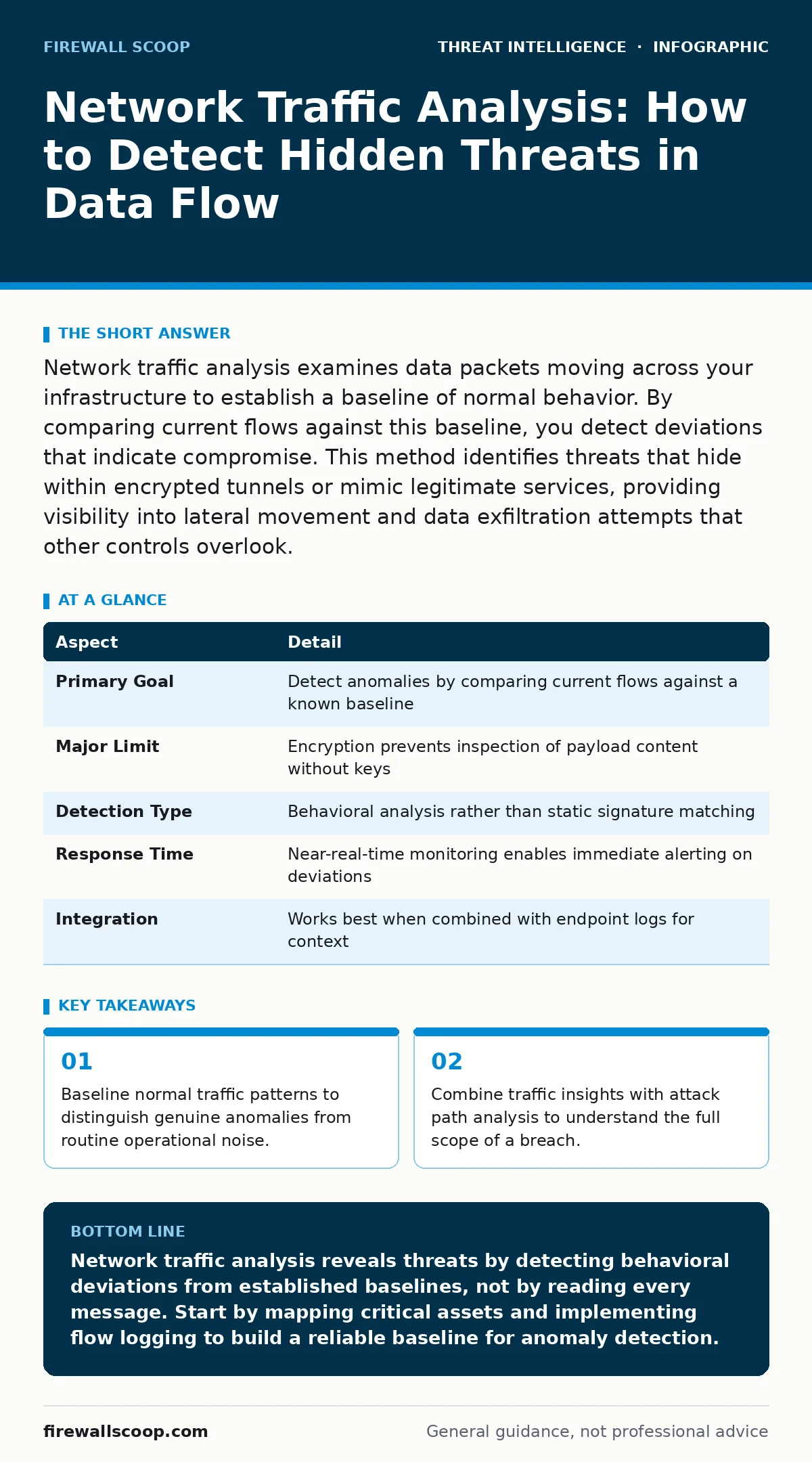
Network traffic analysis examines data packets moving across your infrastructure to establish a baseline of normal behavior. By comparing current flows against this baseline, you detect deviations that indicate compromise. This method identifies threats that hide within encrypted tunnels or mimic legitimate services, providing visibility into lateral movement and data exfiltration attempts that other controls overlook.
Understanding network traffic analysis fundamentals
Imagine a busy highway where every vehicle represents a data packet. You cannot read the letters in every envelope carried by each driver, but you can observe speed, direction, and frequency. Network traffic analysis operates on this same principle. It examines the movement of data across your infrastructure without necessarily inspecting the private contents of every message. This approach allows you to identify unusual patterns that signal malicious activity, even when encryption hides the payload.
This method affects every organization that relies on digital communication. It provides visibility into how systems interact, revealing hidden connections between internal devices and external servers. You use this data to spot deviations from established norms. When a server suddenly communicates with an unknown foreign IP address at odd hours, the traffic pattern changes. This change triggers an alert, prompting further investigation into potential compromise or misconfiguration.
| Aspect | Detail |
|---|---|
| Primary Goal | Detect anomalies by comparing current flows against a known baseline |
| Major Limit | Encryption prevents inspection of payload content without keys |
| Detection Type | Behavioral analysis rather than static signature matching |
| Response Time | Near-real-time monitoring enables immediate alerting on deviations |
| Integration | Works best when combined with endpoint logs for context |
How network traffic analysis works in practice
The process begins with data collection. Sensors placed at strategic network boundaries capture packet headers and flow records. These records contain metadata such as source and destination addresses, port numbers, and protocol types. You do not need to decrypt every packet to gain value. The metadata alone reveals who is talking to whom, how much data is moving, and at what speed.
Next, you establish a baseline of normal behavior. This baseline defines what typical communication looks like for your specific environment. A web server should send small responses to many clients. A database server should receive queries from application servers, not from external internet users. By defining these expected patterns, you create a reference point. Any significant deviation from this reference point becomes a candidate for further scrutiny.
Anomaly detection algorithms then compare live traffic against the baseline. If a workstation suddenly uploads gigabytes of data to an unknown cloud storage service, the volume deviation triggers an alert. If a device communicates with a command-and-control server using irregular timing intervals, the timing deviation raises suspicion. You investigate these alerts to determine if they represent legitimate business activity or a security incident. This continuous comparison allows you to catch threats that evolve too quickly for traditional signature updates.
What people usually get wrong about visibility
Many practitioners believe that network traffic analysis replaces other security controls. This assumption is dangerous. Traffic analysis provides context, but it does not replace endpoint detection or identity management. An attacker who moves laterally between internal hosts may generate traffic that looks perfectly normal. If the compromised host only communicates with authorized servers, the traffic pattern remains within baseline parameters. You miss the threat because the behavior is valid, even if the intent is malicious.
Another common error is ignoring internal traffic. Organizations often focus heavily on perimeter defenses, assuming that threats originate externally. Modern attacks frequently begin with compromised credentials or insider actions. Once inside, attackers move laterally to reach high-value targets. If you only monitor north-south traffic at the edge, you miss east-west movement within the network. You must monitor internal segments to detect lateral movement and data staging activities.
Finally, teams often treat all alerts with equal urgency. This approach leads to alert fatigue. Not every deviation indicates a breach. A software update might cause a spike in outbound traffic. A new application might open unexpected ports. You must tune your detection rules to reduce false positives. Context matters. A large data transfer from a backup server to a disaster recovery site is normal. The same transfer from a finance workstation is suspicious.
The hidden costs of deep packet inspection
Deep packet inspection allows you to look inside encrypted or unencrypted packets to examine the actual content. While powerful, this technique carries significant hidden costs. The primary cost is performance. Inspecting every packet requires substantial computational resources. This processing adds latency to your network, slowing down legitimate business operations. You must balance security visibility with user experience and application performance.
Privacy concerns represent another major cost. Inspecting packet contents means reading employee emails, browsing history, and application data. This level of scrutiny raises legal and ethical questions. You must ensure compliance with local privacy laws and internal policies. Many organizations restrict deep packet inspection to specific high-risk segments or unencrypted traffic to mitigate these risks. You cannot simply turn on full inspection without considering the impact on trust and compliance.
Encryption itself creates a visibility gap. As more applications adopt end-to-end encryption, you lose the ability to inspect payload content. You cannot see malware signatures or sensitive data keywords within encrypted streams. You must rely on metadata analysis, such as domain names and certificate details, to identify threats. This shift requires new detection techniques that focus on behavioral indicators rather than content inspection.
Integrating traffic data with threat hunting
Network traffic analysis serves as a critical data source for threat hunting. Hunters use traffic data to search for indicators of compromise that automated tools might miss. By analyzing flow records, hunters can identify slow-and-low data exfiltration attempts. These attacks transfer small amounts of data over long periods to avoid detection. Automated systems often ignore these small transfers, but a hunter looking for cumulative volume anomalies can spot them.
You also use traffic data to validate findings from other sources. If an endpoint detection system flags a suspicious process, you can check the network logs to see if that process attempted to connect to known malicious infrastructure. This correlation strengthens your confidence in the finding. It helps you distinguish between a false positive and a genuine threat.
Integrating traffic data with attack path analysis provides a complete picture of the breach. You can trace the attacker's movement from initial entry to final objective. This historical view helps you understand the tactics, techniques, and procedures used. It informs your response strategy and helps you identify gaps in your defenses. You use this insight to improve your baseline and detection rules for future incidents.
See also: What Is Intrusion Prevention: How IPS Stops Attacks Before They Land · Lateral Movement Prevention Checklist for Network Security
Practical steps for improving your analysis
Start by mapping your critical assets. Identify which servers and devices hold sensitive data. Focus your initial monitoring efforts on these high-value targets. You cannot monitor everything with equal depth. Prioritizing critical assets ensures you get the most value from your resources. Define what normal traffic looks like for these specific assets.
Next, implement flow logging at key network boundaries. Ensure you capture both inbound and outbound traffic. Store this data in a searchable repository. You need historical data to establish baselines and investigate incidents. Without historical context, you cannot distinguish between a sudden change and a long-standing anomaly.
Regularly review and update your baselines. Business processes change, applications update, and new services launch. Your baseline must evolve to reflect these changes. Static baselines become obsolete quickly, leading to increased false positives and missed detections. Schedule periodic reviews to adjust your thresholds and rules.
Overcoming encryption challenges in modern networks
The widespread adoption of Transport Layer Security creates significant visibility challenges. You cannot inspect the contents of most web traffic. You must shift your focus to metadata. Domain Name System queries reveal which domains your devices are contacting. Certificate transparency logs can help identify suspicious certificates. You analyze these signals to detect threats that hide within encrypted tunnels.
Behavioral analysis becomes even more critical in this environment. You look for unusual connection patterns, such as a device connecting to many different domains in a short period. This behavior might indicate a drive-by download or a command-and-control scan. You also monitor for unusual port usage or protocol violations. These anomalies often reveal malicious activity even when the payload remains hidden.
Consider implementing client-side inspection for high-risk devices. This approach decrypts traffic on the endpoint before it leaves the network. It allows you to inspect the content while maintaining encryption on the wire. This method requires careful deployment to avoid performance issues and privacy concerns. It provides a balance between visibility and security for sensitive environments.
Key takeaways
- Baseline normal traffic patterns to distinguish genuine anomalies from routine operational noise.
- Combine traffic insights with attack path analysis to understand the full scope of a breach.
Network traffic analysis reveals threats by detecting behavioral deviations from established baselines, not by reading every message. Start by mapping critical assets and implementing flow logging to build a reliable baseline for anomaly detection.
Frequently asked questions
Does network traffic analysis work on encrypted traffic?
It cannot inspect the payload of encrypted traffic, but it can analyze metadata such as domain names, timing, and volume to detect anomalies.
How is this different from a firewall?
Firewalls block or allow traffic based on rules. Traffic analysis monitors and evaluates patterns to identify suspicious behavior that may bypass static rules.
Do I need to monitor internal traffic?
Yes, monitoring internal traffic is vital for detecting lateral movement and insider threats that do not cross the perimeter.
What is the biggest challenge in implementation?
The volume of data and the prevalence of encryption make it difficult to distinguish true threats from normal operational noise without careful tuning.
How this guide was produced: written by the Firewall Scoop editorial team with AI assistance, checked against the public references listed below, and reviewed when the facts change. See our editorial policy or report an error.