Small Business Security Metrics That Actually Work
Tracking asset exposure and response latency provides more actionable risk data than counting total vulnerabilities for small teams with limited budgets.

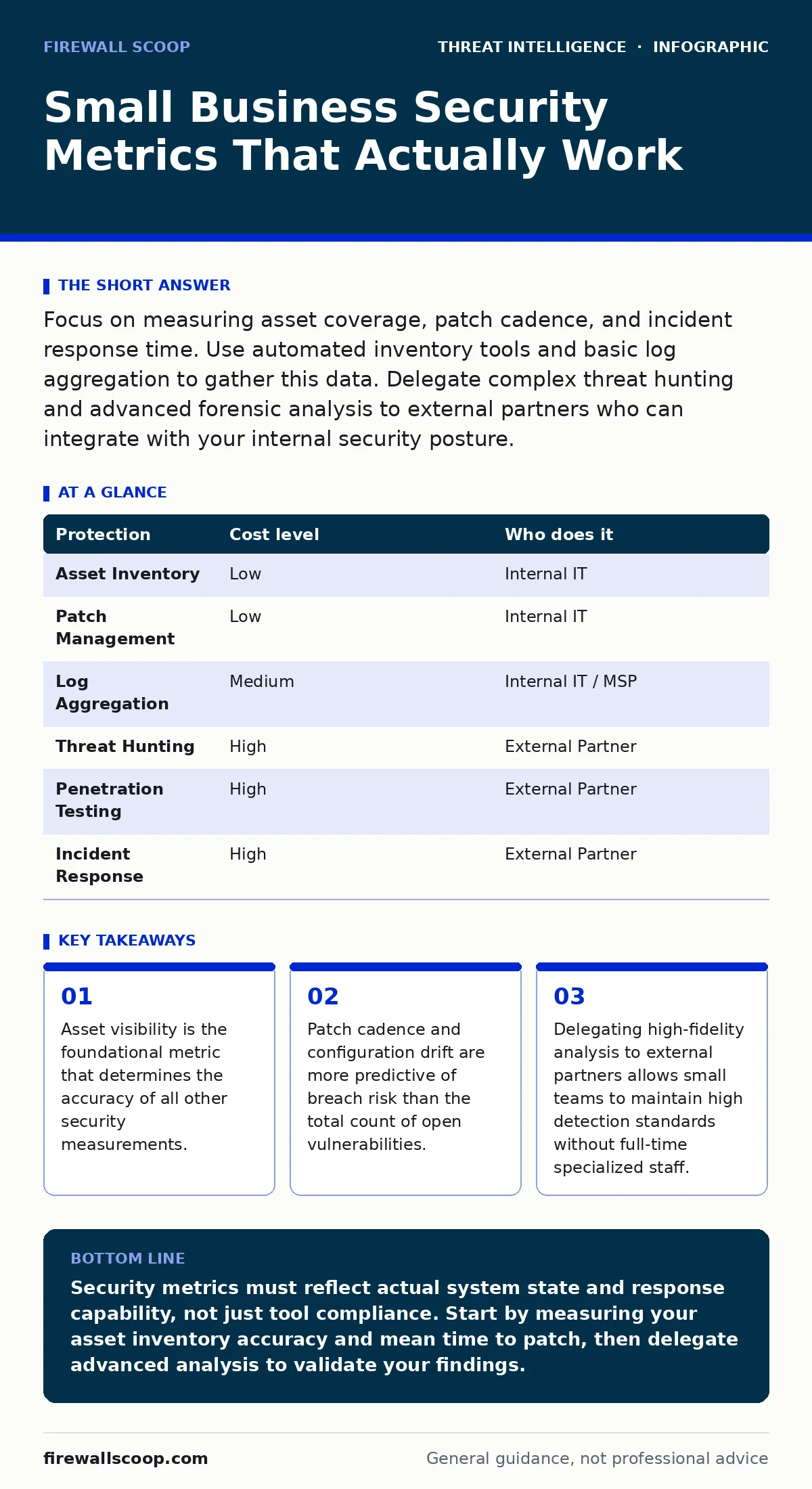
Focus on measuring asset coverage, patch cadence, and incident response time. Use automated inventory tools and basic log aggregation to gather this data. Delegate complex threat hunting and advanced forensic analysis to external partners who can integrate with your internal security posture.
Asset Inventory as the Baseline Metric
Security metrics begin with knowing what you own. You cannot protect what you cannot see. An accurate asset inventory is the denominator for every other security ratio you will calculate.
Many small teams track "number of devices" but fail to track "number of devices reporting to security tools." The gap between these two numbers is your blind spot. This blind spot is where attackers hide.
This metric requires no expensive hardware. It relies on software agents that report status back to a central console. The cost is minimal, but the discipline to update the inventory is high. If an asset is decommissioned but still appears in your inventory, your risk calculations are inflated. If a new laptop is bought but never added to the inventory, your protection coverage drops instantly.
Measuring Patch Cadence and Drift
The total number of vulnerabilities in your system is less important than how long they remain unpatched. A system with ten critical vulnerabilities patched within twenty-four hours is safer than a system with two vulnerabilities left open for six months. You should measure mean time to patch. This is the average time elapsed between a patch release and its application to your production systems.
Configuration drift is the silent companion of unpatched systems. Configuration drift occurs when systems deviate from their approved security baseline over time. This happens when users change settings, software updates alter defaults, or administrators make ad-hoc changes.
These two metrics tell you if your maintenance processes are working. If mean time to patch is high, your deployment process is broken. If configuration drift is high, your change management process is weak. Both conditions increase the attack surface available to threat actors. Tracking these metrics allows you to identify systemic process failures rather than blaming individual users.
Response Latency and Detection Gaps
Detection and response metrics measure how quickly you identify and stop an incident. Mean time to detect is the average duration between the start of an attack and your first alert. Mean time to respond is the average duration between the alert and your containment action. These metrics highlight the effectiveness of your monitoring tools and your team's readiness.
Small teams often lack the staff to monitor logs twenty-four hours a day. This creates a detection gap. You can measure this gap by analyzing the time between a known test incident and your detection of it. This is often called a purple team exercise or a controlled breach simulation. If it takes days to detect a simulated attack, your real-world detection time will likely be similar.
You do not need to simulate complex attacks to measure this. Simple indicators, such as a failed login from an unusual location or a sudden spike in outbound traffic, are sufficient for baseline measurement. The goal is to verify that your alerts are reaching the right people and that those people know how to act. If the alert goes to a generic inbox and is ignored, your mean time to respond is effectively infinite.
Delegation and External Validation
Small businesses cannot hire full-time experts for every security domain. You must decide what to keep in-house and what to delegate. Keep asset management, patching, and basic log monitoring in-house. These tasks require daily attention and intimate knowledge of your environment. Delegate threat hunting, forensic analysis, and advanced penetration testing to external partners.
External partners provide a fresh perspective and specialized skills that are too expensive to maintain internally. They can perform attack path analysis to find gaps in your defense that internal teams might miss because they are too close to the system. You should measure the quality of their work by the depth of their findings and the clarity of their remediation advice.
Do not delegate the responsibility for security. You remain accountable for the decisions made based on their reports. Ensure that any external partner can integrate with your existing tools. If they work in a silo, their findings will not improve your daily operations. You need their insights to feed back into your internal metrics, such as reducing your mean time to patch based on their identified critical paths.
Affordable Data Collection Methods
You do not need expensive commercial platforms to gather these metrics. Open-source tools and built-in operating system features provide sufficient data for most small environments. Windows Event Logs and Linux syslog contain detailed information about login attempts, system changes, and software installations. You can aggregate these logs using free or low-cost aggregation tools.
Network flow data provides visibility into traffic patterns without inspecting packet contents. This helps you identify unusual communication patterns that might indicate a breach. You can measure the volume of traffic to external IP addresses that are not known business partners. A sudden spike in traffic to a new destination is a metric worth investigating.
Endpoint detection tools, even free versions, provide metrics on process execution and file changes. These metrics help you detect malicious activity that traditional antivirus might miss. The key is to ensure that these tools are configured to log the specific events you need to measure. Default configurations often lack the necessary detail for accurate metric calculation.
See also: Database Security Benefits and Limitations Explained · Why ISO 27001 Matters for Security Decisions and Risk Control
Evaluating IT Provider Capabilities
When you delegate security tasks, you must vet your provider's ability to measure and report on these metrics. Do not accept vague promises of "comprehensive protection." Ask for specific data points. You need to know how they measure their own effectiveness.
- Do they provide a current and complete asset inventory?
- What is their average time to patch critical vulnerabilities?
- How do they monitor for configuration drift?
- What is their mean time to detect and respond to incidents?
- How do they validate their detection capabilities?
An IT provider who cannot answer these questions is not measuring their performance. If they cannot measure their performance, they cannot improve it. You are relying on their processes, so you must understand the metrics that drive those processes. This transparency ensures that their work aligns with your security goals.
| Protection | Cost level | Who does it |
|---|---|---|
| Asset Inventory | Low | Internal IT |
| Patch Management | Low | Internal IT |
| Log Aggregation | Medium | Internal IT / MSP |
| Threat Hunting | High | External Partner |
| Penetration Testing | High | External Partner |
| Incident Response | High | External Partner |
Integrating Metrics into Decision Making
Metrics are useless if they do not drive action. You must review these metrics regularly and adjust your security posture accordingly. If your mean time to patch is increasing, invest in better deployment tools. If your configuration drift is high, enforce stricter change management policies. If your detection time is slow, improve your alerting rules.
This continuous improvement loop is the core of effective security management. It moves you from reactive firefighting to proactive risk reduction. You are not trying to achieve perfect security. You are trying to reduce risk to an acceptable level while managing costs. Metrics provide the evidence that your efforts are working.
Remember that security is a balance. Every metric you track has a cost in time or money. Focus on the metrics that provide the most insight into your most critical risks. For a small business, this usually means asset visibility, patching speed, and response readiness. By tracking these specific areas, you build a security program that is measurable, manageable, and effective.
Key takeaways
- Asset visibility is the foundational metric that determines the accuracy of all other security measurements.
- Patch cadence and configuration drift are more predictive of breach risk than the total count of open vulnerabilities.
- Delegating high-fidelity analysis to external partners allows small teams to maintain high detection standards without full-time specialized staff.
Security metrics must reflect actual system state and response capability, not just tool compliance. Start by measuring your asset inventory accuracy and mean time to patch, then delegate advanced analysis to validate your findings.
Frequently asked questions
How often should I review my security metrics?
Review high-frequency metrics like patch cadence and configuration drift weekly. Review slower-moving metrics like asset inventory accuracy and response latency monthly.
Can I use free tools for these metrics?
Yes. Most operating systems provide detailed logging. Free log aggregation and network scanning tools can calculate these metrics without commercial software.
What if my IT provider won't share these metrics?
Request them as part of your service level agreement. If they refuse, they are not transparent about their performance, which is a significant risk factor for your business.
How do I know if my metrics are accurate?
Perform regular manual spot checks. Compare the tool's report against the actual state of a random sample of systems. Discrepancies indicate a need for tool reconfiguration.
How this guide was produced: written by the Firewall Scoop editorial team with AI assistance, checked against the public references listed below, and reviewed when the facts change. See our editorial policy or report an error.