Why ISO 27001 Matters for Security Decisions and Risk Control
ISO 27001 forces you to prove your security controls work through audit evidence, turning vague policies into measurable operational reality.

ISO 27001 provides a structured framework for managing information security risks. It helps teams prioritize controls based on actual business impact rather than fear. This standard ensures consistent decision-making, reduces liability, and builds trust with partners who require verified security practices.
The Discipline of Proof
Security is often treated as a collection of tools rather than a management discipline. You might install an intrusion detection system and assume you are safe. ISO 27001 challenges this assumption by requiring you to prove the tool works. It does not tell you which software to buy. Instead, it demands a systematic approach to identifying assets, assessing threats, and selecting controls that mitigate specific risks.
This standard operates on the principle of evidence. You cannot claim to have a secure process if you cannot show records of it being followed. This requirement changes how teams operate daily. It moves the conversation from "we think we are secure" to "here is the data that shows we are secure." For students entering the field, understanding this shift is fundamental. Security is not just technical configuration; it is governance and accountability.
Decisions Informed by Structure
Many organizations struggle with decision paralysis when facing security choices. Should you encrypt all data? Should you require multi-factor authentication everywhere? ISO 27001 provides a mechanism to answer these questions based on risk. You perform a risk assessment to determine the value of an asset and the likelihood of a threat. The result informs your control selection.
This process prevents wasted effort on low-value targets while ensuring high-risk areas receive adequate protection. It also clarifies trade-offs. You might decide that the cost of protecting a public-facing brochure is higher than the risk of its compromise. The standard allows you to document this decision formally. This documentation is vital for audits and internal reviews. It shows that leadership made an informed choice rather than ignoring the risk.
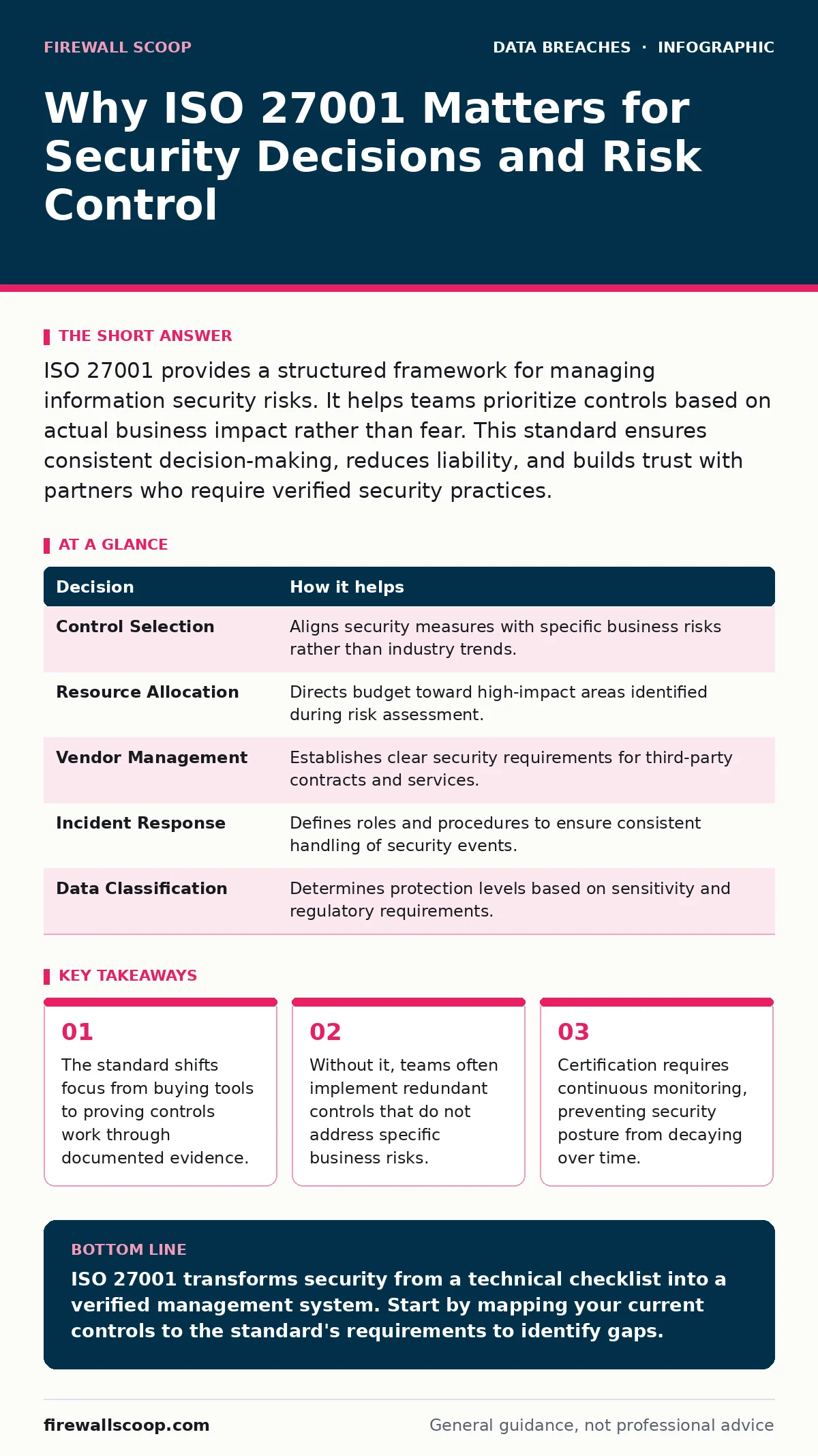
| Decision | How it helps |
|---|---|
| Control Selection | Aligns security measures with specific business risks rather than industry trends. |
| Resource Allocation | Directs budget toward high-impact areas identified during risk assessment. |
| Vendor Management | Establishes clear security requirements for third-party contracts and services. |
| Incident Response | Defines roles and procedures to ensure consistent handling of security events. |
| Data Classification | Determines protection levels based on sensitivity and regulatory requirements. |
What Goes Wrong Without It
Imagine a team that implements security controls based on fear or marketing hype. They buy every tool they hear about. They create policies that are too strict to follow. This approach leads to alert fatigue and policy bypass. Employees find ways to circumvent controls because they hinder productivity. The security team spends all their time fighting symptoms rather than addressing root causes.
Without a framework like ISO 27001, there is no consistent baseline for improvement. You cannot measure progress if you do not define what success looks like. Gaps in coverage remain hidden until a breach occurs. You might discover that your encryption at rest policy was never applied to backup servers. Or that your data retention policies were ignored by the finance department. These gaps are not technical failures; they are management failures. The standard forces you to look at the entire system, not just isolated parts.
How Teams Use the Standard
Teams use ISO 27001 to create a Statement of Applicability. This document lists all controls from the standard and indicates which ones you have implemented and why. For each control, you document the justification. If you exclude a control, you must explain why it is not necessary. This exercise forces clarity. You cannot hide behind vague statements.
This process involves multiple departments. IT, legal, HR, and operations must collaborate. Security is not solely the IT department's responsibility. Employee data breaches often occur due to lack of training or unclear policies. ISO 27001 requires you to address these human factors. You must define roles and responsibilities clearly. You must ensure that everyone understands their part in maintaining security. This holistic view strengthens the organization's overall resilience.
The Hidden Cost of Compliance
There is a hidden cost to maintaining ISO 27001 compliance. It requires significant documentation and regular reviews. You must keep records of risk assessments, training sessions, and incident responses. This administrative burden can feel heavy. However, this cost is the price of consistency. Without it, your security posture drifts. New employees are not trained properly. Old procedures are not updated.
The cost is also in the time required for audits. Internal audits check your adherence to the standard. External audits verify your compliance for certification. These processes demand preparation and honesty. You cannot fake compliance. The auditors will look for evidence. If the evidence is missing, you fail. This pressure ensures that security remains a priority. It prevents complacency. You must continually demonstrate that your controls are effective.
See also: When Should Data Breaches Be Reported: Timing Rules · Data Retention Policies: 8 Practices to Reduce Breach Impact
Integrating Related Security Practices
ISO 27001 does not exist in a vacuum. It integrates with other security practices. For example, database security controls must be defined within your framework. You need to specify who has access to sensitive data and how it is protected. Similarly, data leaks prevention requires clear policies on data handling and transmission. The standard helps you connect these dots.
You must also consider physical security. Printed document leaks can occur if sensitive papers are left on desks or in unsecured printers. ISO 27001 requires you to assess these physical risks. You might implement clean desk policies or secure printing solutions. Additionally, SIM swap fraud protection involves verifying identity through multiple channels. This aligns with the standard's requirement for strong authentication. By integrating these practices, you create a cohesive security program.
Building Trust with Evidence
The ultimate benefit of ISO 27001 is trust. Partners and customers want to know that you protect their data. Certification provides independent verification. It shows that you follow a recognized international standard. This verification can be a competitive advantage. It opens doors to new business opportunities. Many contracts require ISO 27001 certification as a prerequisite.
However, certification is not a magic shield. It does not guarantee that you will never be breached. It proves that you have a system in place to manage risk. It shows that you are committed to continuous improvement. This commitment is what matters. You are telling your stakeholders that you take security seriously. You are willing to invest the time and resources to maintain it. This transparency builds long-term relationships.
Sustaining the Momentum
Maintaining ISO 27001 compliance requires sustained effort. You must conduct regular internal audits. You must review your risk assessments periodically. You must update your controls as your business changes. New technologies introduce new risks. New regulations impose new requirements. Your security program must evolve to address these changes.
This continuous improvement cycle is the heart of the standard. It prevents stagnation. You are always looking for ways to improve. You are always learning from incidents and near-misses. This mindset creates a culture of security. Everyone in the organization understands their role. Everyone is accountable. This culture is your strongest defense. It is more effective than any single tool or policy. It ensures that security remains a core part of your business operations.
Key takeaways
- The standard shifts focus from buying tools to proving controls work through documented evidence.
- Without it, teams often implement redundant controls that do not address specific business risks.
- Certification requires continuous monitoring, preventing security posture from decaying over time.
ISO 27001 transforms security from a technical checklist into a verified management system. Start by mapping your current controls to the standard's requirements to identify gaps.
Frequently asked questions
Does ISO 27001 certify specific security tools?
No, it certifies your management system. It verifies that you have processes to select, implement, and maintain effective controls, regardless of the specific tools used.
How long does it take to get certified?
The timeline varies based on organization size and complexity. It typically involves several months of preparation, internal audits, and final external certification audits.
Is ISO 27001 only for large enterprises?
No, it is scalable. Small and medium-sized businesses can adopt it by tailoring controls to their specific risks and resources.
What happens if I fail an audit?
You receive non-conformity reports. You must create a corrective action plan to address these issues. You can be certified once all major non-conformities are resolved.
How this guide was produced: written by the Firewall Scoop editorial team with AI assistance, checked against the public references listed below, and reviewed when the facts change. See our editorial policy or report an error.