Database Security Benefits and Limitations Explained
Database security controls often create operational friction that slows legitimate business processes while leaving metadata exposed to determined attackers.
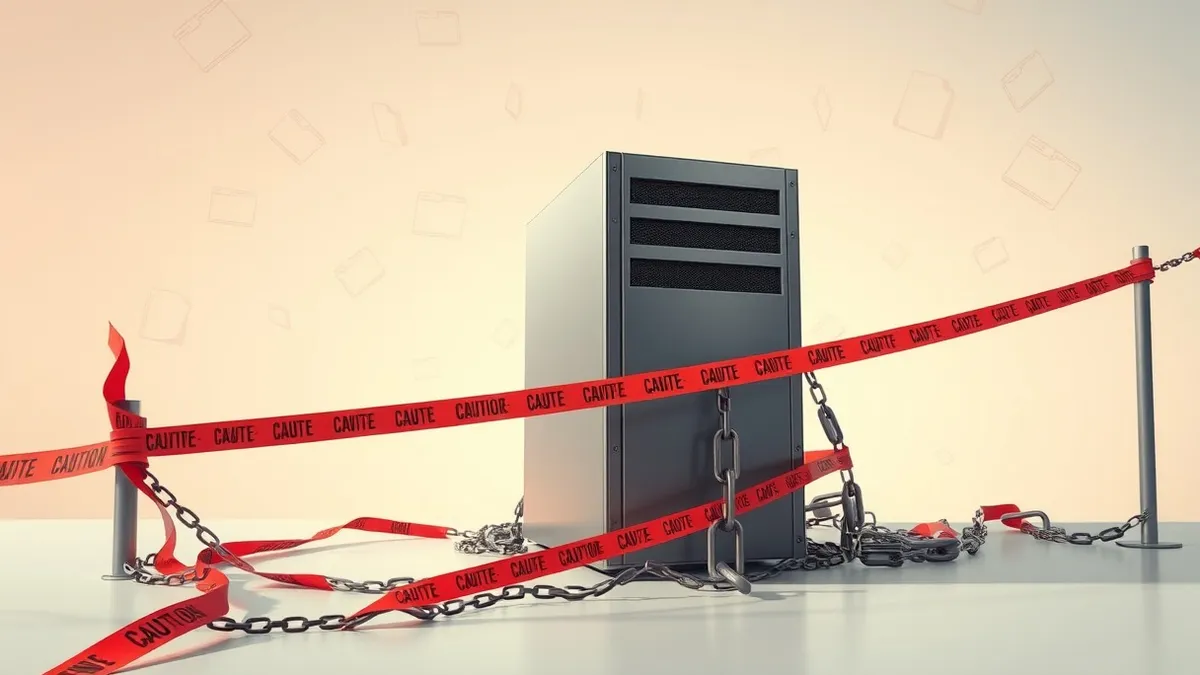
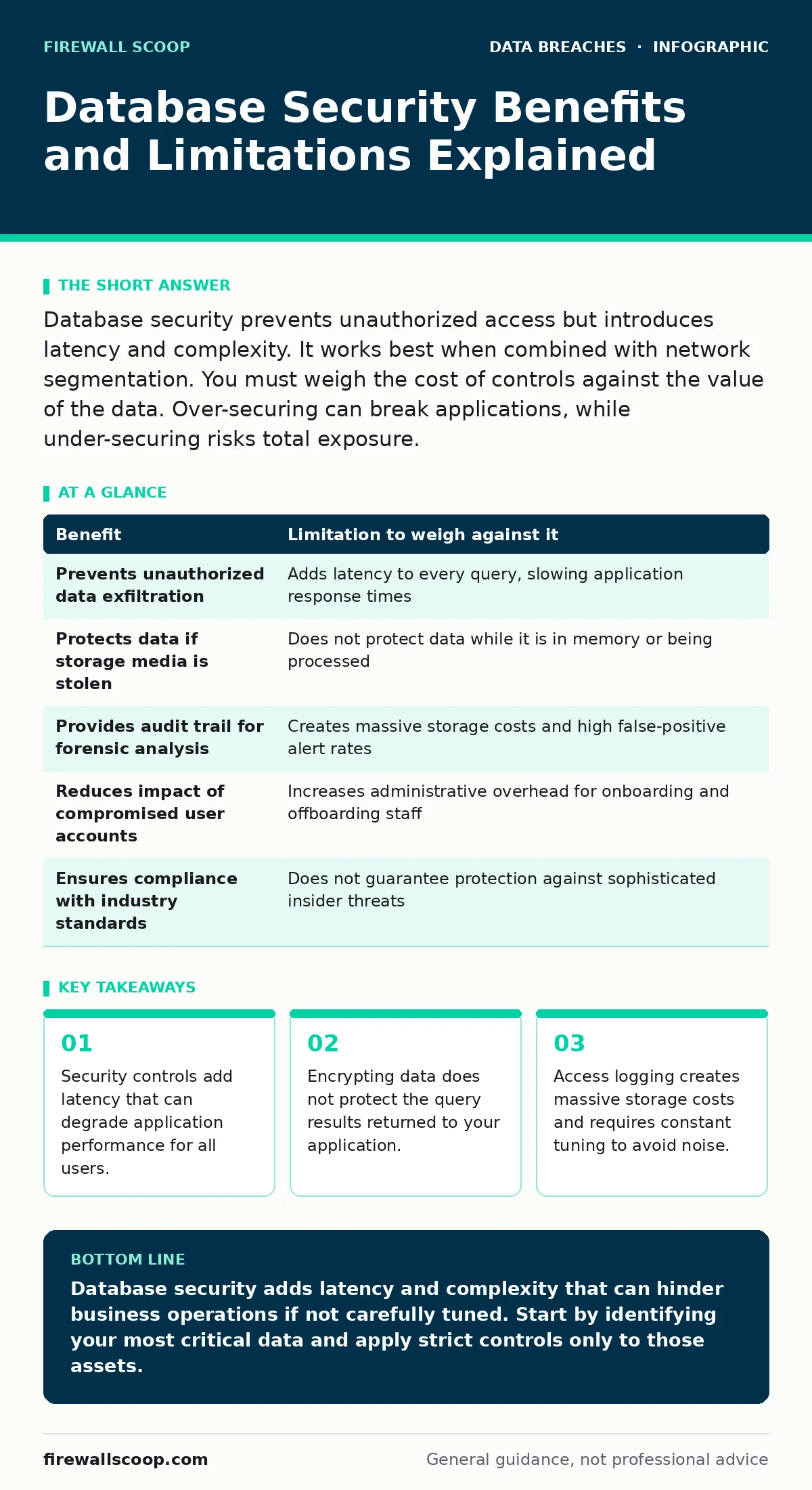
Database security prevents unauthorized access but introduces latency and complexity. It works best when combined with network segmentation. You must weigh the cost of controls against the value of the data. Over-securing can break applications, while under-securing risks total exposure.
The Hidden Cost of Every Control
Every security measure you add to a database creates friction. This friction is not a bug; it is the price of verification. When you enforce strict access controls, the database must check permissions for every single query. This adds milliseconds to each request. For a system handling thousands of requests per second, those milliseconds become seconds of delay.
This delay affects every user, not just the attackers. A slow login page drives users away. A sluggish search function frustrates customers. You are trading speed for safety. You must calculate how much speed you can afford to lose. If your application is time-sensitive, such as high-frequency trading or real-time gaming, heavy database security might make the product unusable.
Access Control and the Principle of Least Privilege
The most common defense is restricting who can see what. This is called the principle of least privilege. It means giving users only the minimum access they need to do their job. An accountant should not have access to the medical records table. An intern should not have write access to the production database.
Implementing this requires detailed role definitions. You must map every job function to specific database permissions. This is tedious work. It also creates a single point of failure for your identity management system. If the system that grants access goes down, your entire organization stops working. You need a backup method for granting emergency access, which itself becomes a security risk if not managed tightly.
Reliance on this model assumes you can perfectly predict what access employees will need. You cannot. Roles change. Projects shift. Access accumulates over time. This phenomenon is known as privilege creep. Users keep old permissions even when they no longer need them. You must audit these permissions regularly. Auditing is expensive and often unpopular with staff who feel distrusted.
Encryption at Rest vs. In Use
Many people believe that encrypting data at rest solves the problem. Encryption at rest scrambles the data on the disk so that if someone steals the hard drive, they cannot read the files. This is a solid defense against physical theft or lost backups. It does not protect data while it is being processed.
When an application needs to use the data, it must decrypt it first. The data sits in memory as plain text. If an attacker compromises the application server, they can read the memory. They do not need to break the encryption on the disk. They just need to be in the place where the data is already unlocked.
This limitation is often overlooked. Organizations spend heavily on disk encryption but neglect the application layer. The data is safe in the vault but exposed on the desk. To protect data in use, you need more advanced techniques like trusted execution environments or homomorphic encryption. These are complex and add significant computational overhead. They are not yet standard practice for most organizations.
Monitoring and the Noise Problem
Logging every database action is the standard advice for detecting intrusions. You record who accessed what, when, and from where. This creates a trail for investigators. It also creates a massive amount of data. A busy database can generate terabytes of logs per day.
Storing this data is costly. Analyzing it is harder. Security teams drown in alerts. Most alerts are false positives. A developer testing a query looks like an attacker scanning for vulnerabilities. You must tune your monitoring rules to ignore normal behavior. This tuning requires deep knowledge of your specific applications. If you tune too loosely, you miss attacks. If you tune too tightly, you miss legitimate anomalies.
The cost of storage and analysis often exceeds the cost of the security tool itself. You need staff to watch the logs. These staff members must be skilled enough to distinguish between a bug and a breach. This is a rare and expensive skill set.
The Trade-Off Table
You must weigh each benefit against its specific limitation. No control is free.
| Benefit | Limitation to weigh against it |
|---|---|
| Prevents unauthorized data exfiltration | Adds latency to every query, slowing application response times |
| Protects data if storage media is stolen | Does not protect data while it is in memory or being processed |
| Provides audit trail for forensic analysis | Creates massive storage costs and high false-positive alert rates |
| Reduces impact of compromised user accounts | Increases administrative overhead for onboarding and offboarding staff |
| Ensures compliance with industry standards | Does not guarantee protection against sophisticated insider threats |
When It Is Worth It
Database security is worth the cost when the data has high value and low turnover. Consider customer personally identifiable information, financial records, or intellectual property. If this data is leaked, the reputational damage and legal liability are severe. The cost of a breach far exceeds the cost of security controls.
It is also worth it when you are required to follow strict frameworks. If you are pursuing ISO 27001 certification, you must demonstrate control over your data. The audit process will require evidence of access controls and logging. Building these controls early avoids painful remediation later.
Imagine you are building a healthcare portal. You handle sensitive patient data. The regulations are strict. The penalty for a leak is catastrophic. In this scenario, the friction of security controls is an acceptable cost of doing business. You must also coordinate these efforts with your data retention policies to ensure you do not hold data longer than necessary, which reduces the blast radius of any potential leak.
When It Is Not
Database security is not worth the heavy investment when the data is public or low-value. If you are hosting a public blog, the content is meant to be seen. Encrypting the database adds cost without reducing risk. The attackers already have the data.
It is also not worth it when the application is short-lived. A prototype or a test environment should not have the same security budget as production. The data in these environments is often fake or temporary. Spending weeks configuring strict access controls for a project that will be deleted in a month is a waste of resources.
Suppose you are running an internal tool for tracking office supply orders. The data is not sensitive. It does not contain personal information. It does not drive revenue. Heavy security here creates frustration for staff without adding meaningful protection. You should focus your budget on areas where the risk is real.
Remember that employee data breaches often start with poor hygiene rather than sophisticated hacking. Sometimes, the best security is clear policies and training. You must also consider the risk of printed document leaks, as physical security is often weaker than digital security. If your digital walls are high but your office printer is left unlocked, you have a false sense of safety.
Conclusion of Controls
Database security is a balancing act. You are not trying to make the database unbreakable. You are trying to make the attack harder than the reward. You must accept that some risk will remain. Your goal is to manage that risk, not to eliminate it.
Choose controls that fit your data value and your performance needs. Do not copy security plans from other organizations. Their data is different. Their threats are different. Your constraints are different. Build a defense that works for you.
Key takeaways
- Security controls add latency that can degrade application performance for all users.
- Encrypting data does not protect the query results returned to your application.
- Access logging creates massive storage costs and requires constant tuning to avoid noise.
Database security adds latency and complexity that can hinder business operations if not carefully tuned. Start by identifying your most critical data and apply strict controls only to those assets.
Frequently asked questions
Does encrypting the database stop hackers from stealing data?
No, encryption at rest only protects data on disk. If an attacker compromises the application server, they can read the data from memory before it is encrypted.
How do I balance security with application performance?
Measure the latency added by each control. Implement controls in a staging environment first. Tune your indexes and queries to compensate for the overhead introduced by security features.
Is logging every database query necessary?
Logging every query creates too much noise and storage cost. Log only successful and failed authentication attempts, and changes to schema or permissions. Use sampling for routine read queries.
Can I rely on network firewalls for database security?
No, firewalls only control network access. They do not stop an attacker who already has a valid user account or who exploits a vulnerability in the database software itself. You need layered defenses.
How this guide was produced: written by the Firewall Scoop editorial team with AI assistance, checked against the public references listed below, and reviewed when the facts change. See our editorial policy or report an error.