When Should Data Breaches Be Reported: Timing Rules
Reporting deadlines depend on data type and jurisdiction, often requiring notification within 72 hours or less for sensitive personal information.

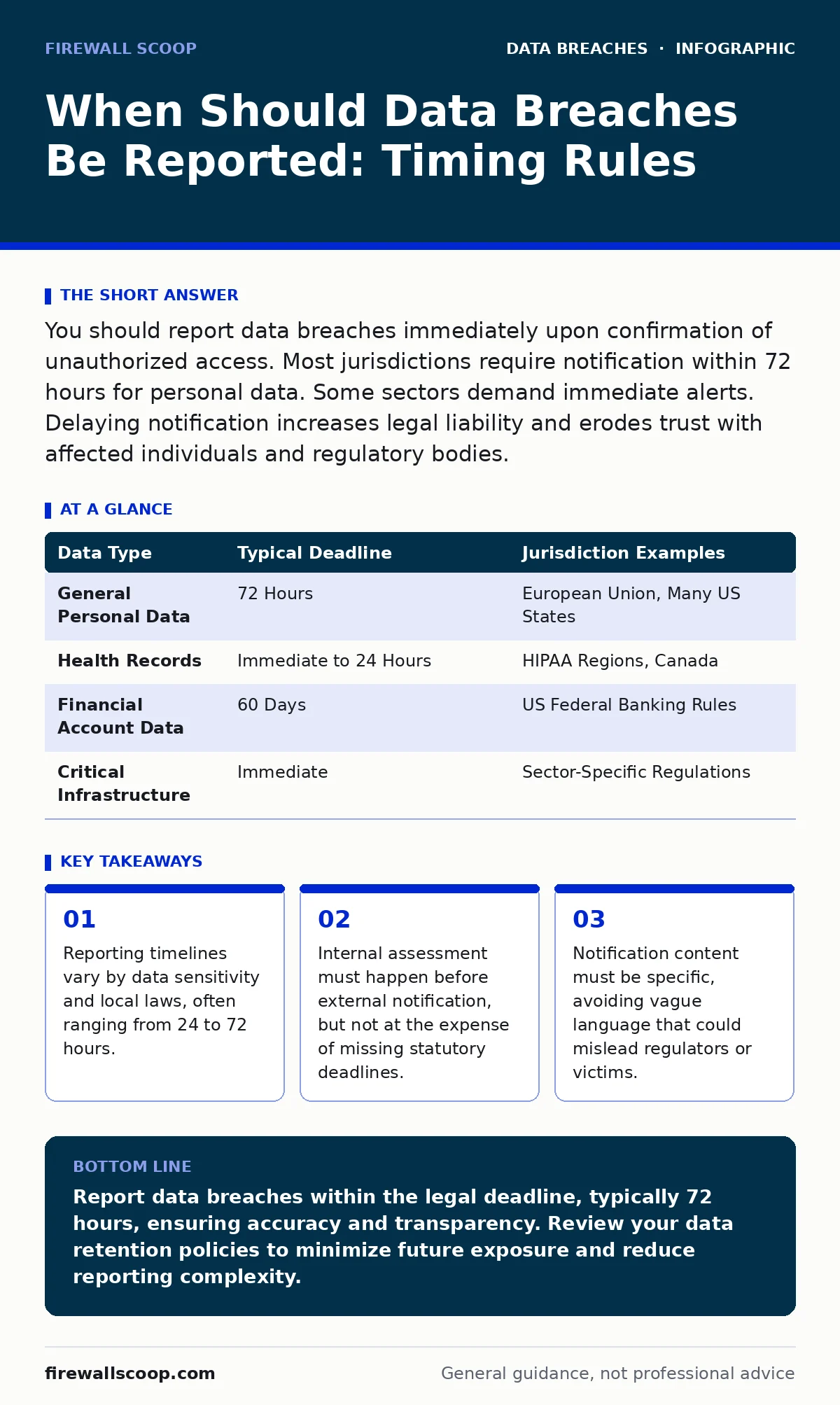
You should report data breaches immediately upon confirmation of unauthorized access. Most jurisdictions require notification within 72 hours for personal data. Some sectors demand immediate alerts. Delaying notification increases legal liability and erodes trust with affected individuals and regulatory bodies.
When should data breaches be reported?
You should report data breaches as soon as you confirm unauthorized access or loss of data, typically within 72 hours for personal information. The exact timing depends on the type of data compromised and the jurisdiction where the breach occurred. Some regulations require immediate notification for critical infrastructure or health data. You must balance the speed of reporting with the accuracy of the information you provide. Rushing to report without facts can cause confusion, but waiting too long violates legal obligations.
What defines a reportable incident?
A reportable incident is any event where confidential data is accessed, used, or disclosed without authorization. Not every security alert qualifies as a breach. If a firewall blocks an attack and no data leaves the system, it is an attempt, not a breach. If logs show an attacker read files but did not exfiltrate them, it is still a breach of confidentiality. You must distinguish between a false positive and a confirmed compromise. Review your audit logging records to verify the scope. If you cannot prove the data remained safe, you must treat it as compromised.
How do you determine the reporting deadline?
Deadlines are set by the laws governing the data type. Personal data often has a 72-hour window from when you became aware of the breach. Health records may have shorter windows, sometimes requiring notification within 24 hours. Financial data follows different rules, often tied to specific banking regulations. You must know which laws apply to your organization. If you operate in multiple regions, you must follow the strictest deadline. Missing a deadline can result in significant fines and legal action.
| Data Type | Typical Deadline | Jurisdiction Examples |
|---|---|---|
| General Personal Data | 72 Hours | European Union, Many US States |
| Health Records | Immediate to 24 Hours | HIPAA Regions, Canada |
| Financial Account Data | 60 Days | US Federal Banking Rules |
| Critical Infrastructure | Immediate | Sector-Specific Regulations |
What happens if you report too early?
Reporting too early risks providing incomplete or incorrect information. Regulators and victims need accurate details about what happened and what data was exposed. If you report that email addresses were stolen, but later find passwords were also taken, you must issue a correction. Corrections damage credibility and increase panic. You should have enough facts to describe the incident accurately before sending the first notice. However, do not delay reporting to gather every single detail. Provide what you know, state that the investigation is ongoing, and promise updates. This approach balances transparency with accuracy.
Can you delay reporting to investigate?
You can delay reporting only if the investigation is likely to conclude quickly and the delay does not violate statutory deadlines. Some laws allow a brief extension if reporting would hinder law enforcement or remediation efforts. You must document the reason for the delay. If the investigation drags on, you must report within the legal window. You cannot use "ongoing investigation" as an excuse to avoid notification indefinitely. The law prioritizes victim protection over internal clarity. Victims have a right to know their data is at risk so they can take protective measures.
See also: Memory Forensics: Benefits, Limits, and When to Use It · Audit Logging Best Practices: Secure Logs Against Tampering
Who must be notified of the breach?
You must notify three main groups: the regulatory authority, the affected individuals, and sometimes major media outlets. Regulatory notifications go to the data protection agency or sector-specific regulator. Individual notifications must be direct and clear. You cannot hide behind a press release. If the breach affects a large number of people, you may need to notify major media outlets to ensure widespread awareness. Check your local laws for specific thresholds. Some regions require media notification if more than 500 people are affected. Others require it for any breach involving sensitive data.
What information must the report contain?
Your report must include specific details about the incident. You need to state when the breach occurred, when you discovered it, and what data was involved. Describe the likely consequences for the affected individuals. Explain what measures you are taking to address the breach. Do not use vague language like "some data was compromised." Be specific: "Unencrypted credit card numbers and names were accessed." This clarity helps victims understand their risk. It also shows regulators that you take the incident seriously. Ambiguity can be interpreted as an attempt to hide the severity.
How do you handle cross-jurisdictional breaches?
Cross-jurisdictional breaches require you to follow the laws of every region where the affected individuals reside. If you have customers in Europe and the US, you must comply with both GDPR and US state laws. This means calculating multiple deadlines and preparing multiple notifications. You must coordinate with legal counsel in each region. Do not assume one notification covers all bases. Each jurisdiction has specific requirements for content and delivery method. Failure to notify a specific region can result in separate fines and lawsuits.
What are the long-term costs of poor reporting?
Poor reporting extends the financial and reputational damage of a breach. Delays or inaccuracies lead to higher fines and loss of customer trust. Victims may sue for damages if they feel misled. Your organization’s brand suffers long-term. Rebuilding trust takes years and significant investment. Good reporting demonstrates accountability and care for victims. It shows that you prioritize transparency over convenience. This can mitigate some negative reactions. It also helps you identify gaps in your security posture. Use the breach as a learning opportunity to improve your defenses.
How does data retention affect breach scope?
Data retention policies determine how much old data is available to attackers. If you keep data longer than necessary, a breach exposes more records. This increases the severity of the incident and the reporting requirements. You must review your data retention policies to minimize the amount of stored data. Delete old records that are no longer needed. This reduces the impact of any future breach. It also simplifies the reporting process. Fewer records mean fewer notifications and less complexity. Regularly audit your data storage practices to ensure compliance.
What role does encryption play in reporting?
Encryption can reduce or eliminate reporting obligations. If the stolen data was encrypted and the key was not compromised, regulators may not require notification. This is because the data is unreadable to the attacker. You must verify that the encryption was strong and the keys were secure. If the key was also stolen, you must report the breach as if the data was unencrypted. Do not assume encryption provides automatic immunity. Check the specific requirements of your jurisdiction. Some laws require notification regardless of encryption if the incident poses a high risk to individuals.
Key takeaways
- Reporting timelines vary by data sensitivity and local laws, often ranging from 24 to 72 hours.
- Internal assessment must happen before external notification, but not at the expense of missing statutory deadlines.
- Notification content must be specific, avoiding vague language that could mislead regulators or victims.
Report data breaches within the legal deadline, typically 72 hours, ensuring accuracy and transparency. Review your data retention policies to minimize future exposure and reduce reporting complexity.
Frequently asked questions
Does a failed phishing attempt count as a data breach?
No, a failed phishing attempt where no data was accessed or entered is not a breach. It is a security incident that requires investigation and employee training.
Can I notify victims via email?
You can notify victims via email if it is the primary contact method and secure. However, some jurisdictions require written notice or other direct communication methods for sensitive data breaches.
What if I am not sure if data was encrypted?
If you are unsure, assume the data was unencrypted. Failing to report an unencrypted breach is riskier than reporting an encrypted one. Consult your security team to verify encryption status.
Who decides if a breach is reportable?
The data protection officer or legal counsel usually decides. They assess the risk to individuals and the legal requirements. All stakeholders should be involved in the decision-making process.
How this guide was produced: written by the Firewall Scoop editorial team with AI assistance, checked against the public references listed below, and reviewed when the facts change. See our editorial policy or report an error.