Memory Forensics: Benefits, Limits, and When to Use It
Volatile memory captures active threats that disk-based tools miss, but acquiring it requires specialized hardware and introduces significant legal constraints.

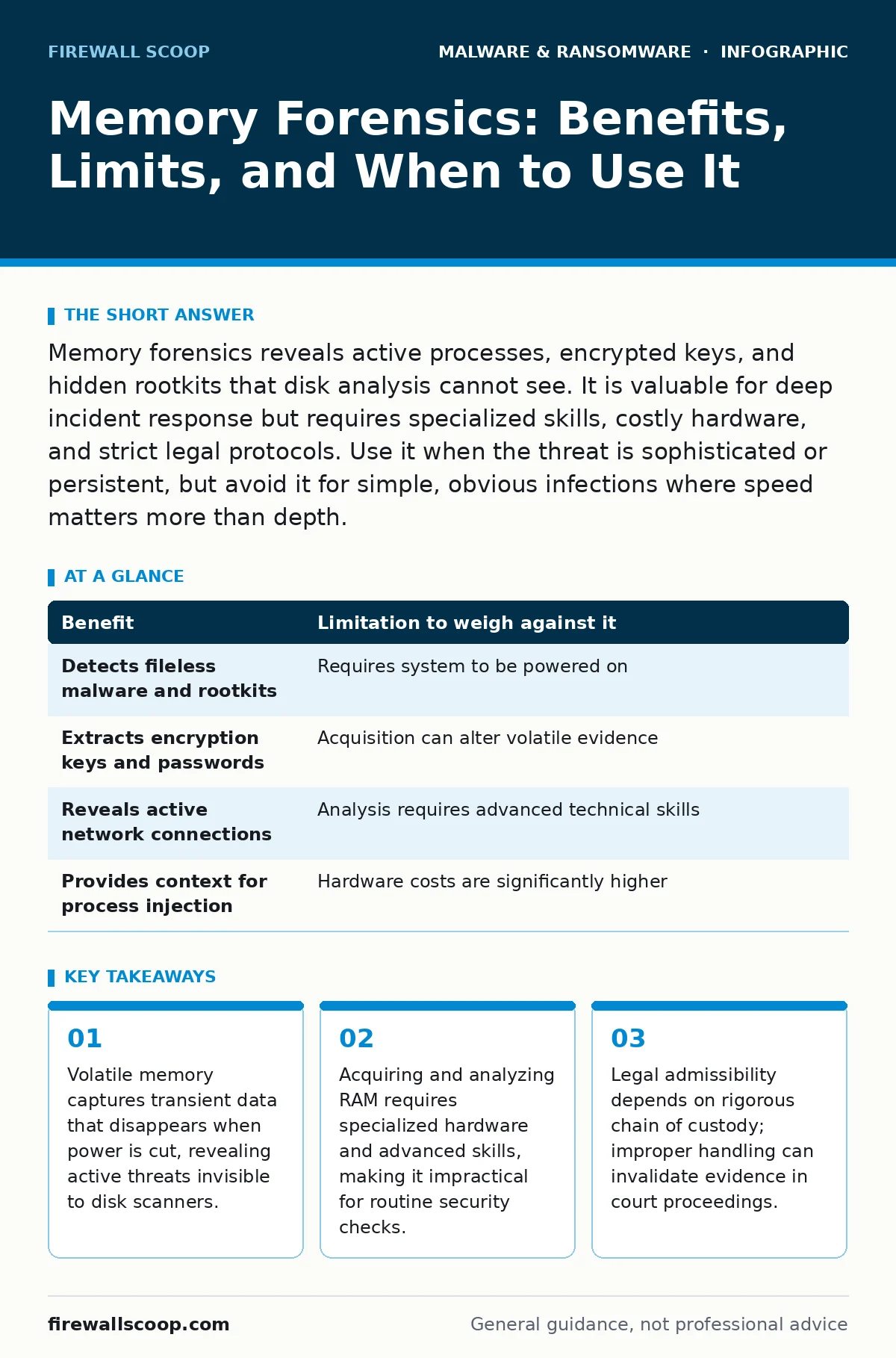
Memory forensics reveals active processes, encrypted keys, and hidden rootkits that disk analysis cannot see. It is valuable for deep incident response but requires specialized skills, costly hardware, and strict legal protocols. Use it when the threat is sophisticated or persistent, but avoid it for simple, obvious infections where speed matters more than depth.
What Memory Forensics Actually Captures
Memory forensics examines the volatile random access memory of a running system. This data exists only while the computer has power. When you shut down a machine, this information vanishes instantly. Disk-based analysis looks at files stored on hard drives or solid-state storage. Those files remain after power loss. Memory forensics looks at what is happening right now. It reveals active processes, loaded kernel modules, and network connections. It can extract encryption keys from memory before they are destroyed. It can identify injected code that never touches the disk. This technique provides a snapshot of the system’s active state.
The Hidden Cost of Volatility
The primary limitation of memory forensics is volatility. You must capture the memory while the system is running. This creates a race against time. If an attacker detects your investigation, they may wipe the memory. Some malware includes mechanisms to scrub sensitive data from RAM upon shutdown. You cannot simply pull the plug. You must use a write-blocker or specialized hardware to acquire the image. This hardware adds cost and complexity. You also risk altering the evidence during acquisition. Any change to the memory during capture can invalidate the forensic image. You must document every step meticulously.
Detecting What Disk Tools Miss
Traditional antivirus software scans files on the disk. It compares file hashes against known signatures. This method fails against fileless malware. Fileless malware lives entirely in memory. It uses legitimate system tools to execute malicious code. Rootkits often hide in the kernel space. They intercept system calls to remain invisible to standard utilities. Memory forensics can detect these anomalies. It analyzes the relationship between processes and their parent processes. It looks for hooks in kernel functions. It can reveal hidden network connections that do not appear in standard task managers. This depth allows investigators to see the full picture of an intrusion.
| Benefit | Limitation to weigh against it |
|---|---|
| Detects fileless malware and rootkits | Requires system to be powered on |
| Extracts encryption keys and passwords | Acquisition can alter volatile evidence |
| Reveals active network connections | Analysis requires advanced technical skills |
| Provides context for process injection | Hardware costs are significantly higher |
The Skill Gap and Analysis Time
Acquiring memory is only the first step. Analyzing it requires significant expertise. Investigators must understand operating system internals. They need to know how the kernel structures memory. They must interpret complex data structures. This analysis is time-consuming. A single memory dump can contain gigabytes of data. Sorting through this data to find relevant artifacts takes hours or days. Most security teams lack the specialized staff for this work. Outsourcing the analysis adds cost and delays the response. During this delay, the attacker may continue their activities. You must balance the depth of analysis with the need for speed.
Legal and Admissibility Challenges
Memory forensics introduces legal complexities. The chain of custody must be unbroken. You must prove that the image you analyze is identical to the memory at the time of capture. Any doubt about the integrity of the image can lead to exclusion in court. Jurisdictions vary in their acceptance of memory evidence. Some judges are skeptical of volatile data. You must be prepared to explain your methodology in detail. Expert testimony may be required. This adds to the cost and duration of legal proceedings. You should consult with legal counsel before initiating memory forensics in any incident that might lead to prosecution.
See also: Audit Logging Best Practices: Secure Logs Against Tampering · Spear Phishing Prevention Checklist for Secure Operations
When It Is Worth It
Memory forensics is worth the effort when the threat is sophisticated. If you suspect a rootkit or fileless malware, disk analysis will not suffice. You need to see what is running in memory. It is also worth it when you need to recover encryption keys. If ransomware has encrypted your files, the key may exist in memory before the attacker destroys it. Extracting it can restore your data without paying. It is also valuable when you need to understand the full scope of an intrusion. Attackers often move laterally across networks. Memory forensics can reveal the initial access vector and subsequent movements. This helps you patch vulnerabilities and prevent recurrence.
When It Is Not Worth It
Do not use memory forensics for simple, obvious infections. If antivirus software has detected a known trojan, you likely do not need deep analysis. Standard removal procedures are faster and cheaper. Do not use it when speed is the only priority. If your recovery time objective is measured in minutes, memory forensics will slow you down.
You need to isolate and wipe the system quickly. Do not use it if you lack the skills or hardware. Attempting memory forensics without proper training can lead to false positives or destroyed evidence. In these cases, rely on established procedures for removing malware from a Mac or other systems. Focus on containment and eradication rather than deep investigation.
Integrating With Your Response Plan
Memory forensics should be part of your broader incident response strategy. It is not a standalone solution. Integrate it with your ransomware recovery plans. Ensure your team knows when to trigger memory acquisition. Train staff on the basics of volatile data collection. Have the necessary hardware ready. Do not wait for an incident to buy write-blockers. Practice your procedures in a controlled environment. This reduces errors during real incidents. Remember that prevention is always better than detection. Strong access controls and offline backups reduce the need for complex forensic investigations.
Key takeaways
- Volatile memory captures transient data that disappears when power is cut, revealing active threats invisible to disk scanners.
- Acquiring and analyzing RAM requires specialized hardware and advanced skills, making it impractical for routine security checks.
- Legal admissibility depends on rigorous chain of custody; improper handling can invalidate evidence in court proceedings.
Frequently asked questions
Can I perform memory forensics on a mobile device?
Mobile devices have different memory architectures and security models. Specialized tools and legal permissions are required. Consult with experts before attempting.
Does memory forensics reveal deleted files?
It may reveal fragments of deleted files if they were recently loaded into memory. However, it is not a reliable method for recovering deleted data from disk.
How long does memory forensics take?
Acquisition takes minutes. Analysis can take hours or days depending on the complexity of the image and the skill of the analyst.
Is memory forensics legal in all countries?
Laws vary by jurisdiction. Some regions have strict rules about data privacy and evidence collection. Always consult local legal counsel.
How this guide was produced: written by the Firewall Scoop editorial team with AI assistance, checked against the public references listed below, and reviewed when the facts change. See our editorial policy or report an error.