Java Deserialization Vulnerabilities: Risks and Protection for Small Businesses
Java deserialization flaws allow attackers to execute arbitrary code on your server without needing credentials or finding other entry points.

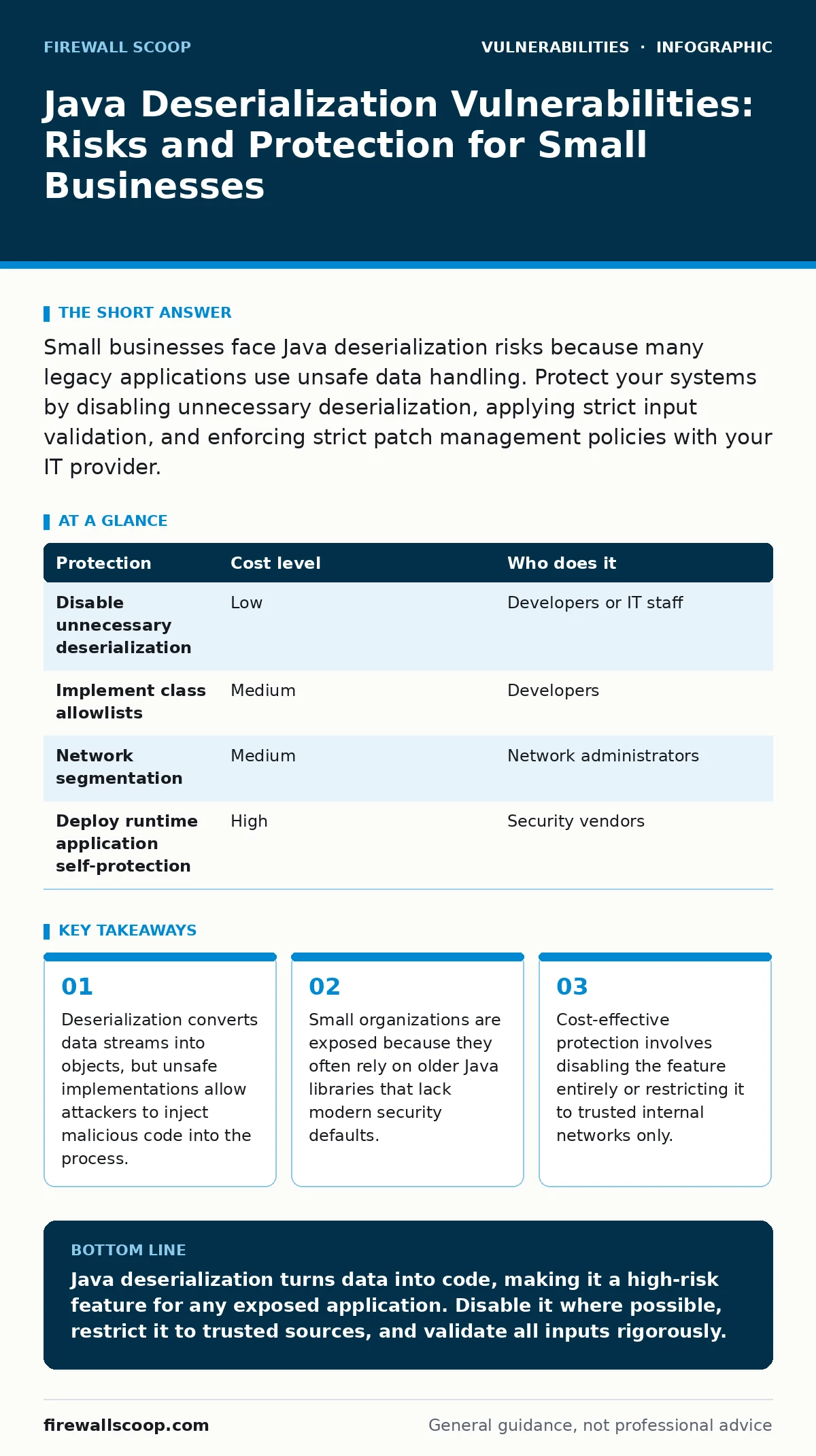
Small businesses face Java deserialization risks because many legacy applications use unsafe data handling. Protect your systems by disabling unnecessary deserialization, applying strict input validation, and enforcing strict patch management policies with your IT provider.
Why Java Deserialization Fails in Small Organizations
Java deserialization vulnerabilities arise when an application converts a stream of data back into a Java object. This mechanism is useful for storing state or transferring data between services. The problem occurs when the application trusts the incoming data stream too much. If the data contains references to classes that should not be executed, the Java Virtual Machine loads and runs them.
Small organizations are particularly exposed because they often inherit legacy codebases. These systems were built when network boundaries were stricter and internal trust was higher. Modern networks expose these internal services to the internet, turning old convenience features into critical attack vectors.
The exposure is not limited to large corporations. Any small business using Java-based enterprise software, web applications, or microservices faces this risk. The attack surface grows when developers use libraries that automatically handle object conversion. These libraries often include complex class hierarchies. An attacker only needs to find one class in that hierarchy that performs a dangerous action, such as writing to a file or opening a network connection. This is similar to how buffer overflow vulnerabilities exploit memory management errors, but here the error is in data interpretation rather than memory limits.
The Hidden Cost of Trusting Data Streams
The core issue is the assumption that data is inert. Developers treat serialized data like a file you open to read. In reality, deserialization is akin to running a program. The Java runtime executes code defined by the data structure. This creates a hidden cost: you cannot inspect the data safely before it runs. Traditional security tools like firewalls look at packet headers and ports. They do not understand the complex object graph inside the payload. If the payload looks like valid Java data, the firewall lets it pass. The execution happens deep inside the application server. This makes detection difficult. By the time an alert fires, the attacker may already have control of the system.
This mechanism bypasses authentication checks. You do not need a username or password to trigger the vulnerability. You only need network access to the endpoint that accepts the data. This makes scanning for open ports and exposed services a primary defensive strategy. It also highlights why server-side template injection (SSTI) and other injection flaws share a similar threat model: untrusted input is processed as executable logic.
Low-Cost Protections for Limited Budgets
You do not need expensive security suites to mitigate this risk. The most effective measure is disabling deserialization entirely. If your application does not need to convert data streams into complex objects, remove the code that does it. Use safer formats like JSON or XML for data transfer. These formats represent data as text. They do not execute code during parsing.
This change often requires refactoring legacy code, but it eliminates the root cause. If you cannot disable the feature, restrict it to internal networks. Do not expose deserialization endpoints to the public internet. Use virtual private networks or zero-trust network access controls to limit who can send data to these endpoints.
Another low-cost step is implementing allowlists. Configure the application to accept only specific classes for deserialization. This is known as gadget chain mitigation. Most attacks rely on chaining multiple classes together. If you block the initial class, the chain breaks. This requires maintaining a list of trusted classes, which is a manual effort but highly effective. Combine this with strict input validation. Check the size and structure of incoming data before processing. Reject anything that exceeds expected limits. These measures cost little in software but require discipline in development practices.
| Protection | Cost level | Who does it |
|---|---|---|
| Disable unnecessary deserialization | Low | Developers or IT staff |
| Implement class allowlists | Medium | Developers |
| Network segmentation | Medium | Network administrators |
| Deploy runtime application self-protection | High | Security vendors |
What to Ask an IT Provider
When outsourcing security, you need clear answers about how they handle Java applications. Do not accept vague promises about monitoring. Ask specific questions about their patch management process. Find out if they track the National Vulnerability Database for Java-related issues. Check if they have a process for testing patches in a staging environment before applying them to production. This prevents downtime while ensuring security. Also, ask about their code review practices. Do they scan for insecure deserialization patterns during development? If they do not, you are relying on hope rather than engineering.
You should also inquire about their incident response plan. If a deserialization attack occurs, how quickly can they isolate the affected server? Can they restore from clean backups? Small businesses often lack dedicated security teams, so your IT provider becomes your first line of defense. Their ability to explain these concepts clearly is a good indicator of their competence. If they cannot explain why deserialization is dangerous, they may not be applying the necessary controls.
Integrating with Broader Security Practices
Deserialization risks do not exist in isolation. They often overlap with other vulnerabilities. For example, an attacker might use a CI/CD pipeline vulnerability to inject malicious code into your build process. This code could then trigger deserialization flaws in the deployed application. Therefore, your defense must be holistic. Secure your development pipeline as rigorously as your production environment. Use static application security testing tools to catch insecure patterns early. These tools analyze code without running it, identifying potential issues before they reach users.
Consider how this relates to WordPress page builder vulnerabilities. Both involve trusting external input to generate dynamic content. The principle is the same: restrict what the system accepts and how it processes it. By applying consistent input validation across all platforms, you reduce the overall risk. This approach aligns with modern security frameworks that emphasize defense in depth. You create multiple layers of protection so that if one fails, others remain.
The Long-Term View on Legacy Code
Legacy Java applications will persist for years. Refactoring them is expensive and time-consuming. You must manage the risk while you transition. One strategy is to wrap legacy components in secure proxies. These proxies intercept and validate all incoming data before passing it to the old code. This adds a layer of control without rewriting the core application. It is a stopgap measure, but it buys you time. During this period, prioritize patching. Keep the Java runtime and libraries updated. Vendors frequently release fixes for known gadget chains. Ignoring these updates leaves you exposed to public exploits.
Education is also key. Train your developers on the dangers of unsafe deserialization. Many junior engineers learn from tutorials that use insecure patterns. Correcting these habits early prevents future vulnerabilities. Encourage the use of safer alternatives like protocol buffers or MessagePack. These formats are efficient and do not execute code during parsing. By shifting the culture toward safer data handling, you reduce the likelihood of reintroducing these flaws.
Monitoring and Detection Strategies
Since prevention is not foolproof, you need detection mechanisms. Monitor for unusual process activity. Java deserialization attacks often spawn new processes or make outbound network connections. Set up alerts for these behaviors. Use endpoint detection and response tools to watch for suspicious file modifications. These tools can catch an attack even if the initial payload bypasses input validation. Regularly review logs for failed deserialization attempts. These failures might indicate scanning activity. Early detection allows you to block the attacker before they achieve full control.
Imagine your system logs a sudden spike in CPU usage from a Java process. This could indicate an attacker is using your server to mine cryptocurrency or launch further attacks. Investigate immediately. Isolate the server and analyze the traffic. Determine the source of the malicious data and block it. Document the incident to improve your defenses. This cycle of detection, response, and improvement is vital for maintaining security over time.
Key takeaways
- Deserialization converts data streams into objects, but unsafe implementations allow attackers to inject malicious code into the process.
- Small organizations are exposed because they often rely on older Java libraries that lack modern security defaults.
- Cost-effective protection involves disabling the feature entirely or restricting it to trusted internal networks only.
Java deserialization turns data into code, making it a high-risk feature for any exposed application. Disable it where possible, restrict it to trusted sources, and validate all inputs rigorously.
Frequently asked questions
Can antivirus software detect Java deserialization attacks?
Traditional antivirus software often fails to detect these attacks because they exploit application logic rather than known malware signatures. You need application-level controls and behavioral monitoring.
Is it safe to use JSON for data transfer instead?
Yes, JSON is generally safer because it represents data as text without executing code during parsing. It does not support the complex object graphs that enable deserialization attacks.
How do I know if my application uses unsafe deserialization?
Review your code for calls to ObjectInputStream or similar libraries. Check if these libraries accept data from external sources. Look for security scanning tools that flag these patterns.
Should I update my Java version to fix this?
Updating Java helps, but it does not remove the vulnerability if your code still uses unsafe deserialization. You must also modify your application code to restrict or disable the feature.
How this guide was produced: written by the Firewall Scoop editorial team with AI assistance, checked against the public references listed below, and reviewed when the facts change. See our editorial policy or report an error.