How Server-Side Template Injection Works: Step-by-Step Mechanics
Server-side template injection allows attackers to execute arbitrary code by tricking the server into processing user input as executable template logic rather than static text.

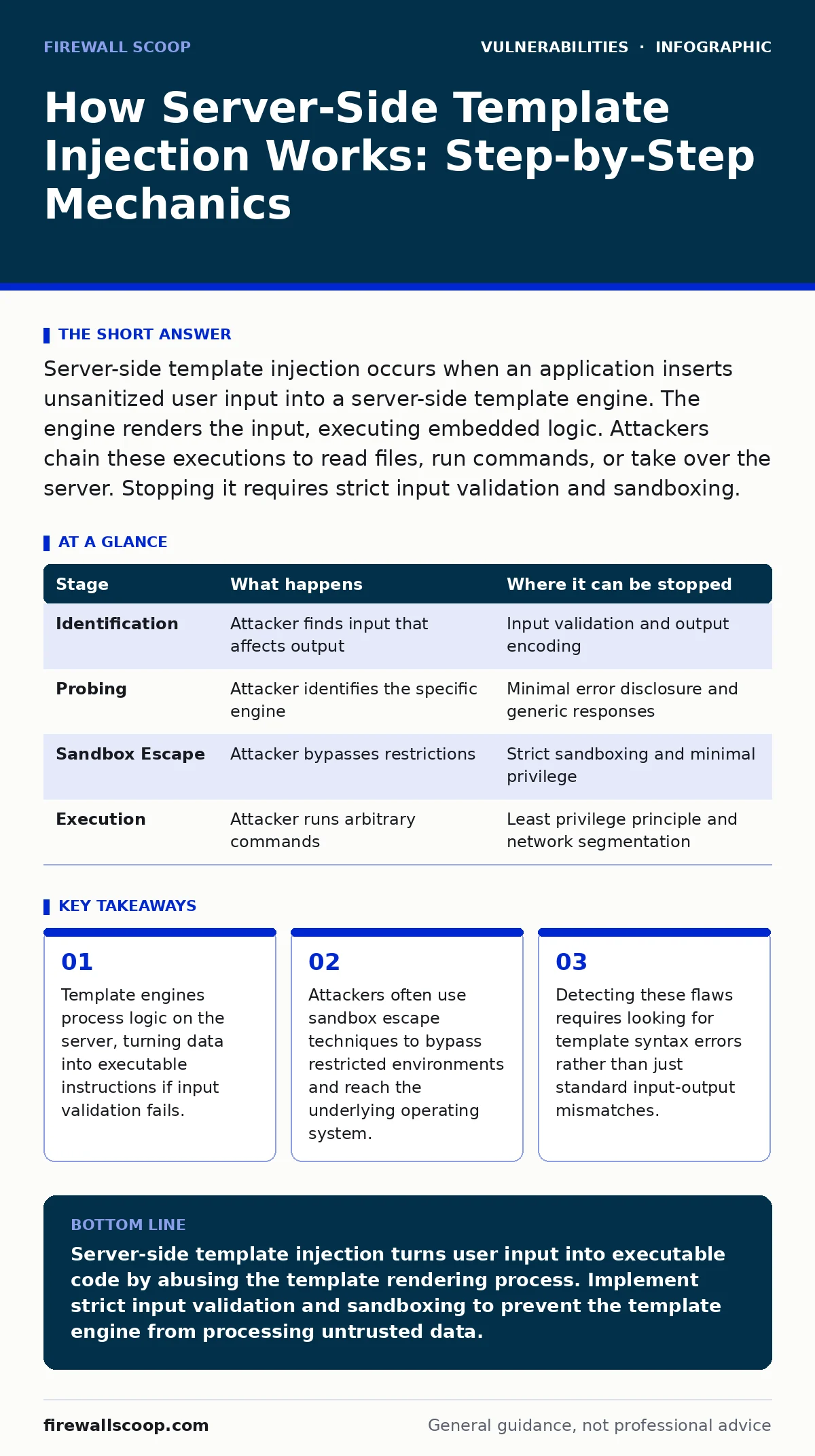
Server-side template injection occurs when an application inserts unsanitized user input into a server-side template engine. The engine renders the input, executing embedded logic. Attackers chain these executions to read files, run commands, or take over the server. Stopping it requires strict input validation and sandboxing.
The Mechanism Behind Template Processing
Template engines allow developers to separate logic from presentation. They take dynamic data and inject it into static HTML or text structures. This separation speeds up development and keeps code organized. The engine parses the template, identifies variables and control structures, and renders the final output.
The vulnerability arises when this rendering process accepts user-controlled input. If the application does not distinguish between static content and executable template syntax, the engine processes the input as code. This shifts the context from data to execution. The server runs the injected logic with the same permissions as the web application.
Stage 1: Identifying the Vulnerable Input Vector
The attacker begins by locating an input field that influences the server’s output. Common vectors include search bars, comment sections, or URL parameters. The goal is to find where the application reflects user input back to the server for processing.
The attacker tests this input with simple template syntax. They might submit a basic mathematical expression or a variable reference. If the server returns the result of the calculation or the value of the variable, the input is likely processed by a template engine. This confirms the presence of a potential injection point.
Stage 2: Probing the Template Engine
Once a vulnerable input is found, the attacker identifies which template engine is in use. Different engines use different syntax and have different security models. Common engines include Jinja2 for Python, Twig for PHP, and Freemarker for Java.
The attacker sends specific payloads designed to trigger errors or unique behaviors in these engines. For instance, some engines expose specific functions or classes that can be referenced. By observing the error messages or output, the attacker maps the capabilities of the target environment. This step is critical because the subsequent exploits depend entirely on the engine’s features.
Stage 3: Escaping the Sandbox
Many modern template engines run in a sandboxed environment. This sandbox restricts access to sensitive functions and system commands. The attacker must bypass these restrictions to gain meaningful control. This process is known as sandbox escape.
The attacker looks for ways to access the base classes or modules that the sandbox cannot fully isolate. They might chain method calls to traverse the object hierarchy. By reaching a class that allows file operations or command execution, they break out of the restricted context. This step often requires deep knowledge of the programming language’s internals.
Stage 4: Arbitrary Code Execution
With sandbox escape achieved, the attacker can execute arbitrary commands on the server. They inject code that reads sensitive files, lists directory contents, or executes system commands. This gives them the same access rights as the web server process.
The attacker might use this access to steal credentials, deface the website, or pivot to other internal systems. The damage depends on the server’s configuration and the sensitivity of the data it holds. This stage transforms a minor injection flaw into a full system compromise.
Where the Chain Breaks
The injection chain can be interrupted at multiple points. The most effective stop is at the input stage. If the application validates and sanitizes all user input, the template engine never receives executable syntax. Proper encoding ensures that special characters are treated as literal text.
Another interruption point is the sandbox configuration. If the sandbox is strictly enforced and no escape routes exist, the attacker remains trapped in a limited context. Regular updates to the template engine also close known escape techniques. This relates directly to the importance of patch management in maintaining secure software dependencies.
| Stage | What happens | Where it can be stopped |
|---|---|---|
| Identification | Attacker finds input that affects output | Input validation and output encoding |
| Probing | Attacker identifies the specific engine | Minimal error disclosure and generic responses |
| Sandbox Escape | Attacker bypasses restrictions | Strict sandboxing and minimal privilege |
| Execution | Attacker runs arbitrary commands | Least privilege principle and network segmentation |
The Hidden Cost of Debugging
Developers often leave debug modes enabled in production environments to troubleshoot issues. These modes provide detailed error messages that reveal the template engine’s version and configuration. This information is gold for attackers trying to identify the right exploitation techniques.
Disabling debug modes and ensuring that error messages do not leak internal details is a simple but often overlooked step. This practice reduces the attack surface significantly. It forces attackers to guess rather than know, increasing the effort required for a successful breach. This principle also applies to mitigating vulnerabilities in AI model serving frameworks where detailed error logs can expose model internals.
Beyond the Web Server
Server-side template injection is not limited to traditional web applications. Any system that renders templates with user input is at risk. This includes email generation systems, report generators, and configuration management tools. The underlying mechanism remains the same: untrusted input becomes executable code.
Understanding this risk helps security professionals look beyond the web layer. They can identify similar flaws in backend processes that handle data transformation. This holistic view is necessary for modern security architectures. It also highlights the value of software composition analysis to track dependencies that might introduce templating libraries with known weaknesses.
Mitigation Strategies for Developers
Developers must treat all user input as untrusted. Never concatenate user input directly into template strings. Use parameterized templates or explicit variable passing where the engine knows exactly what is data and what is logic.
Implement allowlists for template variables. Only predefined variables should be accessible to the template engine. This prevents attackers from referencing arbitrary objects or functions. Additionally, run the template engine in a restricted environment with minimal permissions. This limits the damage if an injection does occur.
The Reality of Detection
Detecting server-side template injection in production is challenging. Unlike buffer overflows that often crash the system, SSTI might execute silently. The attacker can read files or run commands without generating obvious errors.
Security teams should monitor for unusual template syntax in logs. Automated scanning tools can help, but they often miss complex sandbox escape chains. Manual testing by security experts who understand template engines is the most reliable method. This expertise is similar to what is needed to identify container escape vulnerabilities where the boundary between application and infrastructure is breached.
The Role of Language Internals
The exploitability of SSTI depends heavily on the programming language’s object model. Languages with rich object hierarchies provide more paths for sandbox escape. Python, for example, has a powerful __class__ attribute that allows traversal to base classes.
Attackers use these attributes to reach dangerous functions like exec or system. Understanding these language-specific quirks is essential for both attackers and defenders. Defenders must know which classes and attributes are dangerous and ensure they are inaccessible from the template context. This depth of knowledge separates basic security checks from robust defense strategies.
Key takeaways
- Template engines process logic on the server, turning data into executable instructions if input validation fails.
- Attackers often use sandbox escape techniques to bypass restricted environments and reach the underlying operating system.
- Detecting these flaws requires looking for template syntax errors rather than just standard input-output mismatches.
Server-side template injection turns user input into executable code by abusing the template rendering process. Implement strict input validation and sandboxing to prevent the template engine from processing untrusted data.
Frequently asked questions
Can server-side template injection be exploited through cookies?
Yes, if the server uses cookie values in template rendering without sanitization. Any user-controlled input that reaches the template engine is a potential vector.
Does using a modern framework prevent this vulnerability?
Modern frameworks often have safer default configurations, but they are not immune. Misconfiguration or direct use of raw template engines can still introduce SSTI risks.
How does SSTI differ from cross-site scripting?
XSS executes code in the user’s browser, while SSTI executes code on the server. SSTI typically has higher severity because it can compromise the entire server infrastructure.
Can static code analysis detect template injection?
Static analysis can identify potential injection points, but it may struggle with complex sandbox escape chains. Dynamic testing and manual review are often necessary for thorough coverage.
How this guide was produced: written by the Firewall Scoop editorial team with AI assistance, checked against the public references listed below, and reviewed when the facts change. See our editorial policy or report an error.