Prevent AI Model Serving Framework Vulnerabilities
Most AI serving flaws stem from unchecked input parsing and container misconfigurations, not the model weights themselves.

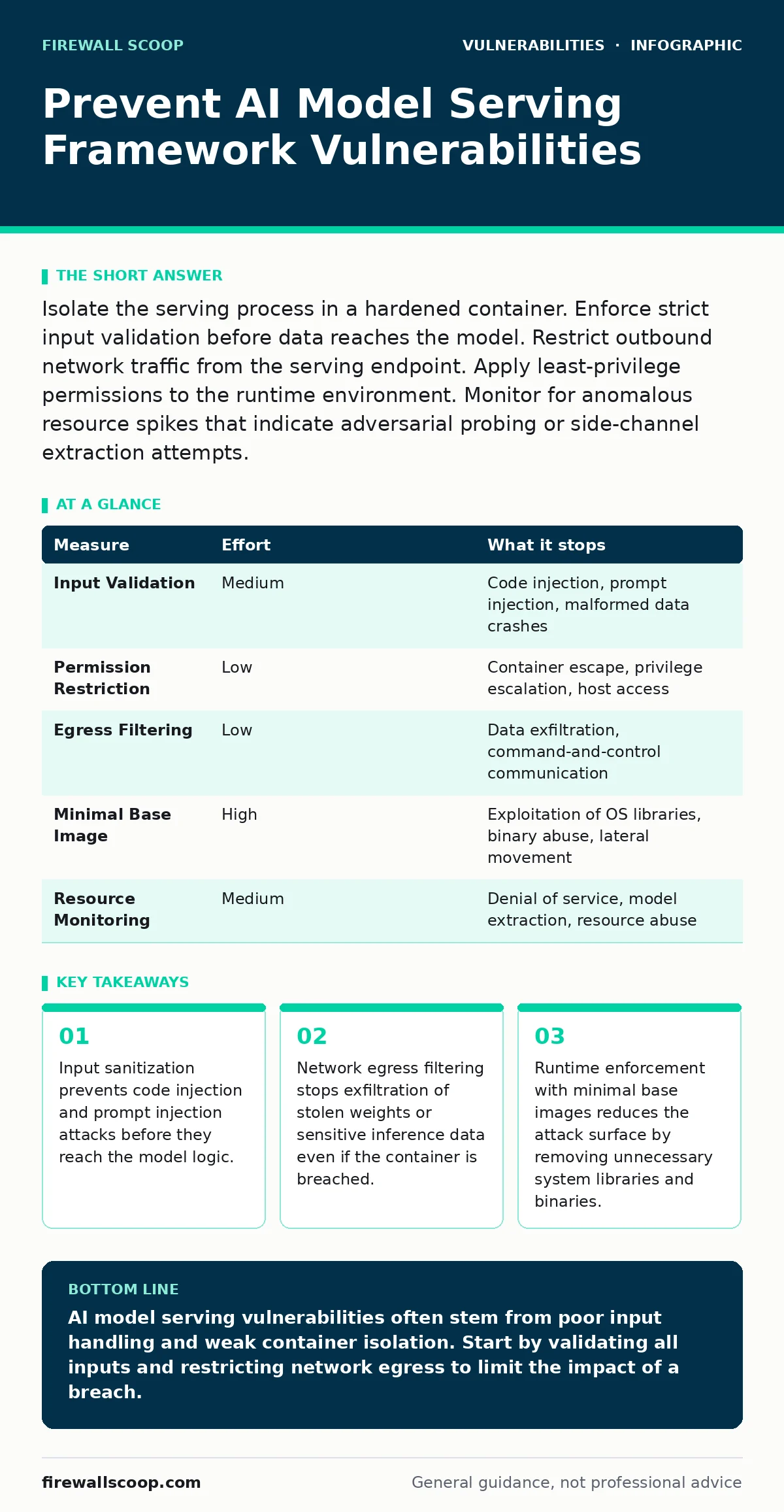
Isolate the serving process in a hardened container. Enforce strict input validation before data reaches the model. Restrict outbound network traffic from the serving endpoint. Apply least-privilege permissions to the runtime environment. Monitor for anomalous resource spikes that indicate adversarial probing or side-channel extraction attempts.
Validate Input Before Model Execution
Input validation is the first line of defense for AI model serving frameworks. Adversaries craft malicious prompts or structured data to exploit parsing logic or trigger unexpected model behavior. You must sanitize all incoming requests at the edge before they reach the inference engine. This process strips control characters, limits payload size, and rejects malformed JSON or binary structures. Without this step, the framework processes garbage data that can cause crashes or leak internal state.
Imagine a text-generation model receiving a prompt containing hidden instructions to output system configuration files. If the framework passes this directly to the model, the model may comply. Input validation intercepts such patterns. It does not stop all adversarial techniques, but it blocks the most common injection vectors. You should implement allowlists for expected data formats rather than blocklists, which attackers easily bypass.
Restrict Container Runtime Permissions
AI models often run inside containers for portability. Containers share the host kernel, creating a risk if the container is compromised. You must run the serving process with the least privileges possible. Drop all Linux capabilities except those strictly required for network binding. Use a non-root user for the application process. Set the filesystem to read-only where possible. This limits what an attacker can do if they exploit a vulnerability in the serving framework.
Many teams assume container isolation is sufficient. It is not. A container escape vulnerability allows an attacker to break out of the container and access the host system. By restricting permissions, you ensure that even if an escape occurs, the attacker has limited tools. You cannot prevent all container escapes, but you can make them significantly harder to exploit. Review your container security profile regularly.
Enforce Network Egress Controls
Serving frameworks need network access to fetch models or log metrics. They should not need access to the entire corporate network or the public internet. You must implement strict egress filtering. Allow connections only to specific trusted endpoints, such as a model registry or a monitoring server. Block all other outbound traffic. This prevents data exfiltration if the serving process is compromised.
Suppose an attacker gains control of the serving endpoint. They might attempt to steal the model weights or inference data. If outbound traffic is unrestricted, they can send this data to an external server. Egress controls stop this transfer. The attacker remains trapped within the isolated network segment. This measure does not prevent the initial compromise, but it limits the damage. You should monitor egress traffic for anomalies, such as large data transfers to unknown destinations.
Minimize the Base Image Surface
The base image of your container includes operating system libraries and utilities. Each package is a potential vulnerability. You must use minimal base images that contain only the dependencies required to run the model serving framework. Remove unnecessary shells, package managers, and debugging tools. This reduces the number of exploitable binaries available to an attacker.
Many teams use full OS images for convenience. This introduces hundreds of unnecessary packages. Each package increases the attack surface. A minimal image might contain only the runtime library and the model server binary. This approach aligns with risk-based vulnerability management principles. You must balance security with operational needs. Some debugging tools are useful for development, but they should not be present in production images. Scan your images for known vulnerabilities regularly.
Monitor for Anomalous Resource Usage
AI models are computationally intensive. Adversaries may probe the model to extract information or cause denial of service. You must monitor resource usage, including CPU, memory, and GPU utilization. Look for patterns that deviate from normal inference requests. Sudden spikes in compute usage or unusual request frequencies may indicate an attack. Alerting on these anomalies allows you to respond before significant damage occurs.
Imagine a series of requests designed to trigger expensive computations in the model. This could degrade performance for legitimate users. Monitoring tools detect these spikes. You can then rate-limit or block the source. This measure does not stop the attack at the source, but it mitigates the impact. You should establish baselines for normal usage patterns. Deviations from these baselines require investigation. Log all inference requests for forensic analysis.
What Does Not Work Alone
Relying solely on external security tools is insufficient for AI model serving. A web application firewall tuning effort can block known attack signatures, but it cannot detect novel adversarial prompts or logic flaws. The model itself may be vulnerable to techniques that bypass signature-based detection. You must combine network-layer defenses with application-layer validation.
Similarly, using a commercial threat intelligence feed does not protect against zero-day vulnerabilities in the serving framework. Attackers discover new exploit paths constantly. You must assume that your external defenses will fail. Implement internal controls that limit the blast radius of a compromise. This layered approach ensures that if one defense fails, others remain in place.
| Measure | Effort | What it stops |
|---|---|---|
| Input Validation | Medium | Code injection, prompt injection, malformed data crashes |
| Permission Restriction | Low | Container escape, privilege escalation, host access |
| Egress Filtering | Low | Data exfiltration, command-and-control communication |
| Minimal Base Image | High | Exploitation of OS libraries, binary abuse, lateral movement |
| Resource Monitoring | Medium | Denial of service, model extraction, resource abuse |
Implement Continuous Security Reviews
Security is not a one-time task. You must continuously review your AI serving infrastructure. Update dependencies regularly to patch known vulnerabilities. Refer to security bulletins for critical updates to your serving framework and underlying libraries. Test new configurations in a staging environment before deploying to production. Automate security checks in your deployment pipeline.
This process ensures that new vulnerabilities are addressed quickly. It also prevents configuration drift over time. You should involve security teams in the model development lifecycle. They can identify risks early, before the model is deployed. This collaboration reduces the effort required to fix issues later. Regular reviews keep your defenses aligned with current threats.
Checklist for Immediate Action
- Audit input validation logic in your serving framework. Ensure all endpoints sanitize and limit request payloads. Reject malformed data before it reaches the model.
- Review container runtime permissions. Drop unnecessary capabilities and run the process as a non-root user. Verify that the filesystem is read-only where possible.
- Configure network egress filtering. Block all outbound traffic except to trusted endpoints. Monitor for anomalous data transfers that indicate exfiltration attempts.
Key takeaways
- Input sanitization prevents code injection and prompt injection attacks before they reach the model logic.
- Network egress filtering stops exfiltration of stolen weights or sensitive inference data even if the container is breached.
- Runtime enforcement with minimal base images reduces the attack surface by removing unnecessary system libraries and binaries.
AI model serving vulnerabilities often stem from poor input handling and weak container isolation. Start by validating all inputs and restricting network egress to limit the impact of a breach.
Frequently asked questions
How do I detect prompt injection attacks in real-time?
Implement strict input validation and monitor for anomalous request patterns. Use allowlists for expected data formats and alert on deviations from normal usage baselines.
Are container escape vulnerabilities common in AI serving frameworks?
Container escapes are rare but high-impact. They occur when the host kernel is accessible or privileges are misconfigured. Restricting permissions and using minimal images reduces this risk significantly.
Does using a National Vulnerability Database help with AI models?
Yes, it helps identify known vulnerabilities in the serving framework and dependencies. It does not cover custom model logic or adversarial prompt techniques specific to your application.
Should I use buffer overflow vulnerabilities checks for AI code?
If your serving framework uses compiled languages like C or C++, yes. Python-based frameworks are less susceptible, but underlying libraries may still have memory safety issues.
How this guide was produced: written by the Firewall Scoop editorial team with AI assistance, checked against the public references listed below, and reviewed when the facts change. See our editorial policy or report an error.