CI/CD Pipeline Vulnerabilities: How Attackers Move From Code to Production
Attackers compromise CI/CD pipelines by injecting malicious code into build artifacts, bypassing application security controls entirely and gaining persistent access to production environments.

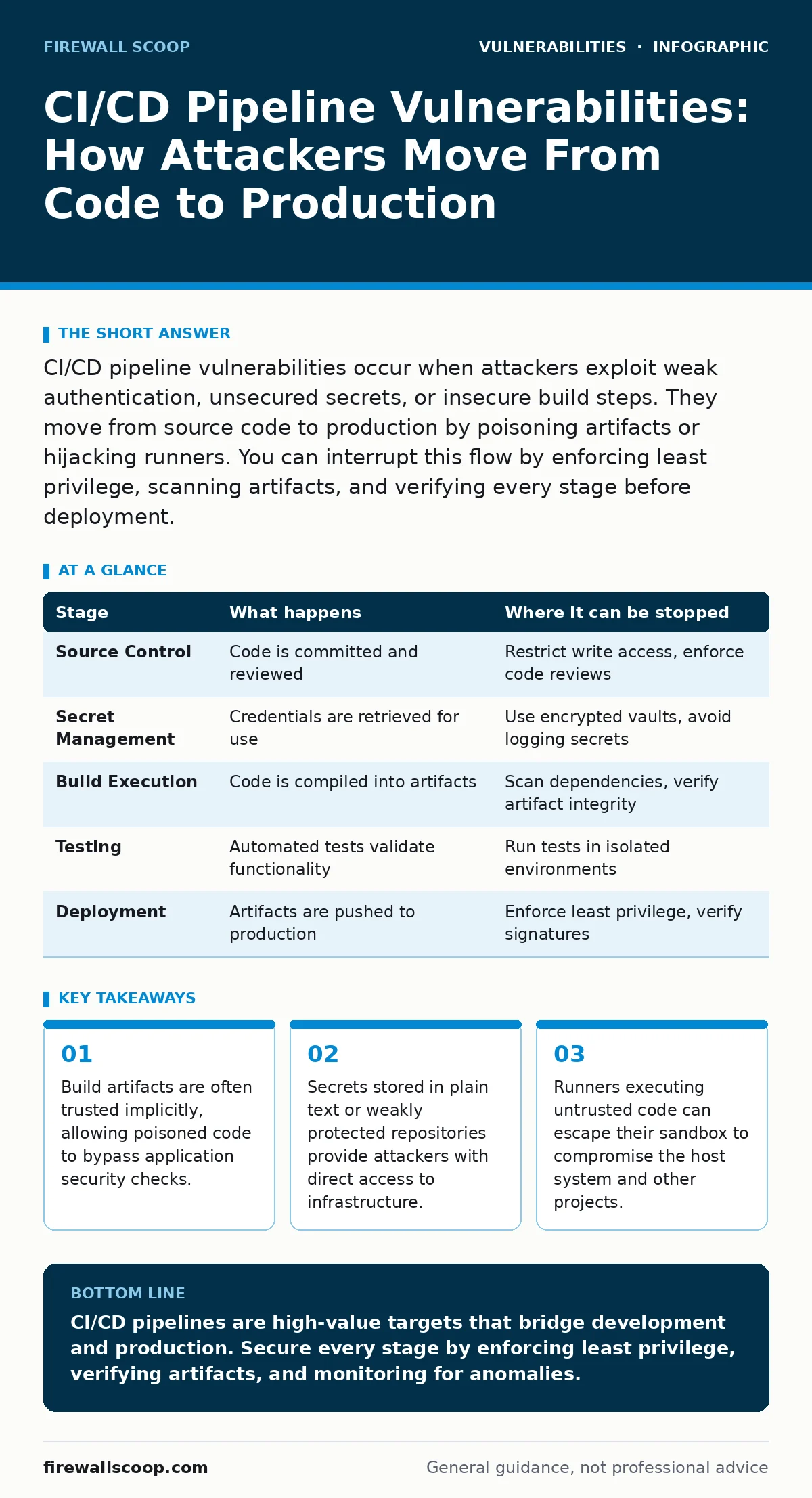
CI/CD pipeline vulnerabilities occur when attackers exploit weak authentication, unsecured secrets, or insecure build steps. They move from source code to production by poisoning artifacts or hijacking runners. You can interrupt this flow by enforcing least privilege, scanning artifacts, and verifying every stage before deployment.
Source Code and Repository Access
The pipeline begins when you push code to a version control system. Attackers target this stage by compromising developer accounts or inserting malicious dependencies. If an attacker gains write access to your repository, they can modify the build configuration files directly. This allows them to inject commands that execute during the build process. You must treat the repository as a trusted zone. Any unauthorized change here propagates through every subsequent stage.
Imagine a developer accidentally commits a script that downloads a tool from an unverified source. The pipeline executes this script without question. The attacker now has a foothold inside your build environment. This mirrors how buffer overflow vulnerabilities allow execution of arbitrary code, but here the overflow happens in trust rather than memory. You must verify every commit and restrict write permissions to essential personnel only.
Secret Management and Credential Handling
Build pipelines require credentials to access databases, cloud services, and deployment targets. These secrets are often stored in environment variables or configuration files. If these secrets are logged, committed, or exposed through error messages, attackers can harvest them. Once an attacker obtains these credentials, they can move laterally within your infrastructure. This is similar to how Ivanti VPN vulnerabilities allow unauthorized network access once initial credentials are compromised.
You must never store secrets in plain text within your repository. Use dedicated secret management solutions that encrypt data at rest and in transit. Rotate secrets frequently to limit the window of exposure. Ensure that logs do not capture sensitive values. Even encrypted logs can be decrypted if the attacker gains access to the decryption keys. Treat every credential as a high-value target that requires constant protection.
Build Execution and Artifact Creation
The build stage compiles your code and creates artifacts ready for deployment. Attackers exploit this stage by injecting malicious code into the build process. They may modify dependencies or introduce backdoors that are not visible in the source code. The resulting artifact contains the malicious payload. If you trust the artifact because it came from your pipeline, you bypass traditional security checks. This is akin to Java deserialization vulnerabilities where untrusted data leads to remote code execution.
You must scan dependencies for known vulnerabilities before building. Verify the integrity of all inputs. Use signed artifacts to ensure that the build output matches the expected source code. Any deviation indicates tampering. Do not assume that because the code passed static analysis, the build is safe. The build environment itself can be compromised. Isolate build runners to prevent lateral movement.
| Stage | What happens | Where it can be stopped |
|---|---|---|
| Source Control | Code is committed and reviewed | Restrict write access, enforce code reviews |
| Secret Management | Credentials are retrieved for use | Use encrypted vaults, avoid logging secrets |
| Build Execution | Code is compiled into artifacts | Scan dependencies, verify artifact integrity |
| Testing | Automated tests validate functionality | Run tests in isolated environments |
| Deployment | Artifacts are pushed to production | Enforce least privilege, verify signatures |
Testing and Quality Assurance
Automated tests run against the built artifacts to ensure functionality and security. Attackers may disable or bypass these tests to hide malicious changes. They might also inject code that passes functional tests but fails security checks. If your testing framework is not isolated, a compromised test runner can affect other projects. This resembles heap overflow vulnerabilities where memory corruption leads to unexpected behavior and potential control.
You must enforce mandatory test execution. Do not allow developers to skip tests for urgent fixes. Use isolated environments for testing to prevent cross-contamination. Monitor test results for anomalies. A sudden drop in test coverage or unexpected pass rates can indicate tampering. Treat test results as security signals, not just quality metrics. Integrate security scans into the test suite to catch issues early.
Deployment and Production Release
The final stage deploys the verified artifact to the production environment. Attackers exploit weak deployment controls to push malicious code to live systems. They may compromise the deployment pipeline itself to alter the final configuration. If deployment credentials are shared or poorly managed, an attacker can impersonate the deployment service. This is similar to directory listing exposure where sensitive files are accessible due to misconfiguration.
You must enforce least privilege for deployment accounts. Use just-in-time access that expires after the deployment completes. Verify the signature of the artifact before deploying. Ensure that rollback procedures are tested and ready. Do not trust the deployment pipeline implicitly. Monitor production for unexpected behavior after deployment. Rapid detection and response are critical if a compromise occurs.
Pipeline Configuration and Orchestration
The pipeline itself is defined by configuration files that dictate the flow of stages. Attackers target these files to alter the pipeline logic. They may add hidden stages or modify existing ones to include malicious actions. If the pipeline configuration is not version-controlled or reviewed, changes can go unnoticed. This is comparable to web application firewall tuning where misconfigured rules allow malicious traffic to pass through undetected.
You must treat pipeline configuration as code. Store it in version control and enforce strict review processes. Use immutable pipeline definitions that cannot be modified at runtime. Monitor for changes to the pipeline configuration. Alert on any unauthorized modifications. Ensure that only authorized personnel can update the pipeline definition. Regular audits of the pipeline configuration can reveal hidden vulnerabilities.
Continuous Monitoring and Feedback
Security is not a one-time event but a continuous process. You must monitor the pipeline for anomalies and threats. Log all actions and access attempts. Analyze logs for signs of compromise. Integrate security feedback into the development loop. This aligns with risk-based vulnerability management where priorities are set based on actual risk rather than theoretical severity.
You must establish baseline behavior for your pipeline. Deviations from this baseline can indicate an attack. Use automated tools to detect anomalies in real-time. Respond to alerts promptly. Investigate any suspicious activity thoroughly. Document lessons learned from incidents. Update your security controls based on new threats. Continuous improvement is key to maintaining pipeline security.
Integration with Application Security
CI/CD pipelines must integrate with broader application security strategies. This includes vulnerability scanning, dependency checking, and compliance verification. Attackers exploit gaps between these tools and the pipeline. If security tools are not integrated, issues may be missed. This is similar to WordPress page builder vulnerabilities where third-party components introduce risks that are not part of the core system.
You must integrate security tools directly into the pipeline. Fail the build if critical vulnerabilities are detected. Ensure that security scans cover all dependencies and configurations. Use standardized formats for reporting vulnerabilities. Track remediation progress. Close the loop by re-scanning after fixes are applied. Security must be a gate, not an afterthought.
Key takeaways
- Build artifacts are often trusted implicitly, allowing poisoned code to bypass application security checks.
- Secrets stored in plain text or weakly protected repositories provide attackers with direct access to infrastructure.
- Runners executing untrusted code can escape their sandbox to compromise the host system and other projects.
CI/CD pipelines are high-value targets that bridge development and production. Secure every stage by enforcing least privilege, verifying artifacts, and monitoring for anomalies.
Frequently asked questions
How do attackers initially access a CI/CD pipeline?
Attackers often compromise developer accounts or exploit weak authentication mechanisms to gain access to the repository or pipeline interface.
Can a compromised build artifact bypass security tests?
Yes, if the security tests are not integrated into the build process or if the artifact is trusted implicitly without verification.
What is the role of secret management in pipeline security?
Proper secret management prevents credential leakage, which attackers can use to move laterally within the infrastructure or deploy malicious code.
How can I verify the integrity of a build artifact?
Use cryptographic signatures to ensure that the artifact has not been tampered with since it was built and verified.
How this guide was produced: written by the Firewall Scoop editorial team with AI assistance, checked against the public references listed below, and reviewed when the facts change. See our editorial policy or report an error.