What Does DevSecOps Mean: Integrating Security Into The Software Pipeline
DevSecOps shifts security left by embedding checks directly into automated pipelines, preventing breaches before code reaches production environments.
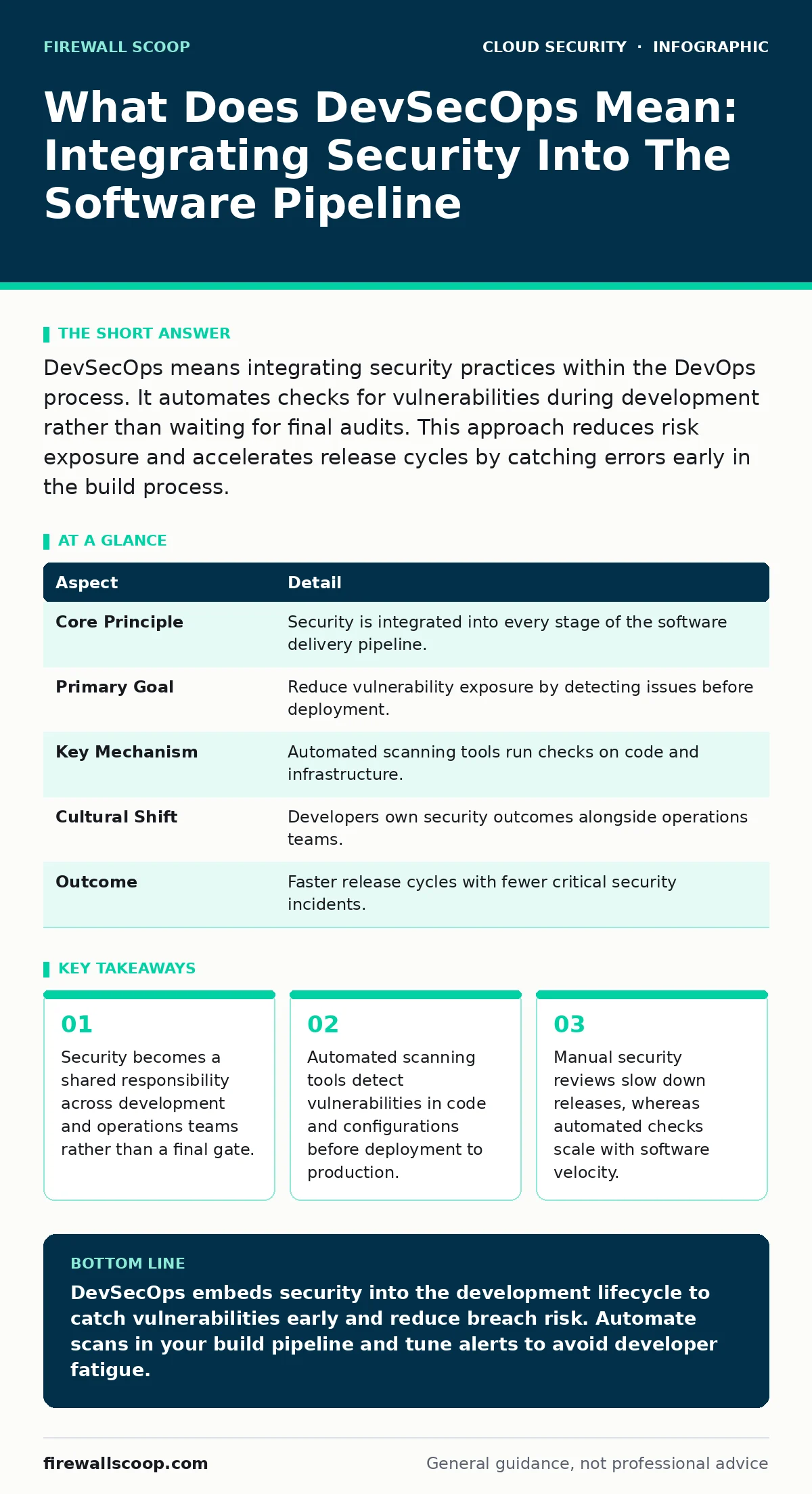
DevSecOps means integrating security practices within the DevOps process. It automates checks for vulnerabilities during development rather than waiting for final audits. This approach reduces risk exposure and accelerates release cycles by catching errors early in the build process.
What Does DevSecOps Mean
What does DevSecOps mean in the context of modern software development? It means shifting security responsibilities from a final audit phase to continuous, automated checks throughout the development lifecycle. Traditional models treat security as a separate department that reviews finished code. DevSecOps treats security as a property of the code itself, verified at every commit.
Imagine a bakery that inspects dough before baking rather than checking cakes after they burn. DevSecOps applies this logic to software. Developers write code, and automated tools immediately scan for weaknesses. This prevents flawed applications from reaching users. The goal is not to slow development but to make security invisible and continuous.
| Aspect | Detail |
|---|---|
| Core Principle | Security is integrated into every stage of the software delivery pipeline. |
| Primary Goal | Reduce vulnerability exposure by detecting issues before deployment. |
| Key Mechanism | Automated scanning tools run checks on code and infrastructure. |
| Cultural Shift | Developers own security outcomes alongside operations teams. |
| Outcome | Faster release cycles with fewer critical security incidents. |
How The Automation Works
The mechanism relies on continuous integration and continuous deployment pipelines. When a developer pushes code, the pipeline triggers multiple checks. Static application security testing scans source code for syntax errors and known vulnerability patterns without executing the program. Dynamic application security testing runs the application and probes it for runtime flaws.
Infrastructure as code templates also receive scrutiny. Tools analyze configuration files for missteps like open ports or weak encryption settings. These checks happen in seconds. If a check fails, the pipeline blocks the deployment. The developer receives immediate feedback. This loop ensures that security decisions are data-driven rather than opinion-based.
Who It Affects And Why
DevSecOps affects every role in the software delivery chain. Developers must understand basic security principles to write safer code. They no longer hand off risky code to a security team for review. Operations engineers must configure secure environments and manage secrets properly. Security engineers build the automated tools that enable this frictionless process.
Business leaders benefit from reduced liability and faster time to market. Customers gain trust from applications that do not contain obvious vulnerabilities. The model changes how teams communicate. Security is no longer a blocker but an enabler. This cultural shift requires training and clear documentation. Teams must agree on what constitutes a acceptable risk level.
Common Mistakes In Implementation
Many organizations claim to practice DevSecOps but only automate the final gate. They add a scanner at the end of the pipeline and call it security. This fails because fixing errors at the end is expensive and slow. Another mistake is alert fatigue. Teams configure tools to flag every minor issue. Developers ignore the noise and miss critical threats.
You must tune scanners to report only actionable findings. Suppress false positives aggressively. Focus on high-severity vulnerabilities that exploit common attack vectors. Do not try to secure every line of code equally. Prioritize assets that handle sensitive data or face external traffic. Integrating cloud workload protection can help monitor runtime behavior that static scans miss.
Hidden Costs And Trade-offs
Implementing DevSecOps introduces latency into the build process. Every scan takes time. If pipelines become too slow, developers bypass them. You must balance security depth with speed. Use lightweight checks for frequent commits and deep scans for release candidates. Another hidden cost is tool sprawl. Different tools require different configurations and maintenance.
Security teams must curate the toolset carefully. Fewer, well-integrated tools perform better than many disjointed ones. Consider how Kubernetes admission controllers enforce policies without adding manual steps. This reduces the operational burden while maintaining strict security boundaries. The trade-off is complexity in setup versus ease of use in daily operations.
See also: Cloud Metadata Service Attack Mistakes and How to Stop Them · Kubernetes Admission Controllers: Enforce Policy Before Workloads Start
What To Do Next
Start by mapping your current software delivery pipeline. Identify where security checks currently occur. If they happen only at the end, move them earlier. Integrate static analysis into the commit hook. This gives developers feedback while they write code. Next, automate configuration checks for infrastructure. Ensure that server settings meet security baselines automatically.
Educate your team on secure coding practices. Provide examples of common vulnerabilities and how to avoid them. Measure the time it takes to fix issues. If remediation takes too long, simplify the rules. Review your federated identity setup to ensure developers have appropriate access to security tools. Align security metrics with business goals to gain executive support.
Integrating With Broader Security
DevSecOps does not exist in isolation. It connects to other security domains. For instance, cloud firewalls control traffic to deployed applications. DevSecOps ensures the applications themselves are secure before they sit behind those firewalls. Similarly, zero trust network access assumes no user or device is trusted. Secure code complements this by ensuring the services accessed are robust.
Be aware of insecure container images used in deployments. DevSecOps pipelines should scan container layers for vulnerabilities before they are pulled into production. Also, monitor for orphaned cloud resources that may leak data if not managed properly. Integrating these controls creates a defense-in-depth strategy. Security becomes a continuous, layered process rather than a single checkpoint.
Key takeaways
- Security becomes a shared responsibility across development and operations teams rather than a final gate.
- Automated scanning tools detect vulnerabilities in code and configurations before deployment to production.
- Manual security reviews slow down releases, whereas automated checks scale with software velocity.
DevSecOps embeds security into the development lifecycle to catch vulnerabilities early and reduce breach risk. Automate scans in your build pipeline and tune alerts to avoid developer fatigue.
Frequently asked questions
Is DevSecOps just a new name for DevOps?
No, DevOps focuses on speed and collaboration between development and operations. DevSecOps explicitly integrates security automation and responsibility into that workflow.
Do I need specialized tools for DevSecOps?
You need tools that integrate into your existing pipeline. Many standard static and dynamic analysis tools offer APIs for this integration.
Can small teams implement DevSecOps?
Yes, small teams can start with basic static analysis and automated configuration checks. The scale of tools changes, but the principles remain the same.
How this guide was produced: written by the Firewall Scoop editorial team with AI assistance, checked against the public references listed below, and reviewed when the facts change. See our editorial policy or report an error.