How Heap Overflow Vulnerabilities Work: Step-by-Step Exploitation Mechanics
Heap overflows corrupt program control by poisoning adjacent metadata rather than overwriting the instruction pointer directly, creating a silent failure mode that standard stack protections ignore entirely.

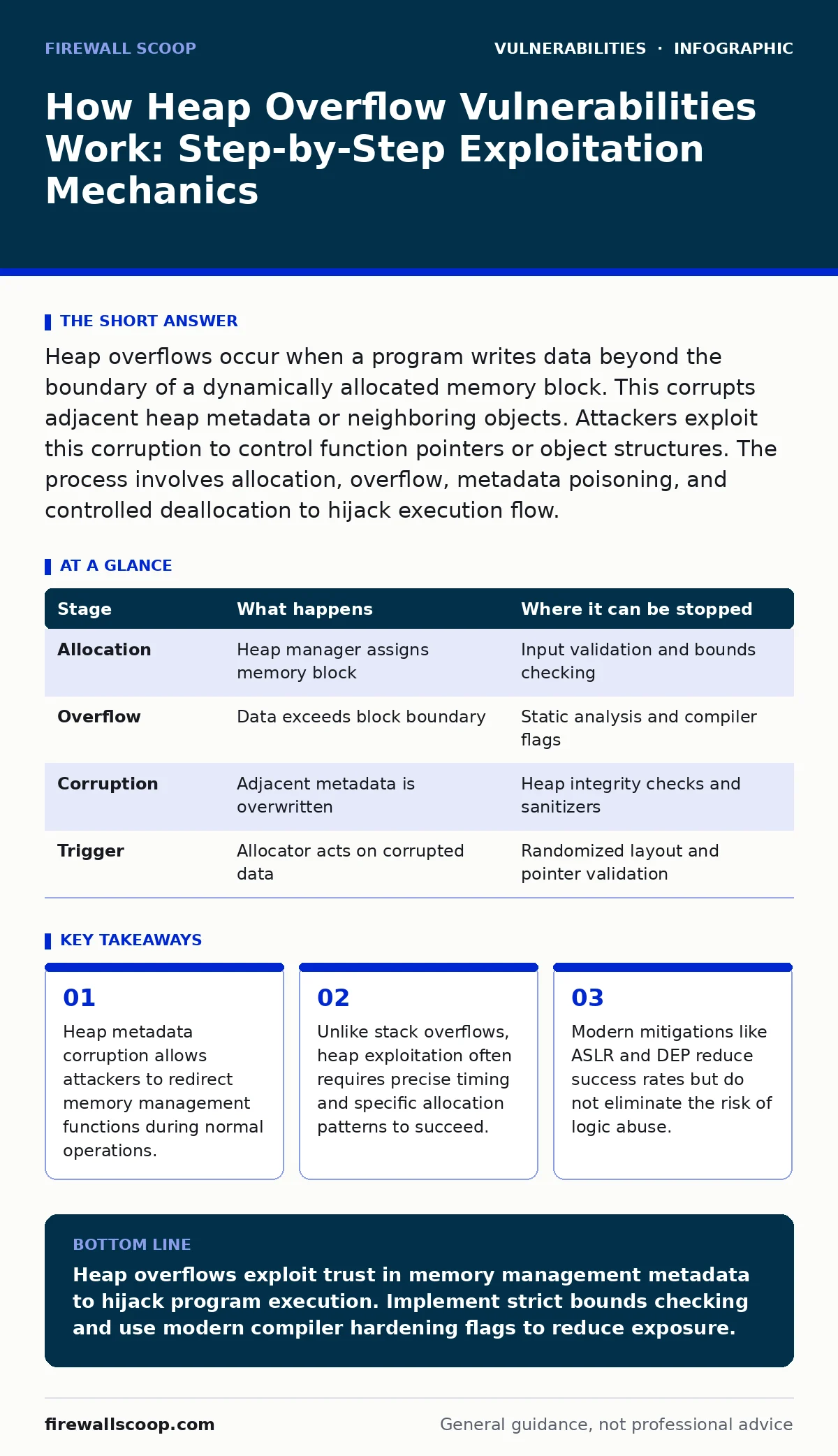
Heap overflows occur when a program writes data beyond the boundary of a dynamically allocated memory block. This corrupts adjacent heap metadata or neighboring objects. Attackers exploit this corruption to control function pointers or object structures. The process involves allocation, overflow, metadata poisoning, and controlled deallocation to hijack execution flow.
Understanding the Heap Memory Model
The heap is a region of memory used for dynamic allocation. When a program requests memory at runtime, the operating system grants a block from this pool. Unlike the stack, which follows a strict last-in-first-out order, the heap is managed by a complex allocator. This allocator keeps track of free and used blocks using metadata headers. These headers store size and status information. If a program writes past the end of its allocated block, it overwrites these headers or adjacent data. This is the root of the vulnerability.
Stage 1: Initial Memory Allocation
The process begins when the application requests memory. The heap allocator finds a suitable free block and marks it as used. It places a header before the block containing its size and status flags. The application then writes data into this block. The allocator assumes the application will respect the boundaries defined in the header. It does not check every write operation. This trust is a fundamental design choice for performance. The allocator records the block as occupied and returns a pointer to the start of the data area. The program now controls this memory region.
Stage 2: The Boundary Violation
The attacker or flawed code writes more data than the allocated block can hold. This extra data spills into adjacent memory. In a well-organized heap, this adjacent memory is often the metadata header of the next block or a neighboring allocated chunk. The overflow does not immediately crash the program. It silently alters the size or status fields of the neighbor. This corruption is invisible to the application logic. The program continues running, unaware that its memory map is now distorted. This silent corruption is what makes heap exploits difficult to detect.
| Stage | What happens | Where it can be stopped |
|---|---|---|
| Allocation | Heap manager assigns memory block | Input validation and bounds checking |
| Overflow | Data exceeds block boundary | Static analysis and compiler flags |
| Corruption | Adjacent metadata is overwritten | Heap integrity checks and sanitizers |
| Trigger | Allocator acts on corrupted data | Randomized layout and pointer validation |
Stage 3: Metadata Poisoning Strategies
The attacker aims to control how the allocator behaves later. By overwriting the size field of a neighboring block, the attacker can trick the allocator into thinking a block is larger or smaller than it is. Suppose the attacker reduces the size of a free block. When the allocator tries to merge this block with an adjacent one, it may skip critical checks. Alternatively, the attacker might overwrite a free list pointer. This redirects the allocator to an arbitrary memory location. The goal is to create a condition where the next allocation or deallocation returns a controlled address.
Stage 4: Triggering the Allocation
The exploit requires a specific sequence of allocations and deallocations. The attacker must free blocks in a way that places their corrupted headers in the allocator's active lists. When the application requests a new block, the allocator uses the poisoned metadata. It might return a pointer to an unexpected location. It might merge blocks incorrectly. This action can overwrite function pointers stored in the heap. It can also place attacker-controlled data where the program expects legitimate object structures. The allocator becomes the vector for arbitrary memory writes.
Stage 5: Gaining Code Execution
Once the allocator returns a controlled pointer, the attacker can overwrite critical data structures. Many programs store function pointers in heap objects. These pointers determine which code runs when an object is used. By redirecting these pointers to shellcode or library functions, the attacker gains control. The program executes the attacker's code as if it were legitimate logic. This stage completes the exploitation chain. The attacker has transformed a memory error into arbitrary code execution. The process relies on the predictability of the heap layout.
Mitigation and Interruption Points
Interrupting this chain requires multiple layers of defense. The most effective method is to prevent the overflow at the source. Use safe memory management libraries that enforce bounds. Enable Address Space Layout Randomization to make heap layouts unpredictable. Use Data Execution Prevention to stop code from running in data regions. However, these measures do not stop the corruption itself. They only make exploitation harder. The only true fix is correct code that never writes out of bounds.
Comparing Heap and Stack Flaws
Heap overflows differ significantly from buffer overflow vulnerabilities. Stack overflows are often easier to exploit because the stack layout is predictable. The return address sits at a fixed offset. Heap overflows require manipulating the allocator's state. This adds complexity and randomness. Attackers must understand the specific allocator implementation. They must craft precise sequences of allocations. This makes heap exploits more sophisticated and harder to reproduce reliably.
Long-Term Security Implications
Ignoring heap safety leads to persistent risk. Memory errors often reveal deeper logic flaws. They indicate a lack of rigorous input validation. Organizations must treat heap overflows as critical defects. They should integrate automated testing tools that detect out-of-bounds writes. Code reviews must focus on memory management routines. Understanding these mechanics helps developers write safer software. It shifts the focus from reactive patching to proactive design.
Key takeaways
- Heap metadata corruption allows attackers to redirect memory management functions during normal operations.
- Unlike stack overflows, heap exploitation often requires precise timing and specific allocation patterns to succeed.
- Modern mitigations like ASLR and DEP reduce success rates but do not eliminate the risk of logic abuse.
Heap overflows exploit trust in memory management metadata to hijack program execution. Implement strict bounds checking and use modern compiler hardening flags to reduce exposure.
Frequently asked questions
Can heap overflows occur in managed languages?
Most managed languages prevent direct heap manipulation, but logic errors can still lead to memory corruption through unsafe native interfaces or bugs in the runtime itself.
Do modern operating systems prevent heap overflows?
Operating systems provide isolation and randomization, but they cannot enforce bounds for every write. The responsibility remains with the application code and its libraries.
How do attackers find heap vulnerabilities?
Attackers use fuzzing to input random data and monitor for crashes. They then analyze the crash dumps to identify which metadata fields were corrupted and how to control them.
Is heap spraying still effective?
Heap spraying is less reliable due to randomization, but it remains a technique to increase the probability of landing code in a predictable location when combined with other exploits.
How this guide was produced: written by the Firewall Scoop editorial team with AI assistance, checked against the public references listed below, and reviewed when the facts change. See our editorial policy or report an error.