Threat Hunting Best Practices: 7 Methods to Find Hidden Threats
Proactive threat hunting reveals stealthy adversaries who bypass automated defenses by analyzing behavioral anomalies rather than known signatures.

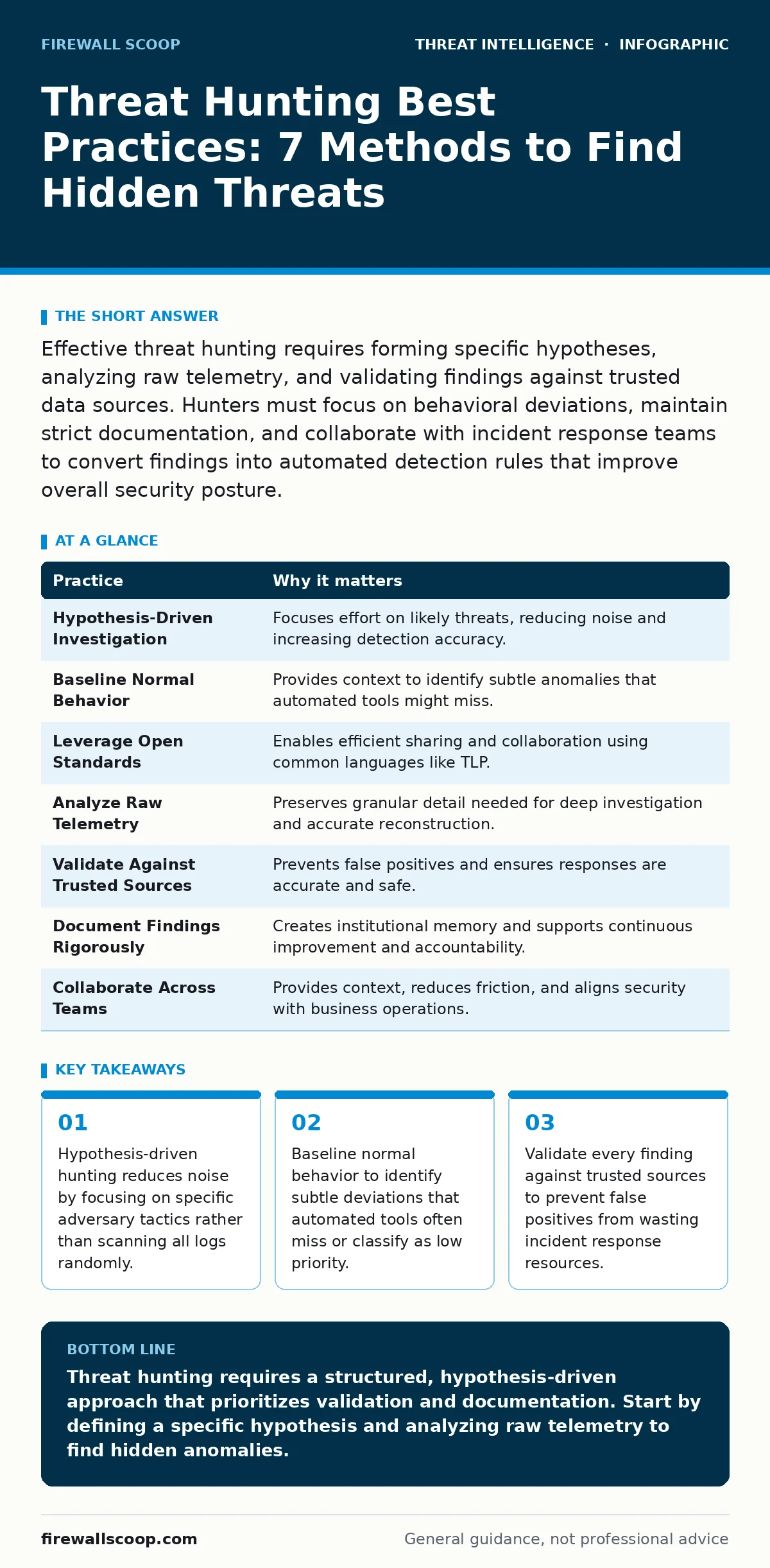
Effective threat hunting requires forming specific hypotheses, analyzing raw telemetry, and validating findings against trusted data sources. Hunters must focus on behavioral deviations, maintain strict documentation, and collaborate with incident response teams to convert findings into automated detection rules that improve overall security posture.
Hypothesis-Driven Investigation
Threat hunting is not passive monitoring. It is a proactive search for threats that evaded existing controls. You start with a specific question, not a blank screen. Forming a hypothesis focuses your effort on likely adversary behaviors. Without a hypothesis, you drown in log noise and miss subtle indicators of compromise.
Imagine an attacker who stole credentials but did not exfiltrate data immediately. Your hypothesis might be that lateral movement is occurring via legitimate administrative tools. You look for unusual login patterns from those tools. This approach finds threats before they cause damage. It turns vague suspicion into a testable theory.
Baseline Normal Behavior
You cannot detect anomalies if you do not know what normal looks like. Every organization has unique traffic patterns, user behaviors, and system processes. Establishing a baseline provides the context needed to spot deviations. Automated tools use static rules. Humans use context. You must understand your environment deeply to see what is wrong.
Suppose a server usually sends 10 megabytes of data per hour. Suddenly it sends 50 megabytes. An automated tool might ignore this if it stays under the alert threshold. A hunter sees the 5x increase and investigates. This baseline knowledge turns raw data into meaningful intelligence. It separates background noise from potential compromise.
Leverage Open Standards
Threat intelligence platforms often provide fragmented data. You need a common language to share findings internally and externally. The Traffic Light Protocol helps you classify the sensitivity of your findings. It ensures you share enough detail to help others without exposing sensitive internal infrastructure details. This standardization speeds up collaboration and reduces friction.
Imagine sharing a finding about a specific attack technique. Using standardized tags allows other teams to understand the risk immediately. It prevents miscommunication during high-pressure incidents. You align your internal processes with industry norms. This makes your intelligence usable and actionable for broader security efforts.
Analyze Raw Telemetry
Aggregated dashboards hide details. They summarize data for easy reading, but they also obscure the granular evidence you need for deep investigation. You must access raw logs and network packets. Aggregation loses context. Raw data preserves the full chain of events. You need to see the exact sequence of commands, timestamps, and metadata to reconstruct an attack.
Suppose an alert triggers for a suspicious process. The dashboard shows the process name. The raw log shows the command-line arguments, the parent process, and the user context. This depth reveals whether the process is legitimate or malicious. You cannot hunt effectively if you rely only on summarized views. You need the unfiltered truth.
Validate Against Trusted Sources
False positives waste time and erode trust in your security program. Every finding must be validated against a known good state or trusted data source. Do not assume an anomaly is malicious. Investigate it first. Check with application owners, review recent changes, and verify system integrity. Validation prevents you from chasing ghosts and ensures your responses are accurate.
Imagine finding an unusual outbound connection. Before blocking it, you check with the application team. They confirm it is a new update server. Blocking it would break business operations. Validation saves you from causing outages. It ensures your hunting efforts support business continuity while maintaining security. You act on facts, not fears.
See also: Implement Threat Intelligence Platforms: A Step-by-Step Guide · Dark Web Search Engines Explained: How Hidden Indexing Works
Document Findings Rigorously
Hunting is useless if the knowledge dies with the session. You must document every hypothesis, step, finding, and conclusion. This documentation creates an institutional memory. It allows other hunters to build on your work. It provides evidence for incident response and legal proceedings. Without documentation, you repeat mistakes and miss patterns over time.
Suppose you investigate a benign anomaly today. Next month, the same anomaly appears but with different parameters. Your notes from today help you recognize the change immediately. Documentation turns isolated events into a timeline of behavior. It supports continuous improvement and ensures accountability. You build a library of knowledge, not just a list of alerts.
Collaborate Across Teams
Threat hunting does not happen in a vacuum. You must collaborate with incident response, system administrators, and application developers. They have context you lack. They know why a server behaves strangely. They know when a change was made. Collaboration reduces friction and speeds up resolution. It turns hunting from a solo activity into a team sport.
Imagine you find a suspicious script. The developer explains it is part of a new deployment pipeline. You update your baselines to include this new behavior. This feedback loop improves your detection capabilities. It prevents future false positives. You align your security efforts with business operations. Collaboration ensures your hunting is relevant and effective.
Convert Findings to Automation
The goal of hunting is not just to find threats. It is to improve detection. When you find a new pattern, you must convert it into an automated rule. This closes the loop. It ensures that the next hunter does not have to manually look for the same thing. Automation scales your insights. It frees you to hunt for new, unknown threats.
Suppose you identify a specific sequence of API calls that indicates data staging. You write a detection rule for that sequence. Now, the system alerts you automatically. You shift from reactive hunting to proactive prevention. This continuous improvement cycle strengthens your defenses. You make your environment more resilient with every hunt.
| Practice | Why it matters |
|---|---|
| Hypothesis-Driven Investigation | Focuses effort on likely threats, reducing noise and increasing detection accuracy. |
| Baseline Normal Behavior | Provides context to identify subtle anomalies that automated tools might miss. |
| Leverage Open Standards | Enables efficient sharing and collaboration using common languages like TLP. |
| Analyze Raw Telemetry | Preserves granular detail needed for deep investigation and accurate reconstruction. |
| Validate Against Trusted Sources | Prevents false positives and ensures responses are accurate and safe. |
| Document Findings Rigorously | Creates institutional memory and supports continuous improvement and accountability. |
| Collaborate Across Teams | Provides context, reduces friction, and aligns security with business operations. |
| Convert Findings to Automation | Scales insights and improves detection capabilities for future threats. |
Key takeaways
- Hypothesis-driven hunting reduces noise by focusing on specific adversary tactics rather than scanning all logs randomly.
- Baseline normal behavior to identify subtle deviations that automated tools often miss or classify as low priority.
- Validate every finding against trusted sources to prevent false positives from wasting incident response resources.
Threat hunting requires a structured, hypothesis-driven approach that prioritizes validation and documentation. Start by defining a specific hypothesis and analyzing raw telemetry to find hidden anomalies.
Frequently asked questions
How does threat hunting differ from red teaming?
Threat hunting looks for existing threats within your environment, while red teaming simulates attacks to test defenses. Hunting is defensive and analytical. Red teaming is offensive and adversarial.
What is the role of deception technology in hunting?
Deception technology creates fake assets to attract attackers. It generates high-fidelity alerts because legitimate users never interact with these assets. Hunters use these alerts to confirm compromise quickly.
Can threat hunting detect insider threats?
Yes. Hunting focuses on behavioral anomalies, which can reveal insiders misusing access. By baselining normal user behavior, hunters can spot deviations like unusual data access or off-hours logins.
How do I handle attacker reconnaissance during hunting?
Look for scanning activity, enumeration attempts, and failed logins. Reconnaissance often precedes exploitation. Detecting it early allows you to block the attacker before they gain access.
How this guide was produced: written by the Firewall Scoop editorial team with AI assistance, checked against the public references listed below, and reviewed when the facts change. See our editorial policy or report an error.