Dark Web Search Engines Explained: How Hidden Indexing Works
Dark web search engines crawl encrypted networks using automated spiders just like traditional web crawlers do, but they index content designed to evade standard discovery.

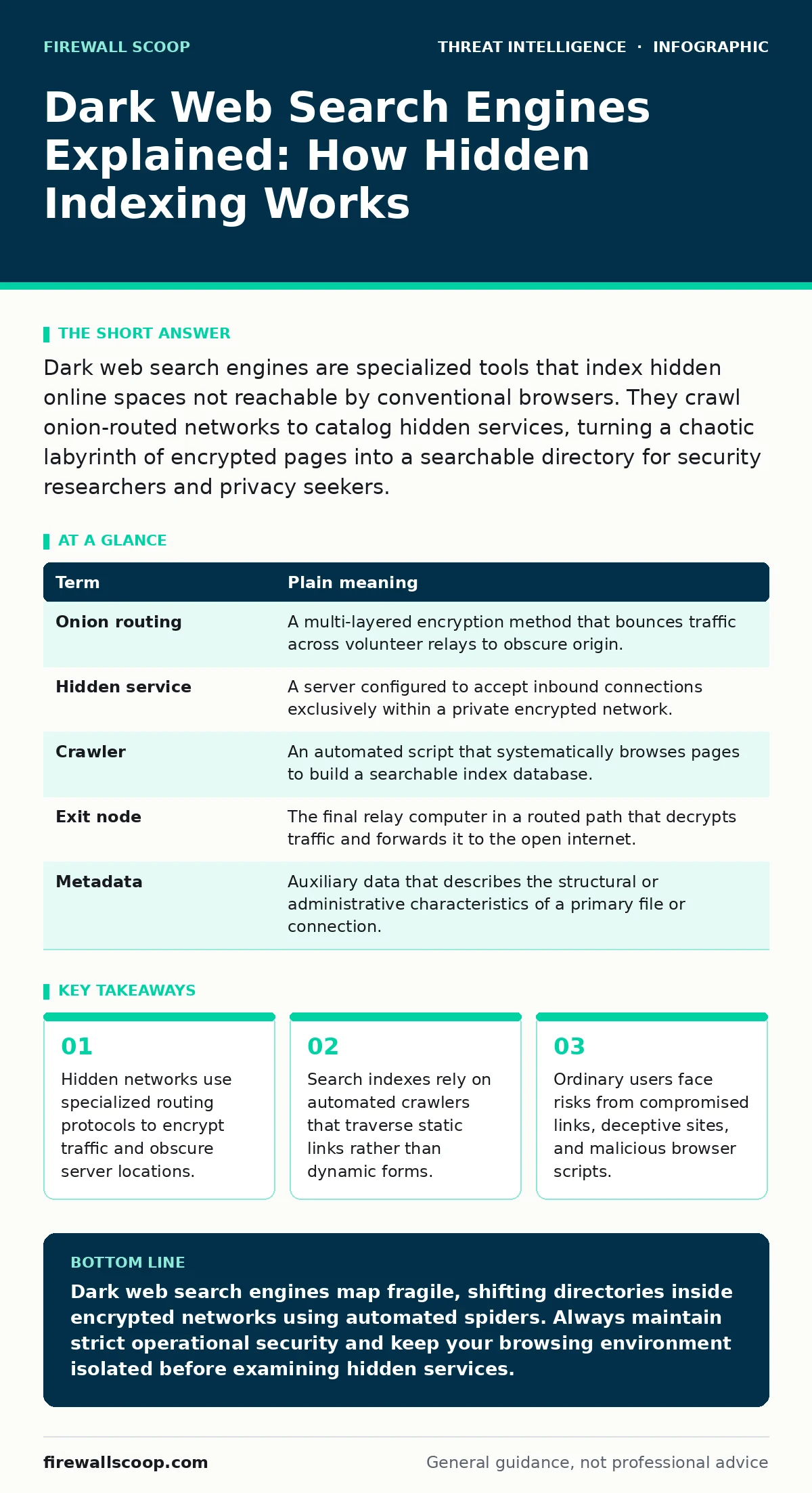
Dark web search engines are specialized tools that index hidden online spaces not reachable by conventional browsers. They crawl onion-routed networks to catalog hidden services, turning a chaotic labyrinth of encrypted pages into a searchable directory for security researchers and privacy seekers.
Understanding Dark Web Search Engines Through an Everyday Analogy
Dark web search engines operate like the basement card catalogs of a secret underground library where books constantly shift shelves. Imagine a vast subterranean archive built behind soundproof walls, lacking electricity signs or municipal maps. Traditional web search engines are like city tour buses that only drive down paved main streets visible from the sky. Dark web search tools function like persistent archivist moles who tunnel through crawl spaces, mapping doorways and organizing names without knowing who owns the rooms.
How Hidden Networks Differ From the Open Internet
Hidden networks rely on overlay routing protocols that bounce encrypted data packets across multiple independent volunteer computers globally. This multi-layered relay system strips away identifying metadata, making the physical origin and destination of a network connection extremely difficult to trace. Conventional browsers cannot resolve the unique addressing schemes used by these private networks. You need specific client software configured to decrypt the routing layers before attempting to load any hidden service page.
What Automated Crawlers Actually Discover
Automated crawlers deployed by search engine operators traverse static hyperlinks published on directory pages and bulletin boards. These spiders fetch raw HyperText Markup Language documents, extract text strings, and store keywords in centralized databases. However, most hidden content remains unindexed because site operators frequently take servers offline or restrict access behind authentication portals. Network traffic analysis often reveals the operational footprints of these hidden servers long before a search index catalogs them.
The Hidden Costs and Surrounding Risks
Using these search engines exposes your browser to unique threats that standard web browsing rarely presents. Malicious actors frequently flood search indexes with deceptive links designed to mimic legitimate communication channels or secure file repositories. Executable scripts running inside poorly configured client browsers can leak real network addresses, entirely bypassing the routing protections you rely on.
What This Means for an Ordinary User
Ordinary users gain little practical utility from querying hidden search indexes unless they actively research threat intelligence or digital privacy mechanisms. Most indexed entries lead to broken connections, expired domains, or repetitive scam operations mimicking legitimate services. The vast majority of working links point to forums discussing technical exploits or privacy tools rather than consumer goods. Attacker reconnaissance often starts in these exact spaces, making them valuable observation posts for defenders studying adversary tactics.
See also: 7 Persistence Mistakes That Keep Attackers Inside Your Network · Attacker Reconnaissance Prevention Checklist for Systems
Simple Safety Habits for Curious Explorers
Safe navigation requires strict discipline and a clear understanding of the limitations inherent in anonymous network architectures. You must never log into personal accounts, input real-world payment details, or download unknown binary files while exploring hidden services.
Try This Exploration Workflow Safely
- Install the official onion-routing client software on an isolated virtual machine rather than your primary daily workstation.
- Review public documentation regarding protocol handshakes and cryptographic verification methods before typing any addresses.
- Compare search results against known community-maintained directories to verify whether a hidden service link is authentic.
| Term | Plain meaning |
|---|---|
| Onion routing | A multi-layered encryption method that bounces traffic across volunteer relays to obscure origin. |
| Hidden service | A server configured to accept inbound connections exclusively within a private encrypted network. |
| Crawler | An automated script that systematically browses pages to build a searchable index database. |
| Exit node | The final relay computer in a routed path that decrypts traffic and forwards it to the open internet. |
| Metadata | Auxiliary data that describes the structural or administrative characteristics of a primary file or connection. |
Key takeaways
- Hidden networks use specialized routing protocols to encrypt traffic and obscure server locations.
- Search indexes rely on automated crawlers that traverse static links rather than dynamic forms.
- Ordinary users face risks from compromised links, deceptive sites, and malicious browser scripts.
Dark web search engines map fragile, shifting directories inside encrypted networks using automated spiders. Always maintain strict operational security and keep your browsing environment isolated before examining hidden services.
Frequently asked questions
Can normal web browsers open dark web search engines?
Standard web browsers cannot resolve the private top-level domains used by hidden networks without specialized proxy configurations.
Are dark web search engines illegal to use?
Using these tools is generally legal in most jurisdictions, though visiting illicit marketplaces or engaging in malicious activities remains illegal.
Why do links in dark web search engines stop working so often?
Hidden servers frequently change addresses or shut down completely to evade detection by law enforcement or malicious adversaries.
Do dark web search engines track your search queries?
Privacy-focused search engines generally avoid storing query logs, but compromised browser configurations can leak your activity to third parties.
How this guide was produced: written by the Firewall Scoop editorial team with AI assistance, checked against the public references listed below, and reviewed when the facts change. See our editorial policy or report an error.