User and Entity Behavior Analytics: 8 FAQs Answered
UEBA shifts detection from rigid rule matching to statistical anomaly scoring, revealing threats that bypass static perimeter controls entirely.

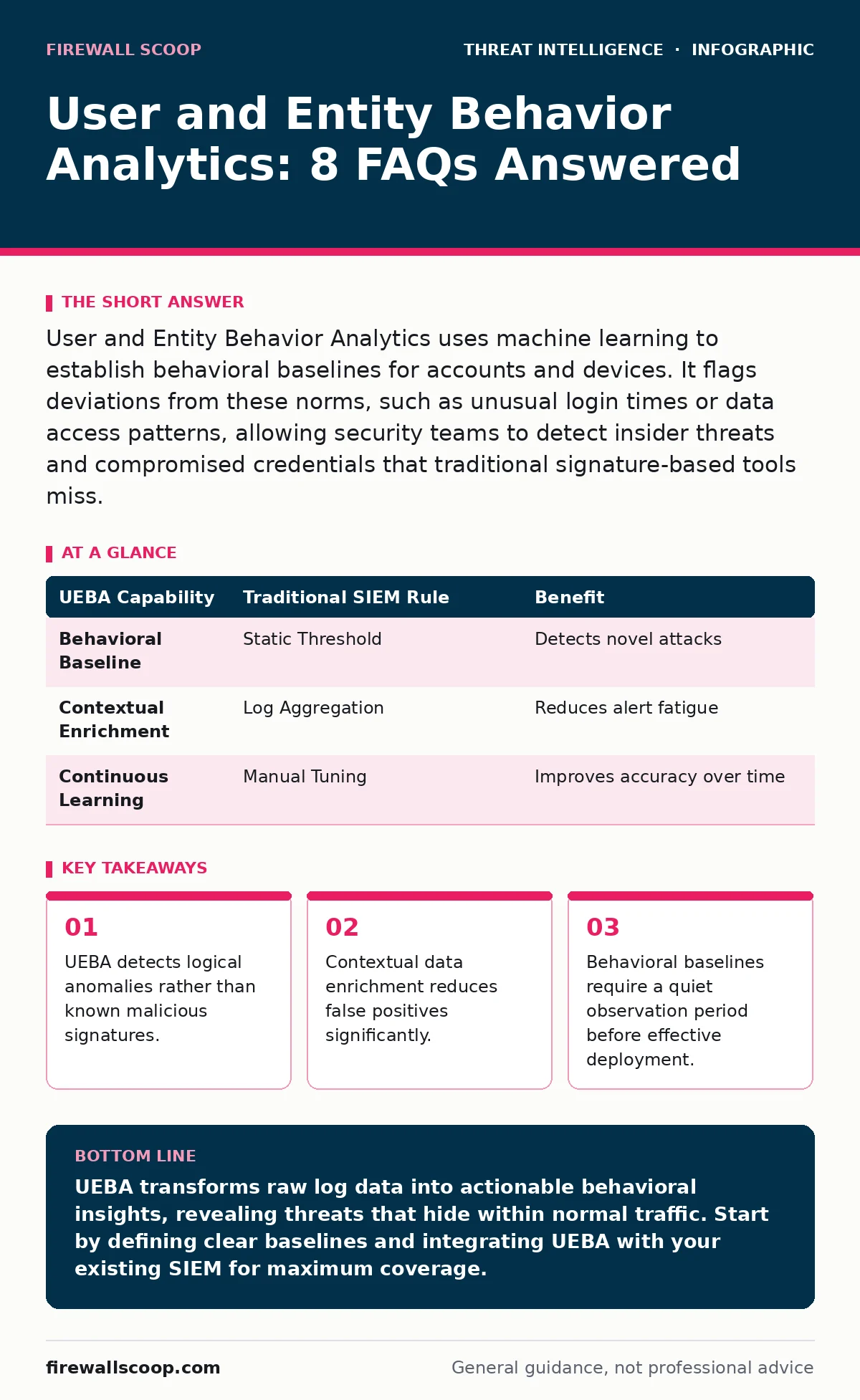
User and Entity Behavior Analytics uses machine learning to establish behavioral baselines for accounts and devices. It flags deviations from these norms, such as unusual login times or data access patterns, allowing security teams to detect insider threats and compromised credentials that traditional signature-based tools miss.
What exactly is User and Entity Behavior Analytics?
User and Entity Behavior Analytics is a security technology that uses machine learning to identify unusual activity by analyzing user and device behavior. It moves beyond static rules by establishing a baseline of normal behavior for each identity and entity within your network. When activity deviates from this baseline, the system generates an alert based on statistical probability rather than a known threat signature.
How does UEBA differ from SIEM?
A Security Information and Event Management system aggregates logs, while UEBA analyzes the context within those logs to find anomalies. SIEM relies heavily on correlation rules and known indicators of compromise, which means it often misses novel attacks. UEBA looks for the "why" behind an action, such as why a specific account is accessing sensitive data at 3 AM, rather than just recording that the access occurred.
What data sources feed into UEBA?
UEBA requires diverse telemetry to build accurate behavioral profiles, including authentication logs, endpoint activity, network flow data, and application usage records. Without sufficient data variety, the machine learning models cannot distinguish between normal variation and genuine threat behavior. You must ensure your data pipeline captures both successful and failed events to understand the full scope of user activity.
How does UEBA handle false positives?
False positives decrease over time as the system refines its baseline through continuous learning and feedback loops. Initial deployments often produce noise because the model has not yet learned the unique rhythms of your organization. Security analysts must review alerts and provide feedback, telling the system which alerts were true positives or benign anomalies, which tightens the detection logic.
Can UEBA detect insider threats?
Yes, UEBA is particularly effective at identifying insider threats because it focuses on behavioral deviations rather than external attack vectors. An insider with legitimate credentials can bypass perimeter defenses, but their actions often differ from their historical patterns. For example, a finance employee suddenly downloading large volumes of HR records triggers a behavioral alert, even though the access itself is technically authorized.
See also: Network Traffic Analysis: How to Detect Hidden Threats in Data Flow · What Is Fast Flux DNS: How Attackers Hide Malware Behind Speed
Does UEBA replace endpoint detection and response?
No, UEBA complements Endpoint Detection and Response by providing context that endpoint agents alone cannot see. EDR tools focus on file system changes and process execution on a single device, while UEBA correlates activity across multiple systems and users. Imagine an attacker moves laterally across the network; EDR sees individual infections, but UEBA sees the coordinated pattern of movement.
What is the role of identity graph in UEBA?
The identity graph maps relationships between users, devices, applications, and data to provide rich context for behavioral analysis. This graph allows the system to understand that a specific laptop belongs to a specific user who typically works from a specific location. When that user logs in from a new device in a different country, the identity graph helps the system assess the risk based on the strength of the relationship between these entities.
How do you integrate UEBA with MITRE ATT&CK Navigator?
You map UEBA detections to specific techniques within the MITRE ATT&CK framework to understand the adversary's stage in the kill chain. This integration helps you prioritize alerts based on the severity of the behavior rather than just the volume of events. For instance, detecting data exfiltration behaviors allows you to map the alert to the "Exfiltration Over C2 Channel" technique, providing immediate context for response teams.
| UEBA Capability | Traditional SIEM Rule | Benefit |
|---|---|---|
| Behavioral Baseline | Static Threshold | Detects novel attacks |
| Contextual Enrichment | Log Aggregation | Reduces alert fatigue |
| Continuous Learning | Manual Tuning | Improves accuracy over time |
What are the common pitfalls in UEBA deployment?
The most common pitfall is deploying UEBA without allowing sufficient time for the learning phase. If you activate alerts immediately, the system will flag normal business variations as threats, leading to analyst burnout. You must define clear use cases and ensure that your data quality is high before relying on automated behavioral scoring.
How does UEBA support incident response?
UEBA accelerates incident response by providing a timeline of anomalous behavior leading up to the detected event. This context helps responders understand the scope of the compromise and identify other potentially affected accounts. By highlighting the root cause of the anomaly, analysts can contain the threat faster and prevent lateral movement.
Can UEBA detect compromised credentials?
Yes, UEBA detects compromised credentials by identifying usage patterns that differ from the legitimate account holder. Even if the attacker uses the correct password, their navigation habits, typing speed, or access times may differ from the baseline. This allows you to detect account takeover attempts that bypass multi-factor authentication through session hijacking or credential stuffing.
Key takeaways
- UEBA detects logical anomalies rather than known malicious signatures.
- Contextual data enrichment reduces false positives significantly.
- Behavioral baselines require a quiet observation period before effective deployment.
UEBA transforms raw log data into actionable behavioral insights, revealing threats that hide within normal traffic. Start by defining clear baselines and integrating UEBA with your existing SIEM for maximum coverage.
Frequently asked questions
Does UEBA require on-premises installation?
Most modern UEBA solutions are cloud-native or hybrid, allowing you to ingest data from on-premises and cloud environments without complex hardware deployment.
How long does it take for UEBA to learn normal behavior?
Typically, systems require two to four weeks of passive observation to establish reliable baselines, depending on the volume and variety of data ingested.
Can UEBA work with open standards?
Yes, UEBA platforms generally accept standard log formats like CEF or LEEF, ensuring compatibility with a wide range of security tools and data sources.
Is UEBA effective against zero-day attacks?
UEBA is effective against zero-day attacks because it detects anomalous behavior rather than specific exploit signatures, allowing it to flag unknown threats based on their impact.
How this guide was produced: written by the Firewall Scoop editorial team with AI assistance, checked against the public references listed below, and reviewed when the facts change. See our editorial policy or report an error.