Credential Stuffing: How Attackers Reuse Stolen Logins to Break In
Attackers do not need to crack your password; they simply test whether your old, leaked credentials still work on other services you use.
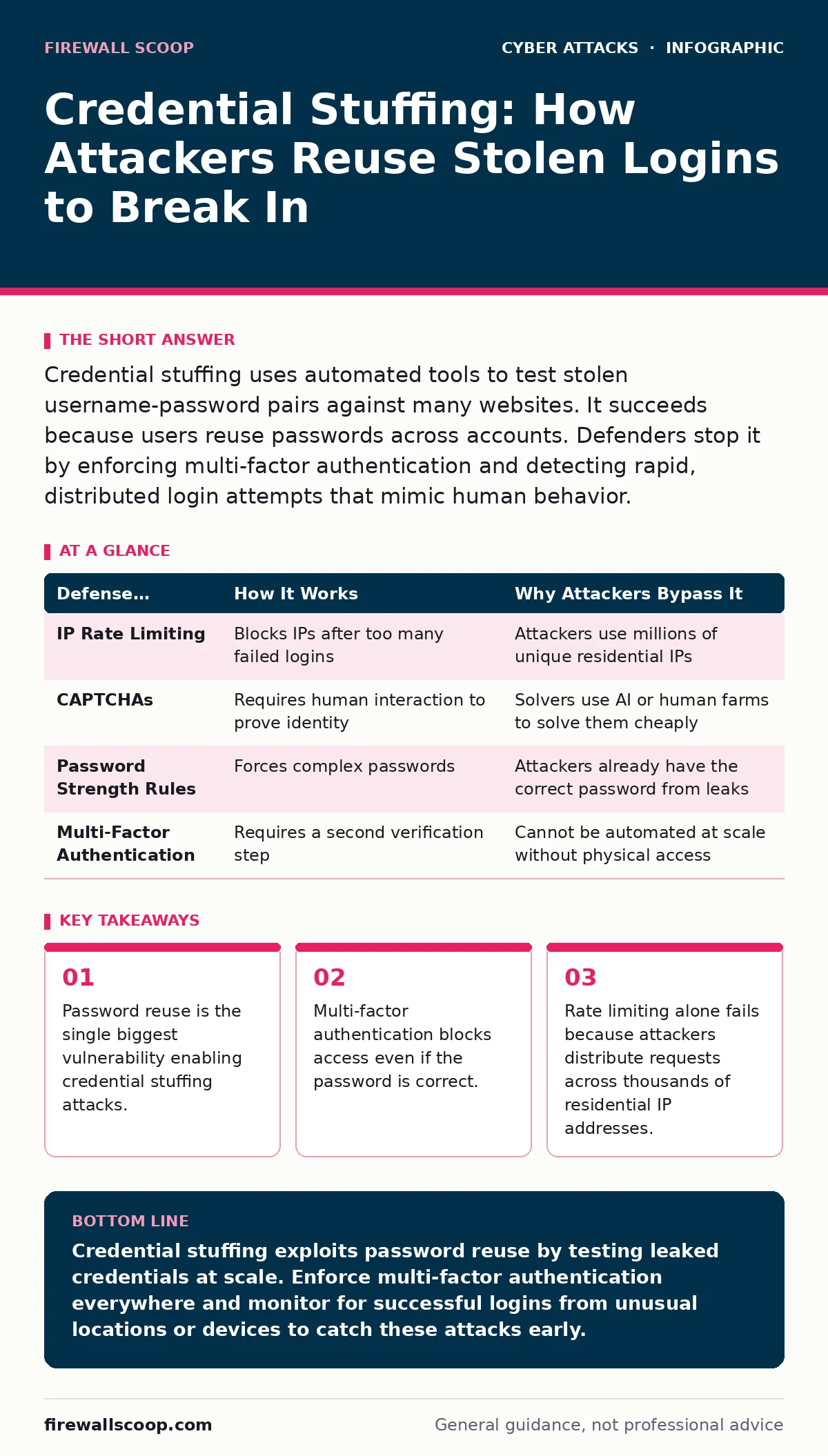
Credential stuffing uses automated tools to test stolen username-password pairs against many websites. It succeeds because users reuse passwords across accounts. Defenders stop it by enforcing multi-factor authentication and detecting rapid, distributed login attempts that mimic human behavior.
What is credential stuffing and how does it work?
Credential stuffing is an automated attack where bots submit stolen username and password combinations to login pages. The attacker does not guess your password; they rely on the fact that you likely use the same credentials on multiple sites. If your email was exposed in a past breach, attackers buy that data and test it against banking, shopping, or social media portals. The goal is to find accounts where you have not changed your password since the initial leak.
Why is credential stuffing different from a brute-force attack?
Brute-force attacks try many possible passwords for a single account, like guessing a PIN by trying 0000, then 0001. Credential stuffing tries a single password for many different accounts simultaneously. This distinction matters for defense because brute-force protection focuses on locking an account after failed attempts. Credential stuffing protection must recognize patterns across many accounts, as each individual login attempt looks valid and succeeds on the first try.
How do attackers get the usernames and passwords?
Attackers obtain these credentials from data breaches on other websites, not by hacking your target site directly. When a service is compromised, its user database often leaks onto underground forums or dark web marketplaces. These lists contain millions of records with email addresses and hashed or plain-text passwords. Attackers use these lists as ammunition, testing them against high-value targets that did not suffer a breach themselves. This is why a breach on a small forum can compromise your bank account.
How can you tell if your account is under attack?
You will see login notifications for devices or locations you do not recognize. Many services send an email or push notification when a new device signs in. If you receive this alert but did not initiate the login, your credentials are likely being tested. Check your account activity logs for rapid sign-ins from different geographic regions within minutes. This pattern indicates an automated bot rather than a human who forgot they were logged in.
Why does multi-factor authentication stop credential stuffing?
Multi-factor authentication requires a second proof of identity, such as a code from an app or a hardware key, in addition to your password. Even if the attacker has your correct password from a leaked list, they cannot complete the login without the second factor. This breaks the automation loop because the attacker cannot scale the second step to millions of accounts simultaneously. It turns a trivial password check into a complex, manual hurdle for each victim.
See also: Multi-Factor Authentication: Real Benefits and Hidden Failure Modes
How do attackers bypass standard login protections?
Attackers use proxy networks that route their requests through thousands of residential IP addresses. These IPs belong to real homes and businesses, often without the owners' knowledge, via infected devices or paid services. This makes the login attempts look like normal users from different cities rather than a single bot farm. Standard IP-based rate limiting fails because no single IP address exceeds the threshold for blocking. The attack looks like organic traffic from many unique locations.
| Defense Mechanism | How It Works | Why Attackers Bypass It |
|---|---|---|
| IP Rate Limiting | Blocks IPs after too many failed logins | Attackers use millions of unique residential IPs |
| CAPTCHAs | Requires human interaction to prove identity | Solvers use AI or human farms to solve them cheaply |
| Password Strength Rules | Forces complex passwords | Attackers already have the correct password from leaks |
| Multi-Factor Authentication | Requires a second verification step | Cannot be automated at scale without physical access |
What role does password reuse play in this risk?
Password reuse is the primary enabler of credential stuffing. If you use a unique password for every site, a breach on one service only compromises that specific account. Reusing passwords creates a chain reaction where one leak opens doors to all your other digital lives. Attackers prioritize high-value targets like email and finance because they know users often reuse credentials there. Changing passwords after a known breach is necessary but not sufficient if you do not change them everywhere.
How do organizations detect credential stuffing at scale?
Organizations analyze login velocity and behavioral biometrics rather than just password correctness. They look for impossible travel, where a user logs in from two distant locations in a short time. They also monitor for rapid succession of logins from different accounts using the same session tokens or browser fingerprints. Machine learning models flag deviations from a user's normal behavior, such as logging in at an unusual time or from a new device type. This allows defenders to step up verification without blocking legitimate users.
Can you recover an account after a successful stuffing attack?
Recovery depends on how quickly you detect the unauthorized access. Attackers often change the email address, phone number, and password immediately to lock you out. They may also enable their own multi-factor authentication to prevent you from regaining control. If you act fast, you can use account recovery options that rely on pre-set security questions or original registration details. However, if the attacker has fully taken over the identity, recovery can be difficult and may require human support from the service provider.
How does this relate to other identity attacks?
Credential stuffing is often the first step in a broader campaign. Once inside an email account, attackers can send convincing messages that mimic your boss or a vendor. This leads to CEO fraud or invoice fraud, where the victim sends money to a scammer. Attackers may also use the compromised email to reset passwords on other services, creating a cascade of access. Understanding this chain helps you prioritize protecting email accounts above all others.
Key takeaways
- Password reuse is the single biggest vulnerability enabling credential stuffing attacks.
- Multi-factor authentication blocks access even if the password is correct.
- Rate limiting alone fails because attackers distribute requests across thousands of residential IP addresses.
Credential stuffing exploits password reuse by testing leaked credentials at scale. Enforce multi-factor authentication everywhere and monitor for successful logins from unusual locations or devices to catch these attacks early.
Frequently asked questions
Does using a password manager stop credential stuffing?
A password manager helps you use unique passwords for every site, which prevents one breach from compromising other accounts. It does not stop the attempt itself, but it ensures that a leaked password cannot be used elsewhere.
Is two-factor authentication enough to prevent all login attacks?
Two-factor authentication stops credential stuffing but does not protect against phishing attacks where you willingly give away the code. It also does not prevent attacks where the attacker has access to your physical device or browser session.
How do I know if my password was in a breach?
Use public breach notification services that allow you to check an email address against known leaked databases. If your email appears, assume the password is compromised and change it on all sites where you used it.
Why do attackers target small websites for credentials?
Small websites often have weaker security, making them easy targets for initial data breaches. Attackers steal credentials from these sites to use against larger, more valuable targets where the financial reward is higher.
How this guide was produced: written by the Firewall Scoop editorial team with AI assistance, checked against the public references listed below, and reviewed when the facts change. See our editorial policy or report an error.