Password Hashing and Salting: Small Business Security Basics
Hashing transforms login credentials into unreadable codes, while salting adds random data to ensure identical passwords produce unique results, protecting you even if attackers obtain your database.

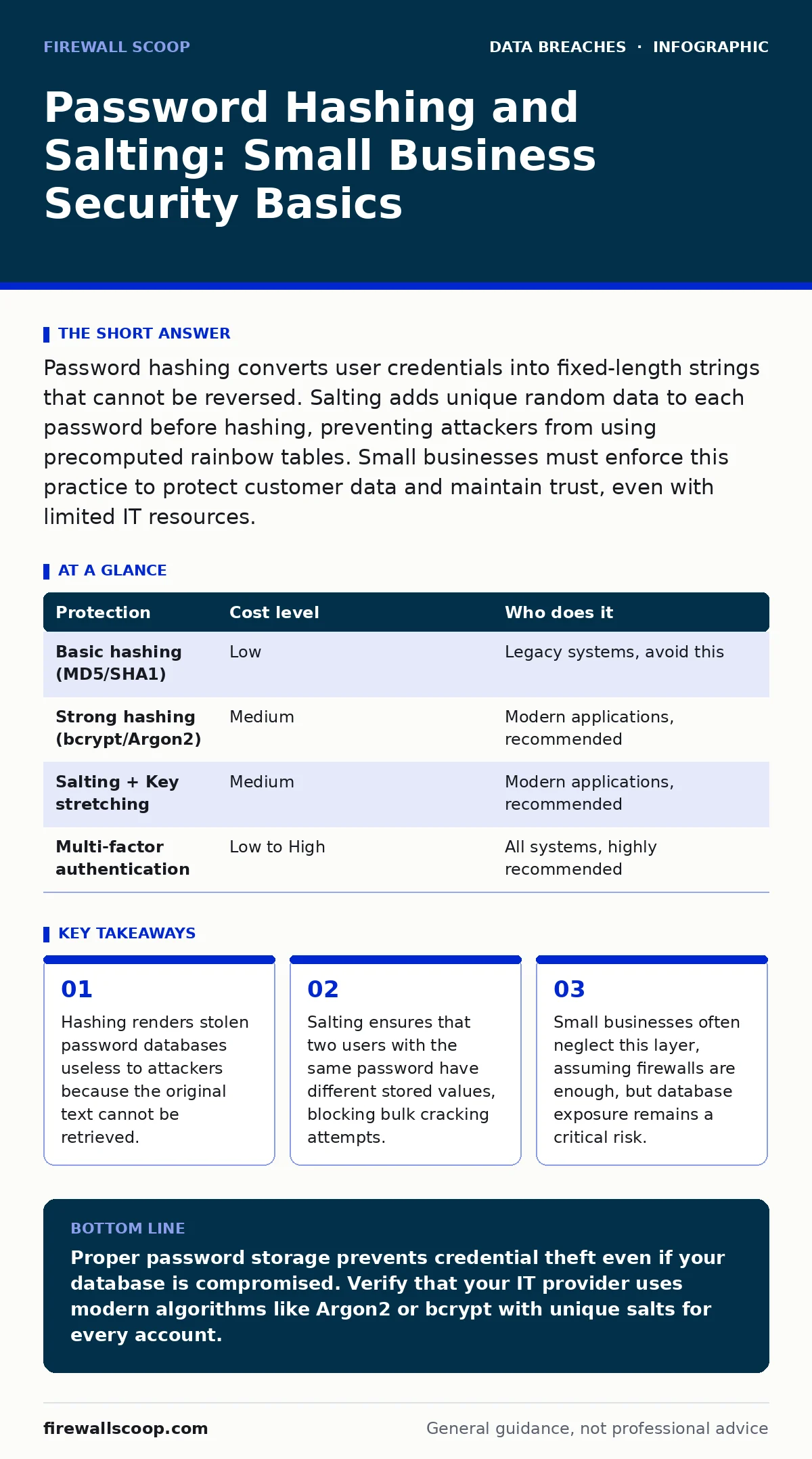
Password hashing converts user credentials into fixed-length strings that cannot be reversed. Salting adds unique random data to each password before hashing, preventing attackers from using precomputed rainbow tables. Small businesses must enforce this practice to protect customer data and maintain trust, even with limited IT resources.
The Ten-Person Company Scenario
Small organizations often operate under the illusion that their size makes them invisible to cyber threats. This belief is dangerous. Attackers frequently target smaller entities because they assume defenses are weak. A single compromised account can lead to ransomware deployment, intellectual property theft, or regulatory fines. The difference between a contained incident and a catastrophic failure often lies in how you store credentials. Storing passwords in plain text is the most significant vulnerability you can introduce into your system. It turns a minor leak into a total loss of user trust and operational continuity.
Why Hashing Matters at Small Scale
Hashing is a mathematical function that takes an input of any length and converts it into a fixed-length string of characters. This process is one-way, meaning you cannot reverse the hash to reveal the original password. When a user logs in, the system hashes the entered password and compares it to the stored hash. If they match, access is granted. This mechanism protects you because even if an attacker steals your database, they only possess the hashes, not the actual passwords.
For a small business, the cost of implementing hashing is negligible. Most modern frameworks and libraries include secure hashing algorithms by default. The trade-off is minimal processing time, which is imperceptible to users. The benefit is immense. You eliminate the risk of immediate credential compromise. Without hashing, a database leak gives attackers instant entry to every account. With hashing, they must expend significant computational power to reverse the process, which is often impractical for strong algorithms.
The Critical Role of Salting
Salting addresses a specific weakness in hashing: collisions. If two users choose the same password, their hashes will be identical. Attackers exploit this by using rainbow tables, which are precomputed databases of hashes for common passwords. If an attacker sees a hash that matches an entry in their rainbow table, they instantly know the original password. Salting adds a unique, random string of data to each password before hashing. This ensures that even if two users have the same password, their resulting hashes are completely different.
The random nature of salt means attackers cannot use precomputed tables. They must compute the hash for every possible password combination for each individual salt. This exponentially increases the time and resources required to crack the passwords. For a small business, salting is as easy as enabling it in your application settings. It adds a layer of defense that makes automated attacks ineffective. You do not need to manage the salts manually; the system generates and stores them alongside the hashed passwords.
Practical Implementation Steps
Implementing secure password storage requires specific technical choices. You must select a hashing algorithm designed for password storage, not general-purpose hashing. Algorithms like SHA-256 are too fast, making them vulnerable to brute-force attacks. Instead, use algorithms that are intentionally slow and computationally expensive. Argon2, bcrypt, and scrypt are industry standards that include memory-hard components, making parallelization on GPUs and ASICs difficult. These algorithms force attackers to spend more time and money per guess.
- Choose a strong algorithm such as Argon2id, which is resistant to both time-memory trade-offs and side-channel attacks.
- Configure the cost factor to the highest value your server can handle without degrading user experience.
- Ensure the salt is generated cryptographically randomly and is at least 16 bytes long.
- Store the salt alongside the hash in your database. The salt does not need to be secret.
- Never implement your own cryptographic functions. Use well-tested libraries provided by your programming language's framework.
| Protection | Cost level | Who does it |
|---|---|---|
| Basic hashing (MD5/SHA1) | Low | Legacy systems, avoid this |
| Strong hashing (bcrypt/Argon2) | Medium | Modern applications, recommended |
| Salting + Key stretching | Medium | Modern applications, recommended |
| Multi-factor authentication | Low to High | All systems, highly recommended |
What to Ask Your IT Provider
When outsourcing IT support or hiring a developer, you must verify their understanding of credential security. Many providers focus on network security and neglect application-layer protections. You need to confirm that your software stack implements modern standards. Ask direct questions about the algorithms used and the configuration of key parameters. Vague answers indicate a lack of expertise or a reliance on outdated systems.
- Which specific hashing algorithm do you use for storing user passwords?
- Do you implement unique random salts for each password entry?
- What is the current cost factor or work factor configured for the hashing algorithm?
- How do you handle password resets to ensure new hashes are generated correctly?
- Can you demonstrate the process for auditing stored credential formats?
See also: Small Business Backup Strategies That Survive Ransomware · 7 Mistakes That Leak Session Tokens to Attackers
Hidden Costs and Edge Cases
A common misconception is that hashing eliminates the need for other security measures. This is incorrect. Hashing protects stored credentials, but it does not protect against phishing, social engineering, or weak password choices. If a user shares their password, hashing offers no protection. You must combine hashing with education and multi-factor authentication. Another hidden cost is the maintenance of legacy systems. Older applications may use deprecated algorithms like MD5 or SHA-1. Migrating these systems requires careful planning to avoid disrupting business operations.
Edge cases also arise with password resets and account migrations. If you change your hashing algorithm, you must support both old and new formats during the transition period. This adds complexity to your authentication logic. You must ensure that the system correctly identifies which format a stored hash uses and applies the appropriate verification process. Failing to handle this correctly can lock out users or leave old, weak hashes in place indefinitely.
Integrating with Broader Security
Password hashing and salting are foundational, but they are not standalone solutions. They work best when combined with other security practices. For instance, encryption at rest protects your database files if the physical server is stolen. Without encryption, an attacker with physical access can bypass the operating system and read the database directly. Hashing protects the data within the database, but encryption protects the container. You need both layers to secure your information assets effectively.
Consider also the risks of employee data breaches. If an employee leaves with access to your systems, they may know how to bypass security controls. Hashing ensures that even if they export the database, they cannot recover the passwords. Additionally, monitor for audit logging anomalies. Sudden spikes in failed login attempts may indicate an attacker is attempting to brute-force your hashes. Proper logging helps you detect and respond to these threats quickly.
Final Verification Steps
Before going live or after a major update, verify your implementation. Test with known passwords and ensure the hashes are unique and consistent. Check that the salt is random and changes for each new password. Verify that the hashing algorithm is configured with appropriate cost factors. Document your security practices for internal reference and potential audits. This documentation demonstrates due diligence and helps new team members understand the security posture.
Regularly review your security configurations. Algorithms and best practices evolve. What is secure today may be vulnerable tomorrow. Stay informed about new developments in cryptography and update your systems accordingly. Engage with security communities and participate in training to keep your knowledge current. Security is an ongoing process, not a one-time fix. By implementing robust hashing and salting, you protect your business and your customers from the most common and devastating cyber threats.
Key takeaways
- Hashing renders stolen password databases useless to attackers because the original text cannot be retrieved.
- Salting ensures that two users with the same password have different stored values, blocking bulk cracking attempts.
- Small businesses often neglect this layer, assuming firewalls are enough, but database exposure remains a critical risk.
Proper password storage prevents credential theft even if your database is compromised. Verify that your IT provider uses modern algorithms like Argon2 or bcrypt with unique salts for every account.
Frequently asked questions
Can hackers reverse a password hash?
No, hashing is a one-way function. Attackers cannot reverse the hash to get the original password. They must guess passwords and compare the resulting hashes, which is slow and resource-intensive.
Is salting enough to protect my passwords?
Salting alone is not enough. You must use a strong hashing algorithm designed for passwords. Salting prevents rainbow table attacks, but weak algorithms can still be cracked via brute force.
How often should I change my hashing algorithm?
You should update to newer algorithms as they become the industry standard. Migrate existing users by rehashing their passwords during their next login. Do not change algorithms for no reason, but stay current with security best practices.
What if I lose my salt?
The salt is stored in the database alongside the hash. You do not need to remember it. If you lose access to the database, you lose the ability to verify passwords. Ensure your database is backed up and encrypted.
How this guide was produced: written by the Firewall Scoop editorial team with AI assistance, checked against the public references listed below, and reviewed when the facts change. See our editorial policy or report an error.