What Is Fast Flux DNS: How Attackers Hide Malware Behind Speed
Fast flux DNS masks malicious infrastructure by changing IP addresses rapidly, making traditional blocking methods fail.

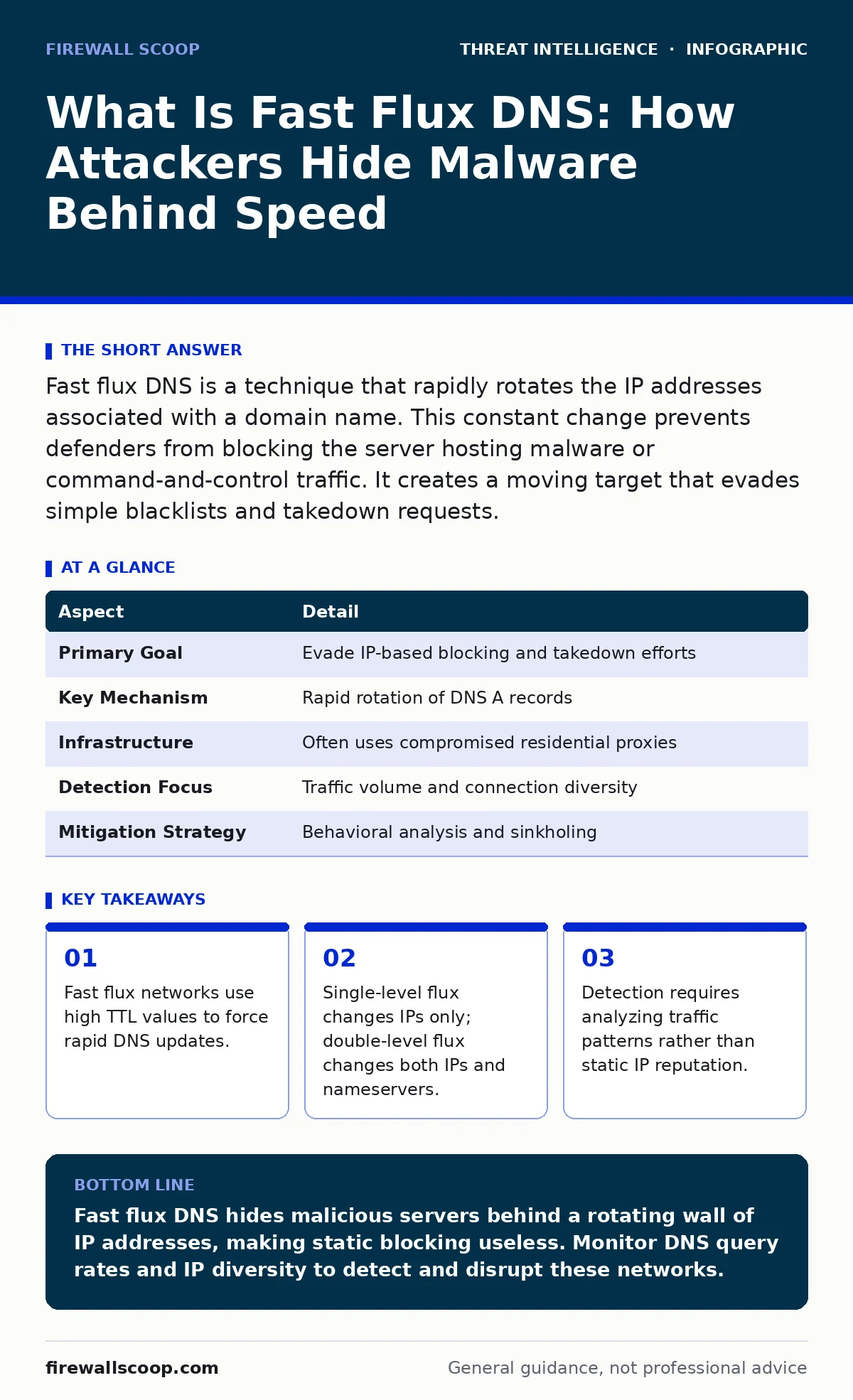
Fast flux DNS is a technique that rapidly rotates the IP addresses associated with a domain name. This constant change prevents defenders from blocking the server hosting malware or command-and-control traffic. It creates a moving target that evades simple blacklists and takedown requests.
What Is Fast Flux
Fast flux DNS is a method used to hide the true location of malicious servers by constantly changing their IP addresses. The technique relies on the Domain Name System to act as a shield rather than a directory. When you query a domain, the DNS resolver returns one of many possible addresses. These addresses change frequently, often every few minutes. This rotation makes it difficult for security teams to identify and block the actual server hosting the threat. The domain remains accessible even if individual IPs are taken offline.
The core mechanism involves setting a very low Time-To-Live value in DNS records. TTL tells a resolver how long to cache an IP address before checking for updates. A low TTL forces the resolver to ask for the address again shortly after. This ensures that the list of active IPs remains fluid. Attackers use this fluidity to distribute their infrastructure across thousands of compromised devices. These devices often belong to residential users who are unaware they are part of the network.
At a Glance
| Aspect | Detail |
|---|---|
| Primary Goal | Evade IP-based blocking and takedown efforts |
| Key Mechanism | Rapid rotation of DNS A records |
| Infrastructure | Often uses compromised residential proxies |
| Detection Focus | Traffic volume and connection diversity |
| Mitigation Strategy | Behavioral analysis and sinkholing |
How Fast Flux Works
The process begins with the attacker registering a domain name. They then configure the DNS records to point to a large pool of IP addresses. In a single-level fast flux network, only the A records change. The nameservers remain constant. This is simpler to manage but easier to detect. In a double-level fast flux network, both the A records and the NS records change. This adds a layer of indirection. The nameservers themselves are hosted on different machines, making the entire chain harder to trace.
Attackers often use compromised computers as part of this pool. These zombies forward traffic to the actual malicious server. This server might host botnet command-and-control channels or exploit kits. Because the traffic passes through many different residential IPs, it looks like normal user activity. Security appliances that rely on static IP blacklists fail here. The blacklist becomes obsolete the moment the IP rotates. The domain simply points to the next available address in the pool.
Who It Affects
Organizations with strict perimeter defenses are primary targets. These defenses often rely on blocking known bad IPs. Fast flux renders this strategy ineffective. Small businesses without advanced monitoring are also at risk. They may not notice the subtle signs of DNS abuse. Individual users suffer indirectly. Their compromised devices become part of the flux network. This exposes them to legal liability and further malware infection. The instability of their network connection may also degrade performance.
Threat intelligence platforms must adapt to this technique. Traditional indicators of compromise lose value quickly. An IP address that was malicious an hour ago may be clean now. This forces analysts to look at broader patterns. They must track the domain itself and the behavior of the traffic. This increases the workload for security operations centers. They must process more data to find the signal in the noise.
What People Usually Get Wrong
Many defenders assume that blocking a domain is enough. They add the domain to a blacklist. However, fast flux networks often use subdomains. They can generate hundreds of subdomains dynamically. Blocking the parent domain may break legitimate services. Blocking each subdomain is impossible at scale. The attacker simply registers a new domain or creates new subdomains. This cat-and-mouse game favors the attacker if the defender relies on static lists.
Another common error is focusing only on the IP addresses. Analysts see many different IPs connecting to a single domain. They may assume it is a legitimate content delivery network. CDNs also use many IPs for load balancing. The difference lies in the behavior. CDN IPs are stable and geographically distributed. Fast flux IPs are often from residential ranges and change rapidly. Mistaking one for the other leads to missed threats. You must analyze the frequency of change, not just the number of IPs.
See also: Lateral Movement Prevention Checklist for Network Security · Network Traffic Analysis: How to Detect Hidden Threats in Data Flow
Detection and Mitigation
Detection requires looking at the DNS query patterns. You must identify domains that resolve to many different IPs in a short time. Network traffic analysis tools can help here. They monitor the rate of DNS changes. A sudden spike in unique IPs for a single domain is a red flag. You should also look at the geographic distribution of the IPs. Fast flux networks often use IPs from many different countries. Legitimate servers usually have a more predictable geographic footprint.
Mitigation involves disrupting the command-and-control channel. You cannot block every IP. Instead, you must sinkhole the domain. This redirects traffic to a safe server you control. This breaks the botnet's communication. You can then study the traffic to identify the true control server. User and entity behavior analytics can also help. They detect when internal devices start communicating with these volatile domains. This allows you to isolate infected machines before they spread the malware.
Strategic Implications
Fast flux networks highlight the limitations of perimeter-based security. You cannot secure the network by simply listing bad actors. The internet is too dynamic. You must shift to a model of continuous verification. Every connection must be evaluated for behavior. This requires more resources and better tools. It also requires a deeper understanding of DNS protocols.
The rise of fast flux has pushed attackers to use more sophisticated techniques. They now combine fast flux with other evasion methods. This increases the complexity of threat intelligence. You must correlate data from multiple sources. You must understand the context of the traffic. This is not just about blocking; it is about understanding the adversary's infrastructure. It requires a holistic approach to security.
Key takeaways
- Fast flux networks use high TTL values to force rapid DNS updates.
- Single-level flux changes IPs only; double-level flux changes both IPs and nameservers.
- Detection requires analyzing traffic patterns rather than static IP reputation.
- Blocking requires identifying the underlying infrastructure, not just the domain.
Fast flux DNS hides malicious servers behind a rotating wall of IP addresses, making static blocking useless. Monitor DNS query rates and IP diversity to detect and disrupt these networks.
Frequently asked questions
How does fast flux differ from a CDN?
CDNs use many IPs for performance and stability, with predictable geographic distribution. Fast flux uses many IPs for evasion, with rapid, unpredictable changes and often residential locations.
Can I stop fast flux with a standard firewall?
Standard firewalls that block by IP are ineffective. You need a firewall that can inspect DNS traffic and block based on domain reputation or behavioral anomalies.
Why do attackers use residential IPs?
Residential IPs are trusted by many security systems. They are harder to block without affecting innocent users. They also provide anonymity for the attacker.
Is fast flux legal?
The technique itself is neutral, but it is almost exclusively used for malicious purposes. Using compromised devices without permission is illegal.
How this guide was produced: written by the Firewall Scoop editorial team with AI assistance, checked against the public references listed below, and reviewed when the facts change. See our editorial policy or report an error.