Traffic Light Protocol: How to Share Threat Intelligence Safely
The Traffic Light Protocol prevents accidental data leaks by defining exactly who can read shared security findings and where they can talk about them.

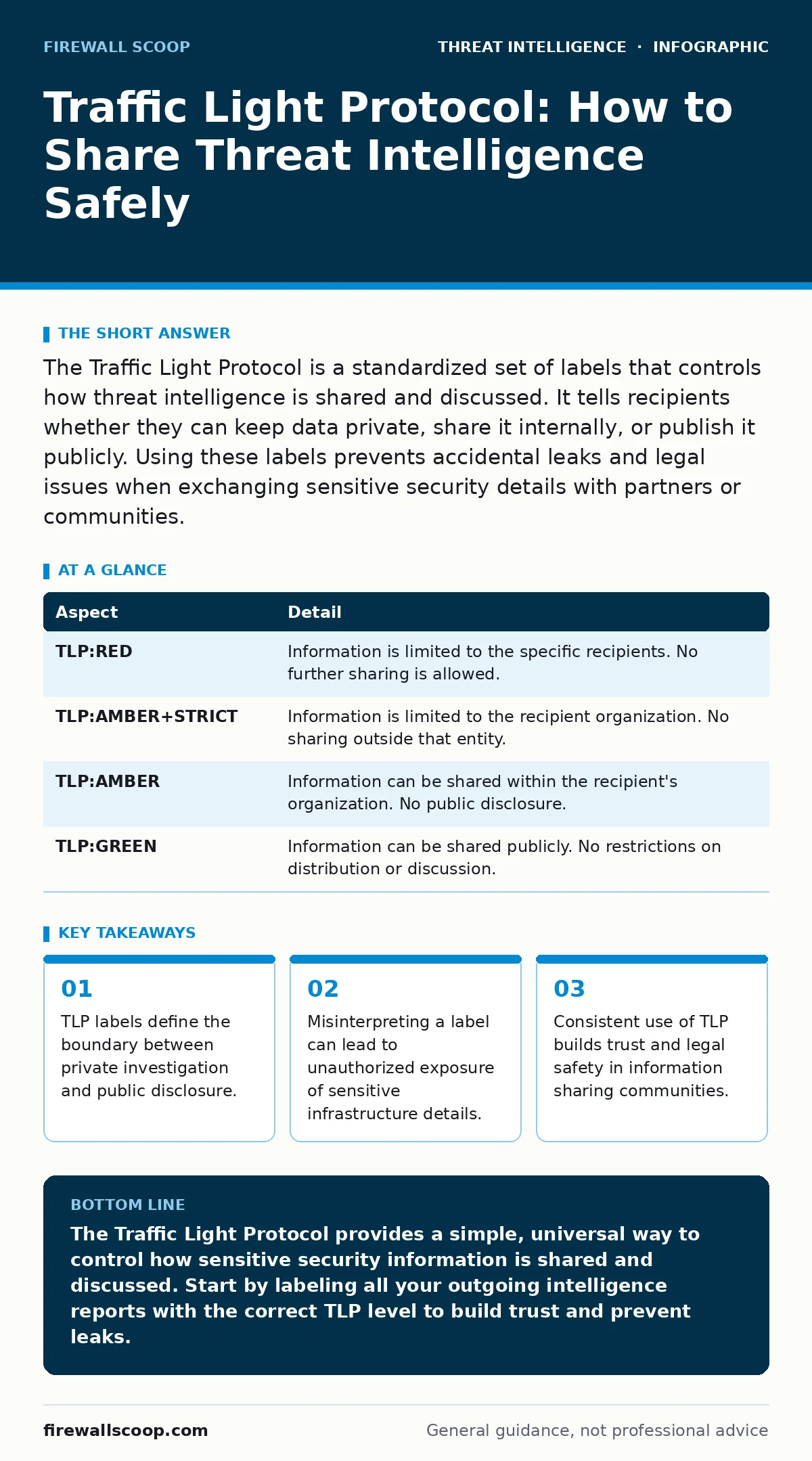
The Traffic Light Protocol is a standardized set of labels that controls how threat intelligence is shared and discussed. It tells recipients whether they can keep data private, share it internally, or publish it publicly. Using these labels prevents accidental leaks and legal issues when exchanging sensitive security details with partners or communities.
Everyday Analogy for Information Sharing
Imagine you find a broken lock on a neighbor’s shed. You can tell the homeowner privately so they fix it. You can tell the neighborhood association so they watch for burglars. You cannot post the address and lock model on social media, because that invites criminals. The Traffic Light Protocol works the same way. It assigns a color to information to dictate who can see it and how they can talk about it. This simple visual cue replaces complex legal negotiations for every piece of shared data.
What Is the Traffic Light Protocol
The Traffic Light Protocol is a standard for labeling information to control its distribution. It uses four color-coded levels to define sharing boundaries. These levels are Green, Amber, Red, and Amber+Strict. Each color corresponds to a specific set of permissions and restrictions. The protocol originated in law enforcement and intelligence communities. It has since become the standard for cybersecurity information sharing. Using TLP ensures that sensitive details do not leak to adversaries or the general public. It provides a common language for trust and confidentiality.
At a Glance: TLP Levels and Rules
| Aspect | Detail |
|---|---|
| TLP:RED | Information is limited to the specific recipients. No further sharing is allowed. |
| TLP:AMBER+STRICT | Information is limited to the recipient organization. No sharing outside that entity. |
| TLP:AMBER | Information can be shared within the recipient's organization. No public disclosure. |
| TLP:GREEN | Information can be shared publicly. No restrictions on distribution or discussion. |
How TLP Works in Practice
You apply a TLP label to a document, email, or database record. The label sits at the top or bottom of the content. Recipients must respect the label before acting on the information. If you receive a TLP:RED report, you read it and keep it to yourself. You do not forward it to colleagues unless they are named recipients. If you receive TLP:AMBER, you can share it with your internal security team. You cannot post it on a public forum or send it to a partner company. The protocol relies on mutual trust and clear communication. It does not use technical encryption to enforce the rules.
Who Is Affected by TLP
Security analysts rely on TLP to share findings without legal risk. Threat intelligence platforms use these labels to categorize feeds. Community managers enforce TLP rules to maintain trust among members. Legal teams reference TLP to define confidentiality in sharing agreements. Attackers monitor public channels for TLP:GREEN data to learn defenses. They ignore restricted labels because they cannot access that data. Everyone in the security ecosystem benefits from clear boundaries. Misunderstanding these boundaries creates liability and erodes trust.
See also: Implement Threat Intelligence Platforms: A Step-by-Step Guide · Dark Web Search Engines Explained: How Hidden Indexing Works
Common Mistakes with TLP Labels
People often assume TLP:AMBER means they can share with trusted partners. This is incorrect. TLP:AMBER restricts sharing to the recipient’s own organization. Sharing with a partner requires TLP:GREEN or a separate agreement. Another mistake is ignoring the label when quoting data. You must keep the label when forwarding or referencing the information. Stripping the label removes the context and increases leak risk. Some users treat TLP as a technical control. It is a social contract, not a firewall rule.
What to Do About TLP
Always check the label before opening or sharing any threat intelligence. If the label is missing, assume the data is sensitive and ask the source. Define your organization’s default handling for each TLP level. Train staff on the difference between Amber and Amber+Strict. Use TLP consistently in your own reports and alerts. This clarity helps partners trust your sharing practices. It also protects your organization from accidental disclosures. Consistency is more important than perfection in early adoption.
Integration with Other Security Practices
TLP works alongside technical controls like network traffic analysis. It complements strategic efforts like attack path analysis. When conducting threat hunting, you often encounter TLP:AMBER indicators. You must handle these carefully to avoid exposing your methods. Red teaming exercises may generate TLP:RED findings about internal weaknesses. These must stay strictly internal. User and entity behavior analytics can detect anomalies in how TLP data is accessed. Attacker reconnaissance often targets poorly labeled public data.
Key takeaways
- TLP labels define the boundary between private investigation and public disclosure.
- Misinterpreting a label can lead to unauthorized exposure of sensitive infrastructure details.
- Consistent use of TLP builds trust and legal safety in information sharing communities.
The Traffic Light Protocol provides a simple, universal way to control how sensitive security information is shared and discussed. Start by labeling all your outgoing intelligence reports with the correct TLP level to build trust and prevent leaks.
Frequently asked questions
Can I change a TLP label on a document I received?
No. You must keep the original label. Changing it violates the sharing agreement and may expose sensitive data.
What if a document has no TLP label?
Assume the data is confidential. Contact the source to clarify the intended sharing level before distributing it.
Does TLP replace legal non-disclosure agreements?
No. TLP is a practical standard for daily operations. Legal agreements provide formal enforcement and liability protection.
Is TLP used outside of cybersecurity?
Yes. It originated in law enforcement and intelligence. It is now used in healthcare, finance, and critical infrastructure sectors.
How this guide was produced: written by the Firewall Scoop editorial team with AI assistance, checked against the public references listed below, and reviewed when the facts change. See our editorial policy or report an error.