Software Composition Analysis: Answers to Your Top Questions
Software composition analysis reveals hidden supply chain risks by mapping every open-source component to known vulnerabilities before deployment.
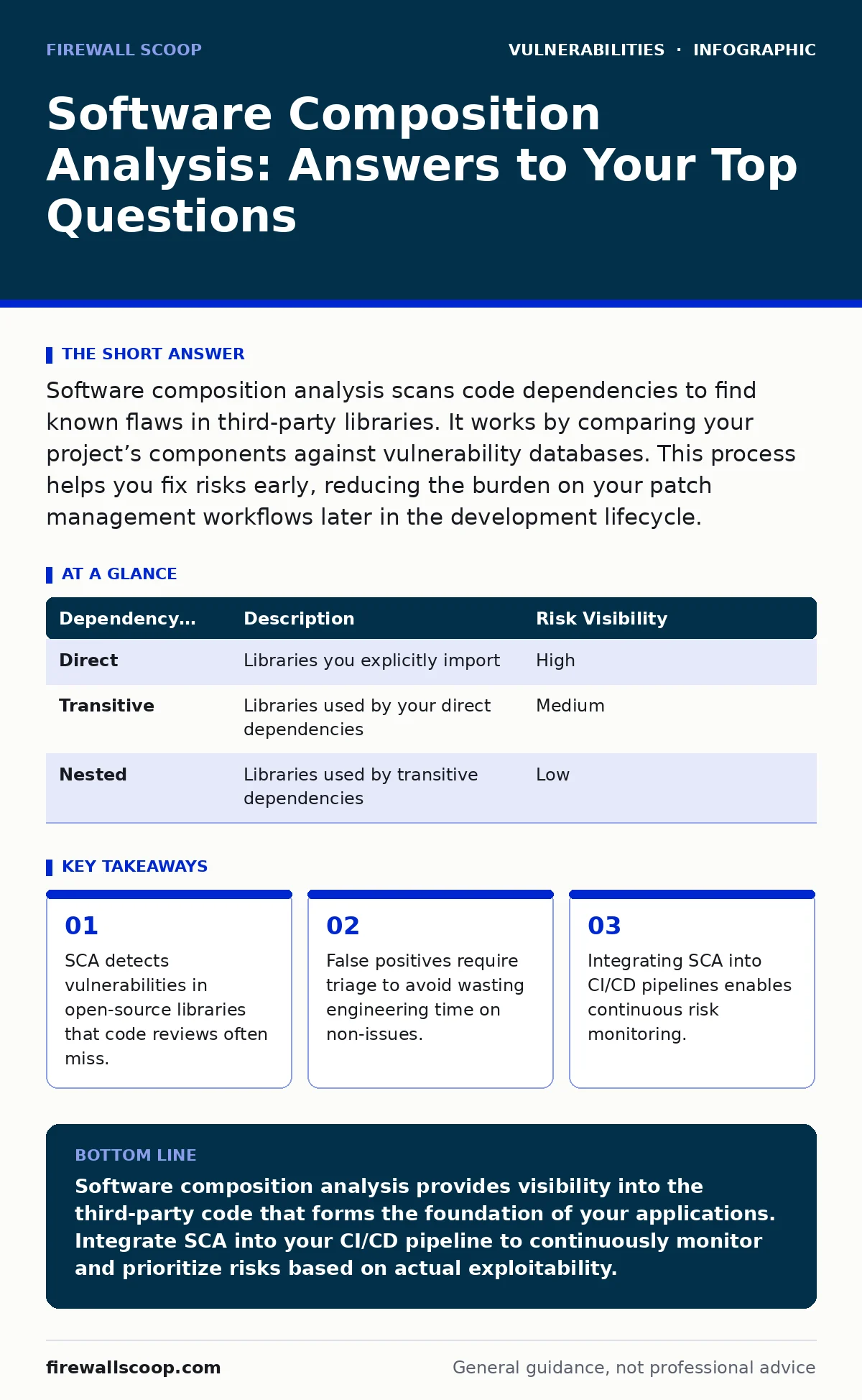
Software composition analysis scans code dependencies to find known flaws in third-party libraries. It works by comparing your project’s components against vulnerability databases. This process helps you fix risks early, reducing the burden on your patch management workflows later in the development lifecycle.
What is software composition analysis?
Software composition analysis (SCA) is an automated security tool that inventories and assesses the open-source and commercial components within your software. It identifies known vulnerabilities, license compliance issues, and outdated libraries by comparing your dependencies against public databases. Unlike static application security testing (SAST), which scans your custom source code, SCA focuses on the third-party code you have included. This distinction matters because most modern applications are built largely from reused components rather than original code.
How does SCA differ from SAST?
SCA and SAST serve different purposes in the security testing pipeline. SAST analyzes your own source code for logic errors, injection flaws, or poor coding practices. SCA, however, looks at the libraries and frameworks you import, checking them against known vulnerability records. You need both because SAST cannot detect a flaw in a library you did not write, and SCA cannot detect how you might have misused that library. Relying on only one leaves significant blind spots in your application security posture.
Where does SCA get its vulnerability data?
SCA tools pull data from curated vulnerability feeds, such as the National Vulnerability Database (NVD) and other industry standards. These databases contain structured information about flaws, including severity scores, affected versions, and remediation steps. The accuracy of your SCA results depends entirely on the quality and freshness of this underlying data. If a vulnerability is newly discovered but not yet indexed, your SCA tool will not flag it until the database updates.
Why do SCA tools report false positives?
False positives occur when an SCA tool flags a vulnerability that does not actually affect your running application. This often happens because the tool detects a vulnerable library version but cannot determine if the vulnerable function is ever called. You might import a large framework but only use a small, safe subset of its features. These noise issues create alert fatigue, forcing security teams to waste time investigating risks that do not exist in practice. Effective triage processes are required to filter these out.
How does SCA handle transitive dependencies?
Transitive dependencies are libraries that your direct dependencies rely on, creating a deep chain of components. SCA tools must map this entire graph to ensure nothing is missed. Imagine you use Library A, which uses Library B, which uses a vulnerable Library C. A shallow scan would miss Library C, leaving your application exposed. Deep dependency mapping reveals these hidden risks, ensuring you understand the full supply chain of your software.
| Dependency Level | Description | Risk Visibility |
|---|---|---|
| Direct | Libraries you explicitly import | High |
| Transitive | Libraries used by your direct dependencies | Medium |
| Nested | Libraries used by transitive dependencies | Low |
See also: WordPress Page Builder Vulnerabilities: What to Know · How Security Bulletins Work: The Hidden Mechanics of Patch Intelligence
Can SCA detect logic flaws or zero-days?
SCA cannot detect logic flaws in your custom code or zero-day vulnerabilities that have no public record. It relies on known signatures and database entries to identify risks. If a hacker discovers a new flaw in a popular library, SCA will not alert you until that flaw is documented and added to the vulnerability feed. This lag time means SCA is a reactive measure, not a proactive one. You must combine it with other testing methods to catch unknown or custom issues.
How does SCA integrate with development workflows?
Modern SCA tools integrate directly into continuous integration and continuous deployment (CI/CD) pipelines. This allows developers to receive feedback on vulnerabilities as soon as they commit code. You can configure the tool to block builds if critical vulnerabilities are detected, enforcing security standards automatically. This shift-left approach reduces the cost and effort of fixing issues compared to finding them after deployment. It also supports better patch management by identifying outdated components early.
Does SCA replace manual code reviews?
No, SCA does not replace manual code reviews or other security testing methods. It automates the inventory of third-party components, freeing up human reviewers to focus on custom logic and architecture. Manual reviews are still necessary to catch security misconfigurations, business logic errors, and improper usage of secure libraries. SCA is one layer of defense, not a complete solution. A balanced security strategy uses automated tools for scale and human expertise for context.
How do you prioritize SCA findings?
Prioritization requires understanding which vulnerabilities are actually exploitable in your environment. Not all reported flaws pose an immediate threat. Some may require specific configurations or user interactions to exploit. You should focus on vulnerabilities that are reachable, have high severity, and lack workarounds. This approach aligns with risk-based vulnerability management, ensuring you address the most dangerous issues first. It prevents wasting resources on fixing theoretical risks that will never materialize.
What are the limitations of SCA tools?
SCA tools struggle with dynamically loaded libraries, custom-built open-source forks, and compiled binaries without metadata. They also cannot assess the security of the supply chain process itself, such as whether a maintainer’s account was compromised. Additionally, SCA does not protect against race condition vulnerabilities or other runtime issues. Understanding these limits helps you set realistic expectations and complement SCA with runtime application self-protection (RASP) or other monitoring solutions.
How often should you run SCA scans?
You should run SCA scans continuously, ideally with every code commit and during nightly builds. Vulnerabilities are discovered daily, and your dependency graph changes as you update libraries. A one-time scan becomes outdated quickly, leaving you exposed to new threats. Continuous scanning ensures you have the latest risk profile and can respond to emerging threats promptly. This frequency supports a culture of security throughout the development lifecycle, rather than treating it as a final checkpoint.
Key takeaways
- SCA detects vulnerabilities in open-source libraries that code reviews often miss.
- False positives require triage to avoid wasting engineering time on non-issues.
- Integrating SCA into CI/CD pipelines enables continuous risk monitoring.
Software composition analysis provides visibility into the third-party code that forms the foundation of your applications. Integrate SCA into your CI/CD pipeline to continuously monitor and prioritize risks based on actual exploitability.
Frequently asked questions
Is SCA the same as a software bill of materials?
No, a software bill of materials (SBOM) is a list of components, while SCA is a process that analyzes those components for vulnerabilities and licenses. An SBOM can be an output of SCA, but SCA involves active assessment and risk scoring.
Does SCA check for license compliance?
Yes, most SCA tools also scan for license compliance issues, ensuring that open-source components meet your organization’s legal requirements. This helps prevent accidental use of restrictive licenses that could limit your software distribution.
Can SCA detect vulnerabilities in private repositories?
SCA can detect vulnerabilities in private repositories if they use public open-source components. However, it cannot assess custom code within those private libraries unless combined with SAST or other scanning methods.
How do I reduce false positives in SCA results?
You can reduce false positives by tuning your SCA tool to ignore vulnerabilities that are not reachable in your application. This involves mapping code paths and understanding which functions are actually called by your application logic.
How this guide was produced: written by the Firewall Scoop editorial team with AI assistance, checked against the public references listed below, and reviewed when the facts change. See our editorial policy or report an error.