Race Condition Vulnerabilities: Risks and Protection for Small Businesses
Race conditions allow attackers to bypass security checks by exploiting the tiny time gap between a system verifying access and executing the action.

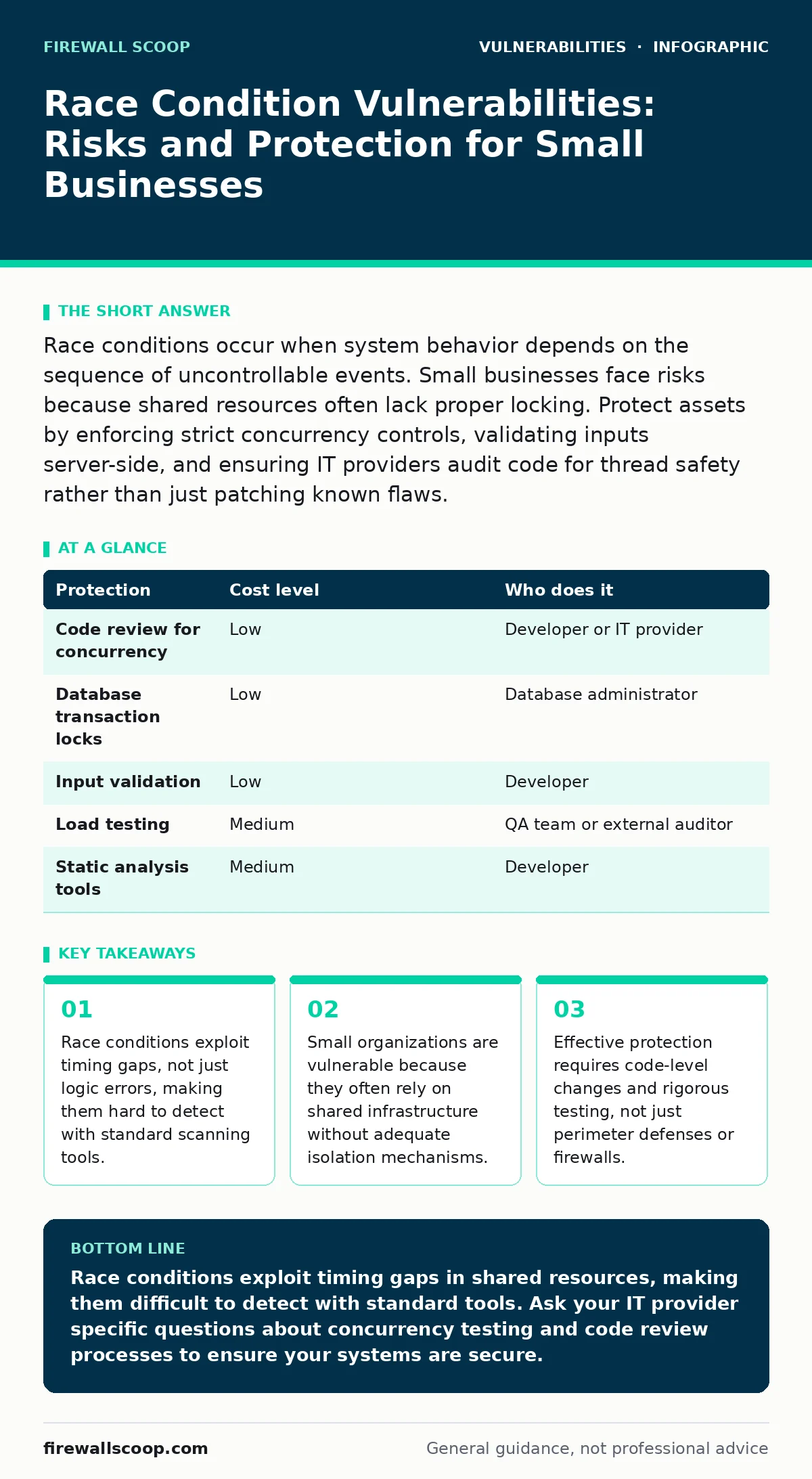
Race conditions occur when system behavior depends on the sequence of uncontrollable events. Small businesses face risks because shared resources often lack proper locking. Protect assets by enforcing strict concurrency controls, validating inputs server-side, and ensuring IT providers audit code for thread safety rather than just patching known flaws.
The Mechanics of Timing Attacks
A race condition occurs when the behavior of a software system depends on the sequence or timing of uncontrollable events. In computing, these events are often concurrent operations accessing shared data. The vulnerability exists in the gap between a security check and the resulting action. If an attacker can manipulate that gap, they can bypass controls.
This is not a bug in the code logic itself, but in the code’s handling of time. Standard logic tests often pass because they run sequentially. The flaw only appears when two processes run at the same time. This makes race conditions distinct from typical input validation errors. They are timing-based, not content-based.
Small organizations are particularly exposed because they often use shared hosting or multi-tenant cloud services. These environments increase the likelihood of concurrent access to shared resources. Without proper isolation, a poorly coded application can affect other users or the system itself. The assumption that "only our staff uses this" is rarely true in modern interconnected networks.
Why Small Teams Struggle With Concurrency
Large enterprises have dedicated teams to handle thread safety and concurrency. Small businesses often rely on off-the-shelf software or custom scripts written by generalist developers. These developers may not anticipate how the software behaves under high load or simultaneous access.
The hidden cost here is complexity. Fixing a race condition requires understanding the entire flow of data. It is not a simple patch. You must ensure that every step from input to storage is atomic. Atomic means the operation completes entirely or not at all, with no intermediate state visible to other processes.
If your IT provider only looks for known signatures, they will miss these issues. Race conditions do not have a single signature. They manifest differently depending on the hardware speed and network latency. This variability makes them elusive. They often go unnoticed until an attacker exploits them repeatedly.
The Risk of Shared Resources
The core danger lies in shared state. This includes files, database records, memory locations, or configuration settings. When multiple processes read and write to the same resource without coordination, data corruption or logic errors occur.
Consider a login system. It checks if a password is correct. Then it grants access. If an attacker sends thousands of login attempts simultaneously, they might trigger a state where the system grants access before it can log the failure. This bypasses account lockout policies. The attacker gains entry not by guessing the password, but by overwhelming the timing mechanism.
For small businesses, this risk extends to financial transactions, inventory management, and user registration. Any process that updates a shared counter or balance is a potential target. The impact is not just data loss, but integrity loss. Your records no longer reflect reality.
Low-Cost Protections for Limited Budgets
You do not need expensive hardware to mitigate these risks. The primary defense is proper software design. This starts with code reviews that specifically look for non-atomic operations. Ask your developers to identify every place where data is read and then written.
Implement strict locking mechanisms. A lock ensures that only one process can access a resource at a time. If a second process tries to access it, it must wait. This adds slight latency but prevents corruption. For web applications, use database transactions with appropriate isolation levels.
Validate all inputs on the server side. Client-side validation is insufficient because attackers can bypass it. Server-side validation ensures that the data structure is correct before any processing begins. This reduces the attack surface for timing-based exploits.
| Protection | Cost level | Who does it |
|---|---|---|
| Code review for concurrency | Low | Developer or IT provider |
| Database transaction locks | Low | Database administrator |
| Input validation | Low | Developer |
| Load testing | Medium | QA team or external auditor |
| Static analysis tools | Medium | Developer |
What to Ask Your IT Provider
Your IT provider plays a key role in identifying and fixing these vulnerabilities. You need to move beyond basic maintenance questions. Ask specific questions about how they handle concurrency and timing issues.
- How do you test applications for race conditions?
- Do you use static analysis tools that detect thread safety issues?
- What is your process for reviewing code that handles shared resources?
- How do you ensure database transactions are atomic and consistent?
- Can you provide examples of past concurrency issues you have resolved?
If the provider cannot answer these questions clearly, they may not have the expertise to protect you. Race conditions require a deep understanding of system architecture. General IT support is often insufficient. You need someone who understands the underlying mechanics of software execution.
Integrating With Broader Security Practices
Race conditions do not exist in isolation. They often interact with other vulnerabilities. For example, a race condition might allow an attacker to bypass access controls, leading to security misconfigurations. It is vital to understand how these issues compound.
When evaluating software, consider software composition analysis to identify third-party libraries that may have known race conditions. Many open-source components have hidden concurrency flaws. Using risk-based vulnerability management helps prioritize fixing these issues based on their potential impact.
Stay updated with security bulletins from your software vendors. They often release patches for timing-related issues. Additionally, keep an eye on the National Vulnerability Database for new disclosures. Understanding attack vectors in CVSS can help you assess the severity of reported race conditions.
Regular firmware updates are also critical. Some hardware components, like network interfaces, can have race conditions in their drivers. Ensuring all layers of your stack are updated reduces the overall risk. Avoid directory listing exposure as well, as it can provide attackers with the information needed to craft precise timing attacks.
The Long-Term Strategy
Protecting against race conditions is an ongoing process. As your business grows, so does the complexity of your systems. What works for ten users may fail with a thousand. You must scale your security practices accordingly.
Invest in training for your development team. Understanding concurrency is a specialized skill. Encourage them to learn about thread safety and synchronization. This knowledge pays off in fewer bugs and more secure applications.
Document your architecture. Clearly define which resources are shared and how they are protected. This documentation helps new team members understand the critical points. It also aids in troubleshooting when issues arise.
Remember, no system is perfectly secure. The goal is to reduce risk to an acceptable level. By understanding race conditions, you take a significant step toward that goal. You move from reactive patching to proactive design. This mindset shift is the most valuable asset you can build.
Key takeaways
- Race conditions exploit timing gaps, not just logic errors, making them hard to detect with standard scanning tools.
- Small organizations are vulnerable because they often rely on shared infrastructure without adequate isolation mechanisms.
- Effective protection requires code-level changes and rigorous testing, not just perimeter defenses or firewalls.
Race conditions exploit timing gaps in shared resources, making them difficult to detect with standard tools. Ask your IT provider specific questions about concurrency testing and code review processes to ensure your systems are secure.
Frequently asked questions
Can a firewall stop a race condition attack?
No, firewalls filter network traffic based on rules. Race conditions occur within the application logic after the traffic is accepted. You need application-level controls to mitigate them.
How often should I test for race conditions?
You should test whenever you update code that handles shared data. Regular load testing and code reviews are the best ways to catch these issues early.
Are race conditions common in cloud services?
Yes, cloud environments are highly concurrent. Any application using shared databases or storage is at risk. Proper configuration and coding practices are essential.
What is the difference between a race condition and a buffer overflow?
A buffer overflow is a memory error where data exceeds allocated space. A race condition is a timing error where the order of operations causes unexpected behavior. Both are serious but require different fixes.
How this guide was produced: written by the Firewall Scoop editorial team with AI assistance, checked against the public references listed below, and reviewed when the facts change. See our editorial policy or report an error.