Credit Monitoring for Small Business: Protect Identity and Assets
Small firms face disproportionate identity theft risks because they lack the automated fraud detection layers that large corporations deploy to spot anomalies.

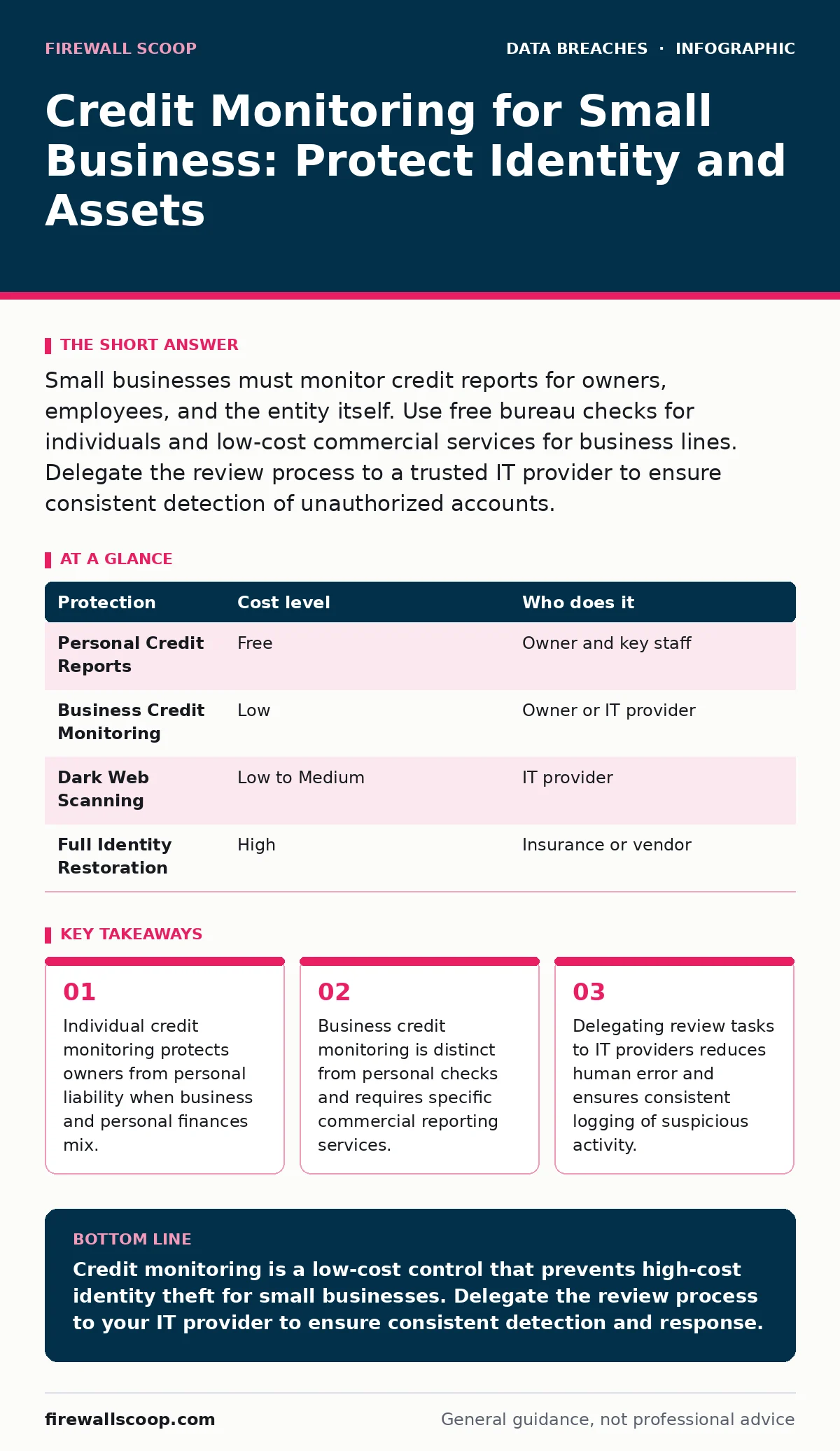
Small businesses must monitor credit reports for owners, employees, and the entity itself. Use free bureau checks for individuals and low-cost commercial services for business lines. Delegate the review process to a trusted IT provider to ensure consistent detection of unauthorized accounts.
Credit monitoring is not just a consumer luxury. It is a structural control for small organizations that handle sensitive data. When you run a small business, your personal financial identity often blends with the company's operations. This blending creates a single point of failure. If a breach occurs, attackers target the easiest path to value. That path is usually the owner or key employee whose credentials grant access to banking or payroll systems.
The Personal-Business Identity Blend
Small business owners frequently use personal credit cards for operational expenses. This practice simplifies accounting but expands the attack surface. An attacker who compromises your business email can reset passwords for personal banking or credit card accounts. They do not need to break into your business ledger to cause damage. They only need your personal identity.
Credit monitoring services track changes to your credit report. They alert you when a new account is opened or when a significant change occurs in your credit history. This is different from credit scoring, which measures your risk to lenders. Monitoring is about detection. It tells you that something has changed, allowing you to react before the damage compounds.
For small teams, this means monitoring must cover three distinct entities. You must monitor the business entity. You must monitor the business owner. You must monitor key employees who have administrative access to financial systems. Missing any of these leaves a gap that attackers will exploit.
Affordable Monitoring Strategies
You do not need enterprise-grade security suites to achieve effective monitoring. The most effective strategy combines free resources with targeted paid services. For individuals, the three major credit bureaus provide free weekly reports. This is a baseline control. It costs nothing and provides immediate visibility into personal credit activity.
Business credit monitoring is less standardized. There is no free equivalent to the personal bureau reports. However, commercial credit bureaus offer tiered services for small businesses. These services track business credit files, public records, and tax liens. They cost significantly less than full identity theft restoration packages. You pay for the alert, not the cleanup.
| Protection | Cost level | Who does it |
|---|---|---|
| Personal Credit Reports | Free | Owner and key staff |
| Business Credit Monitoring | Low | Owner or IT provider |
| Dark Web Scanning | Low to Medium | IT provider |
| Full Identity Restoration | High | Insurance or vendor |
Dark web scanning is another low-cost option. These services scan underground forums for your email addresses or domain names. They alert you if your credentials appear in a data leak. This is particularly useful for early detection. It tells you if your data is already compromised before you see the financial impact.
What to Delegate to IT
Reviewing credit reports is tedious. It requires consistency. Human error is the primary failure point in manual monitoring. You might forget to check a report for a month. You might miss a small, unusual inquiry that signals a larger attack. Delegating this task to your IT provider or managed service provider removes this risk.
Your IT provider should have a process for reviewing alerts. They should log every alert and verify whether it is legitimate. This creates an audit trail. If a breach occurs, you have proof that you monitored for it. This is critical for legal and insurance purposes. It demonstrates due diligence.
Do not delegate the decision to act. The IT provider should alert you to anomalies. You must decide whether to freeze credit or dispute charges. They provide the intelligence. You provide the authority. This separation ensures that no single person has unchecked power over financial controls.
Questions for Your IT Provider
When you hire an IT provider to handle monitoring, you need to ask specific questions. You need to know how they detect anomalies. You need to know how they communicate them. You need to know how they handle false positives.
- How do you distinguish between a legitimate inquiry and a fraudulent one?
- What is your response time for critical alerts?
- Do you monitor dark web activity for our domain and email addresses?
- How do you log and store alert verification records?
- Can you provide a monthly summary of all credit-related alerts?
These questions ensure that your provider is not just collecting data. They are analyzing it. They are acting as a filter between noise and signal. This reduces alert fatigue. It ensures that you only act when there is a real threat.
The Hidden Cost of Inaction
The cost of credit monitoring is low. The cost of inaction is high. When identity theft occurs, the immediate cost is financial. You lose money to fraudulent charges. But the secondary cost is operational. You must spend time disputing charges. You must freeze credit. You must notify clients and partners.
This distraction is the hidden cost. It pulls you away from running your business. It damages your reputation. Clients lose trust when they see your business is entangled in fraud. This loss of trust is difficult to quantify. It is harder to repair than financial loss.
Monitoring also protects against SIM swap fraud. Attackers often use stolen identity data to port your phone number to their device. They then bypass two-factor authentication on your business accounts. Credit monitoring alerts you to new account openings. This is often the first sign of a SIM swap attack. You can freeze your phone service before they access your email.
See also: Small Business Backup Strategies That Survive Ransomware · 7 Mistakes That Leak Session Tokens to Attackers
Integrating with Broader Security
Credit monitoring is one layer of defense. It must work with other controls. For example, if you monitor for data leaks, you will see if your company's data appears on the dark web. This complements credit monitoring. It tells you if your data is at risk, not just if your identity is stolen.
You should also review your data retention policies. Keeping old employee data increases your risk. If you delete unnecessary data, there is less to steal. This reduces the likelihood of identity theft. It is a proactive control that works alongside monitoring.
See our guide on data retention policies for methods to reduce your data footprint. See database security for ways to protect the data you must keep. See encryption at rest to ensure that stolen data is unreadable. See employee data breaches to understand how insider threats amplify external risks. See printed document leaks to secure physical records that often contain credit information. See SIM swap fraud for ways to protect your phone number, a key identity anchor.
The Role of ISO 27001
Small businesses often ignore ISO 27001. This is a mistake. The framework provides a structure for monitoring. It requires you to identify assets. It requires you to monitor access. It requires you to review logs. You do not need certification. You need the discipline.
Adopting ISO 27001 principles helps you organize your monitoring. You create a register of assets. You define who monitors them. You set review intervals. This structure prevents gaps. It ensures that credit monitoring is not an afterthought. It is part of a systematic approach to security.
See ISO 27001 for a full framework on building this discipline. It helps you move from reactive monitoring to proactive security.
Key takeaways
- Individual credit monitoring protects owners from personal liability when business and personal finances mix.
- Business credit monitoring is distinct from personal checks and requires specific commercial reporting services.
- Delegating review tasks to IT providers reduces human error and ensures consistent logging of suspicious activity.
Credit monitoring is a low-cost control that prevents high-cost identity theft for small businesses. Delegate the review process to your IT provider to ensure consistent detection and response.
Frequently asked questions
Is credit monitoring enough to prevent identity theft?
No. Monitoring detects unauthorized activity after it happens. It does not prevent the initial compromise. You must combine it with strong access controls and encryption.
Do I need to monitor every employee's credit?
Only monitor employees with access to financial systems or sensitive data. Monitoring every employee is costly and may violate privacy laws. Focus on key personnel.
How often should I review credit reports?
Review personal reports monthly. Review business reports weekly if you have high transaction volume. Your IT provider can automate this for business reports.
How this guide was produced: written by the Firewall Scoop editorial team with AI assistance, checked against the public references listed below, and reviewed when the facts change. See our editorial policy or report an error.