Detecting SIM Swap Attacks Through Log Analysis and Signal Correlation
SIM swap fraud bypasses perimeter defenses by hijacking the identity channel, leaving distinct anomalies in authentication logs rather than network traffic patterns.

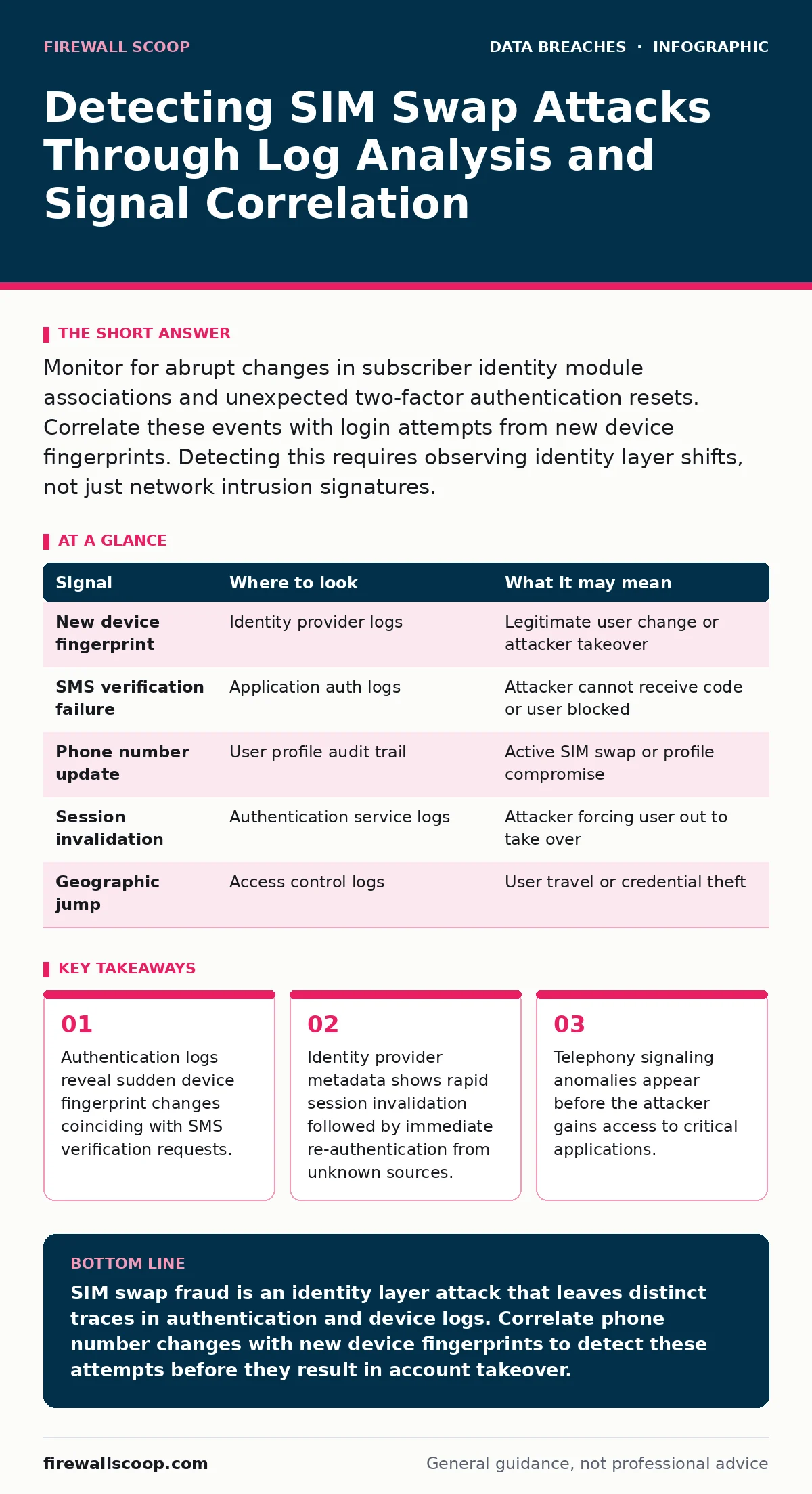
Monitor for abrupt changes in subscriber identity module associations and unexpected two-factor authentication resets. Correlate these events with login attempts from new device fingerprints. Detecting this requires observing identity layer shifts, not just network intrusion signatures.
The Identity Layer Shift
SIM swap fraud does not involve breaking into your network. It involves convincing your telecommunications provider to move your phone number to a different device. This is an identity attack, not a network intrusion. The attacker gains control of the SMS channel that serves as the second factor in your authentication process.
When this happens, your security tools often look at the wrong layer. You might monitor for brute force attacks or SQL injection. Those tools remain silent because the attacker is not attacking the application code. They are attacking the verification mechanism that sits between the user and the application.
You must treat the mobile number as a high-privilege credential. If that credential moves to a new device without user initiation, the security boundary has been breached. The evidence of this breach appears in identity logs, not firewall logs.
Authentication Log Anomalies
The first reliable signal appears in your identity provider logs. Look for a sequence where a user’s associated phone number changes, or where a new mobile device registers for two-factor authentication. This is often preceded by a request to reset the SMS verification method.
Many systems treat a phone number change as a routine profile update. This is a dangerous assumption. A sudden change in the recovery contact information, especially when combined with a password reset, indicates an active takeover attempt.
Check for the timestamp correlation. If the phone number update happens within minutes of a login attempt from a new geographic location or device fingerprint, the risk is high. The attacker is racing to secure access before the legitimate user notices.
Device Fingerprint Divergence
Modern applications collect device intelligence during login. This includes browser headers, operating system details, and installed plugins. When a SIM swap occurs, the attacker logs in from their own device.
Your logging system should record these device fingerprints. Compare the current session’s fingerprint against the historical baseline for that user account. A complete mismatch in hardware identifiers suggests the user is not on their usual machine.
This divergence is subtle. The user might have changed phones legitimately. However, when combined with an SMS verification request from a new number or a change in the registered mobile identifier, the pattern becomes distinct. The attacker is using their device to receive the code sent to the victim’s number.
| Signal | Where to look | What it may mean |
|---|---|---|
| New device fingerprint | Identity provider logs | Legitimate user change or attacker takeover |
| SMS verification failure | Application auth logs | Attacker cannot receive code or user blocked |
| Phone number update | User profile audit trail | Active SIM swap or profile compromise |
| Session invalidation | Authentication service logs | Attacker forcing user out to take over |
| Geographic jump | Access control logs | User travel or credential theft |
Telephony Signaling Indicators
If you have access to detailed carrier logs or use a specialized secure voice platform, you can see signaling events. These are technical messages between networks that establish a call or text session.
Look for a sudden loss of service on the victim’s device followed by immediate service activation on a new international mobile subscriber identity. This is the technical definition of a SIM swap. The old SIM card becomes invalid, and the new one becomes active.
Most organizations do not have direct access to carrier signaling. However, you can infer this from application behavior. If the user reports no signal while your logs show successful SMS delivery to their number, the phone number has moved. The messages are going to a device that is not the user’s.
Common Blind Spots in Detection
Many security teams miss SIM swap fraud because they rely on the application layer alone. The application sees a valid password and a valid two-factor code. It assumes the user is legitimate.
The blind spot is the assumption that the SMS channel is secure. It is not. The SMS protocol was designed for reliability, not security. It lacks end-to-end encryption and relies on trust in the telecommunications infrastructure.
Another blind spot is the delay in detection. By the time the user notices their phone has lost service, the attacker may have already changed passwords, added recovery emails, or initiated data exfiltration. The window for detection is often minutes, not hours.
You must also consider the social engineering vector. The attacker often calls the carrier pretending to be the user. This means the fraud starts long before any log entry appears in your security information and event management system. The first evidence is often a support ticket from the user claiming lost service.
See also: Detect Employee Data Breaches: Log Signals and Blind Spots · How to Detect Kerberoasting: Signals, Logs, and Hidden Blind Spots
Integrating Signals for Response
Detecting this fraud requires connecting disparate data points. You need to link identity changes, device fingerprinting, and geographic anomalies. Siloed logs hide the pattern.
Automate the correlation. Create rules that trigger an alert when a phone number change occurs within a short window of a new device login. This reduces the time to detection from days to seconds.
Do not rely on manual review for these events. The speed of the attack outpaces human response. Automated blocking of the session or requiring a secondary, non-SMS verification method is necessary.
This approach aligns with broader data retention policies. You must keep logs long enough to reconstruct the timeline of the attack. Short retention periods make it impossible to correlate the initial signal with the final breach.
Strengthening the Verification Channel
The most effective defense is to remove SMS from the authentication chain. Push notifications to an authenticator app or hardware security keys do not rely on the mobile network. They rely on the device itself.
If you must use SMS, monitor for the signals described above. Treat the mobile number as a credential that can be stolen. Rotate it as frequently as you rotate passwords.
Integrate these checks into your database security strategy. Ensure that user profile changes are logged with the same rigor as database access. The identity layer is part of the data integrity equation.
Linking to Broader Security Controls
SIM swap fraud is often a precursor to more severe breaches. Once the attacker controls the account, they may access sensitive information. This connects directly to data leaks if the account contains private communications or financial details.
It also highlights the importance of encryption at rest. If the attacker gains access to the account, encrypted data remains protected from immediate exfiltration. However, they can still reset passwords and lock out the legitimate user.
For organizations adhering to ISO 27001, this is a control failure in identity management. The standard requires monitoring and review of user access. SIM swap detection is a specific implementation of that requirement.
Consider employee data breaches as a related risk. Internal actors may facilitate SIM swaps or use them to access corporate resources. Monitoring for these patterns protects against both external fraud and internal misuse.
Key takeaways
- Authentication logs reveal sudden device fingerprint changes coinciding with SMS verification requests.
- Identity provider metadata shows rapid session invalidation followed by immediate re-authentication from unknown sources.
- Telephony signaling anomalies appear before the attacker gains access to critical applications.
SIM swap fraud is an identity layer attack that leaves distinct traces in authentication and device logs. Correlate phone number changes with new device fingerprints to detect these attempts before they result in account takeover.
Frequently asked questions
How long does it take for a SIM swap to be detected?
Detection depends on log correlation speed. Automated systems can flag anomalies in real-time, while manual review may take hours or days, allowing the attacker to secure access.
Can hardware keys prevent SIM swap attacks?
Yes, hardware security keys are bound to the physical device. They do not rely on the mobile network, so moving the phone number does not grant the attacker access to the authentication factor.
What logs are most critical for investigation?
Identity provider logs showing profile changes, application logs showing device fingerprints, and telephony logs showing service activation are the most critical sources of evidence.
Does two-factor authentication protect against SIM swaps?
Only if the second factor is not SMS. Authenticator apps and hardware keys protect against SIM swaps, while SMS codes do not because the attacker controls the SMS channel.
How this guide was produced: written by the Firewall Scoop editorial team with AI assistance, checked against the public references listed below, and reviewed when the facts change. See our editorial policy or report an error.