Red Teaming Meaning: How Simulated Attacks Reveal Hidden Risks
Red teaming exposes how attackers chain minor flaws into major breaches, forcing organizations to fix systemic weaknesses rather than isolated configuration errors.

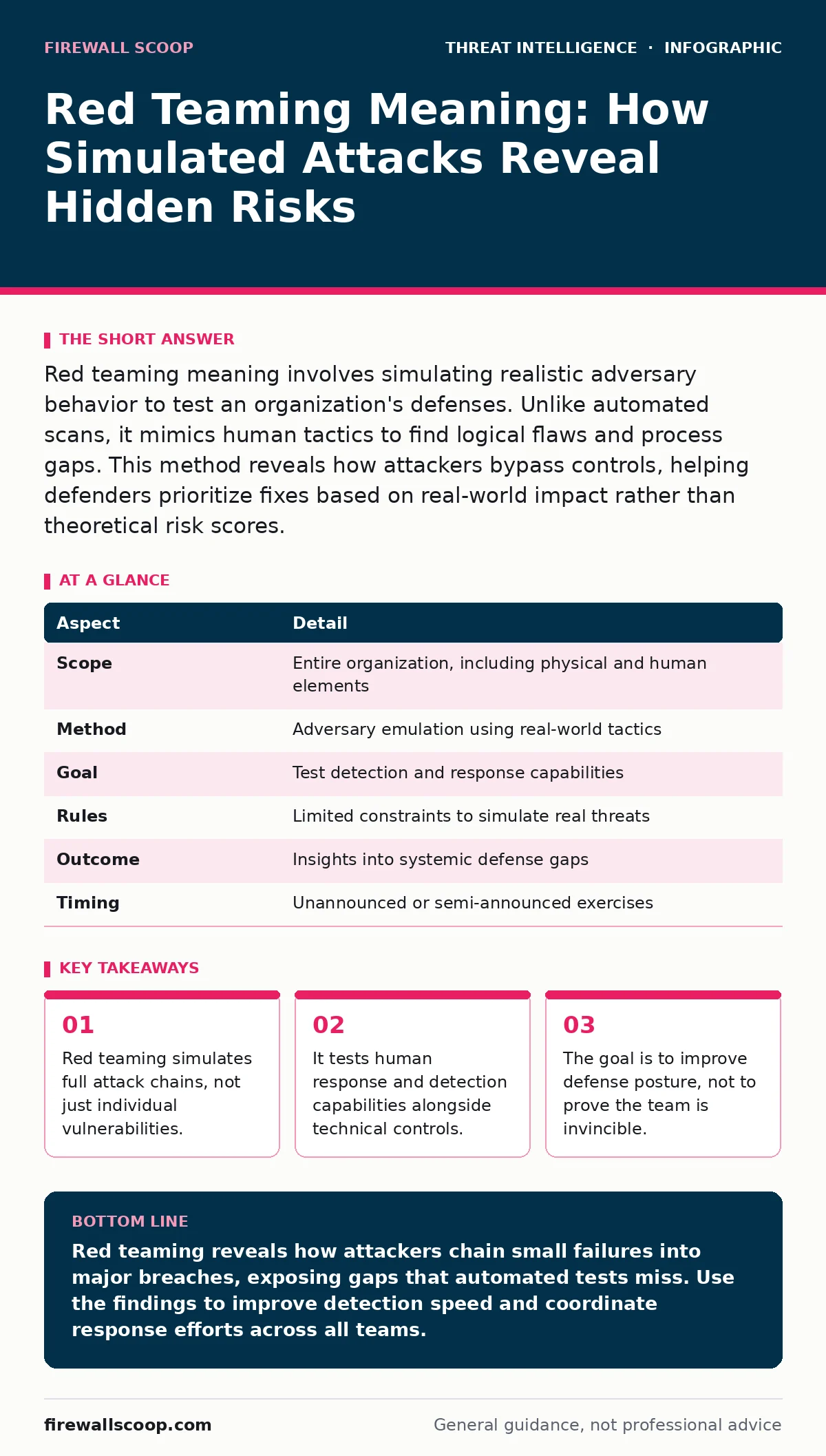
Red teaming meaning involves simulating realistic adversary behavior to test an organization's defenses. Unlike automated scans, it mimics human tactics to find logical flaws and process gaps. This method reveals how attackers bypass controls, helping defenders prioritize fixes based on real-world impact rather than theoretical risk scores.
The Core Concept Behind Red Teaming Meaning
Imagine a bank hiring safe-crackers to test its vault. They do not just check if the lock works. They try to trick guards, pick pockets, and find structural weaknesses. Red teaming meaning follows this same logic. It assigns a group to think and act like adversaries. This team attempts to breach systems, bypass policies, and exfiltrate data. The goal is not to cause harm. The goal is to prove that defenses fail under pressure.
How Red Teaming Differs from Other Assessments
Many organizations confuse red teaming with penetration testing. Penetration testing scans for known vulnerabilities. It checks if servers have unpatched software. It operates within strict rules and time limits. Red teaming operates differently. It ignores specific targets. It searches for any path to success. It uses social engineering, physical intrusion, and digital attacks. It mimics the patience and adaptability of real criminals.
| Aspect | Detail |
|---|---|
| Scope | Entire organization, including physical and human elements |
| Method | Adversary emulation using real-world tactics |
| Goal | Test detection and response capabilities |
| Rules | Limited constraints to simulate real threats |
| Outcome | Insights into systemic defense gaps |
| Timing | Unannounced or semi-announced exercises |
Red teaming requires a broader mandate. It often takes weeks or months. It tests the entire kill chain. It evaluates how security tools alert defenders. It measures how quickly teams contain incidents. This holistic view provides value that isolated tests cannot match. Organizations gain insight into their true resilience.
The Phases of a Red Team Engagement
Red teaming follows a structured lifecycle. It begins with intelligence gathering. The team researches the target. They map the network architecture. They identify key personnel. They look for exposed data in public records. This phase mirrors how real attackers prepare. It requires patience and thoroughness. Rushing this step leads to shallow assessments.
Next comes the weaponization phase. The team crafts attacks. They create phishing templates. They develop exploit code. They prepare physical access tools. These assets must be tailored to the target. Generic tools often fail against modern defenses. Customization increases the chance of success. It also makes the simulation more realistic.
The delivery phase follows. The team launches attacks. They send emails. They attempt to bypass firewalls. They try to gain physical entry. They monitor for detection. If defenders spot the activity, the exercise may end. The team notes which alerts fired. They record which alerts were ignored. This data is valuable for tuning defenses.
What Red Teaming Actually Tests
Red teaming tests more than software. It tests processes and people. It evaluates incident response plans. It checks if communication channels work under stress. It sees if leadership receives timely updates. It measures the speed of containment. These non-technical factors often determine success. A strong firewall means little if responders cannot coordinate.
Technical controls are also evaluated. The team tests endpoint detection. They assess network monitoring. They check identity management systems. They look for privilege escalation paths. They attempt to move laterally. This movement tests segmentation. Poor segmentation allows attackers to spread. Red teaming highlights these architectural flaws.
Common Misconceptions About Red Team Operations
Many believe red teaming is just hacking. This view is too narrow. Hacking is a tactic. Red teaming is a strategy. It includes deception and manipulation. It targets the weakest link. That link is often human. Employees may be tricked into handing over credentials. Physical security may be bypassed by tailgating. These methods are valid in red teaming.
Another mistake is assuming red teaming finds all vulnerabilities. It does not. It finds exploitable paths. Some vulnerabilities are too theoretical. Some require rare conditions. Red teaming focuses on realistic scenarios. It prioritizes likely threats. It ignores unlikely edge cases. This focus saves resources. It directs effort toward high-risk areas.
Some organizations fear red teaming will disrupt operations. Proper planning prevents this. Rules of engagement define boundaries. They protect critical systems. They ensure business continuity. Clear communication is key. Defenders must know a test is happening. They should not treat it as a real breach. Confusion causes unnecessary panic.
See also: Threat Hunting Best Practices: 7 Methods to Find Hidden Threats · 7 Persistence Mistakes That Keep Attackers Inside Your Network
Integrating Findings Into Defense Strategy
The value of red teaming lies in the aftermath. The report is not the end. It is the beginning. Defenders must analyze the findings. They must identify root causes. They must fix systemic issues. Patching one server is insufficient. Improving the patching process is better. Training staff is necessary. Updating detection rules is required.
This integration requires cross-team collaboration. Security, IT, and management must work together. They must share insights. They must align on priorities. Red teaming results should feed into risk management. They should influence budget decisions. They should shape security architecture. Ignoring findings wastes the investment. Acting on them builds resilience.
The Role of Threat Intelligence in Red Teaming
Red teaming relies on accurate threat intelligence. Teams model their attacks on real adversaries. They use known tactics and techniques. They mimic specific threat actors. This makes the simulation relevant. It prepares defenders for likely attacks. Generic attacks do not reflect reality. Tailored attacks do.
Organizations should consult cyber threat intelligence sources. They should understand their industry risks. They should know who targets them. This context shapes the red team's approach. It ensures the test is meaningful. It avoids wasted effort on irrelevant threats. Intelligence drives the narrative. It guides the attack path. It validates the defense strategy.
RELATED: Understanding cyber threat intelligence helps you select the right adversary models for your red team exercises.
Best Practices for Effective Red Team Programs
Start with clear objectives. Define what you want to test. Choose relevant adversary models. Set strict rules of engagement. Ensure all stakeholders understand the scope. Provide a debrief session. Discuss findings openly. Focus on learning, not blaming. Encourage defenders to share their perspective. This builds trust. It improves future cooperation.
Rotate red team members. Fresh perspectives find new gaps. Regular teams become predictable. They may rely on old methods. Variation keeps defenses honest. It tests different attack vectors. It prevents complacency. Schedule exercises regularly. Annual tests are insufficient. Quarterly or biannual tests are better. They keep skills sharp. They track progress over time.
RELATED: Implementing deception technology can help you detect when red teamers or real attackers bypass your perimeter controls.
RELATED: Use Traffic Light Protocol standards to share sensitive findings securely with different stakeholder groups during the debrief.
RELATED: Analyze logs with user and entity behavior analytics to spot the subtle anomalies that red teamers leave behind.
RELATED: Consider how ISACs share industry-specific threat data, which can inform the tactics your red team should emulate.
RELATED: Review Kerberoasting techniques to understand how attackers extract credentials from Active Directory environments during lateral movement.
RELATED: Explore how cyber espionage groups operate to better model the patience and resourcefulness of advanced adversaries.
Key takeaways
- Red teaming simulates full attack chains, not just individual vulnerabilities.
- It tests human response and detection capabilities alongside technical controls.
- The goal is to improve defense posture, not to prove the team is invincible.
Red teaming reveals how attackers chain small failures into major breaches, exposing gaps that automated tests miss. Use the findings to improve detection speed and coordinate response efforts across all teams.
Frequently asked questions
Is red teaming legal?
Red teaming is legal when authorized by the organization. Written permission must define the scope and rules. Unauthorized testing is illegal and constitutes a cybercrime. Always ensure proper contracts and legal review.
How long does a red team engagement take?
Engagements vary in duration. Simple tests may take a few weeks. Complex simulations can last months. The timeline depends on the scope, rules of engagement, and depth of analysis required.
Can we red team our cloud environment?
Yes, cloud environments are common targets. Red teaming in the cloud tests identity management, configuration errors, and access controls. Providers often have specific rules for security testing. Check their policies before starting.
What is the difference between a purple team and a red team?
Red teams attack. Blue teams defend. Purple teams combine both. They collaborate during the exercise. Blue teams improve detection while red teams attack. This real-time feedback accelerates learning and improves security posture faster.
How this guide was produced: written by the Firewall Scoop editorial team with AI assistance, checked against the public references listed below, and reviewed when the facts change. See our editorial policy or report an error.