Federated Identity Checklist: Verify Trust and Reduce Risk
Federated identity shifts trust from passwords to cryptographic assertions, creating a single point of failure that attackers target with precision rather than brute force.

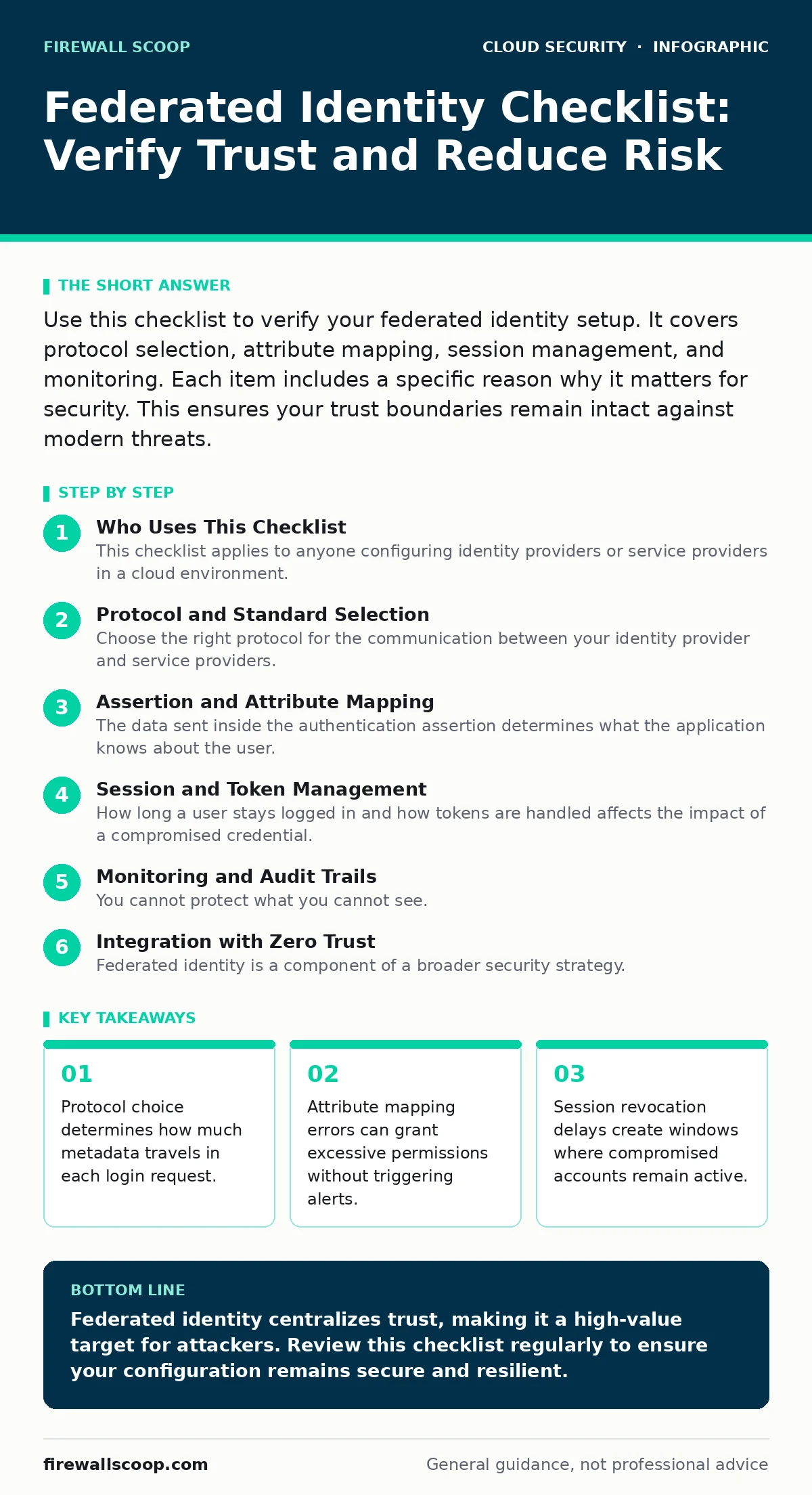
Use this checklist to verify your federated identity setup. It covers protocol selection, attribute mapping, session management, and monitoring. Each item includes a specific reason why it matters for security. This ensures your trust boundaries remain intact against modern threats.
Who Uses This Checklist
This checklist applies to anyone configuring identity providers or service providers in a cloud environment. You use it to verify that trust between systems is explicit and limited. Do not treat this as a one-time setup task. Review these items whenever you add a new application or change your identity provider configuration. The goal is to ensure that when one system says "this user is allowed," the other system trusts that statement only under strict conditions.
Protocol and Standard Selection
Choose the right protocol for the communication between your identity provider and service providers. The protocol dictates how authentication data is packaged and verified.
- Use SAML 2.0 or OIDC: These standards provide well-defined structures for authentication assertions and reduce parsing errors.
- Disable legacy protocols like LDAP bind: Older protocols often transmit credentials in ways that are harder to audit or encrypt effectively.
- Enforce TLS 1.2 or higher: Transport Layer Security encrypts the connection between the user, the provider, and the application.
- Validate certificate chains: Ensure the service provider verifies the digital signature of the identity provider to prevent spoofing.
Assertion and Attribute Mapping
The data sent inside the authentication assertion determines what the application knows about the user. Incorrect mapping can lead to privilege escalation or data leakage.
- Map only required attributes: Sending unnecessary data like email or phone number increases the attack surface if the assertion is intercepted.
- Use standard claim names: Non-standard attribute names may cause the application to ignore security groups or roles.
- Restrict group claims: Ensure only authorized groups are mapped to application roles to prevent unauthorized access.
- Validate attribute formats: Enforce strict formatting for emails or IDs to prevent injection attacks in downstream systems.
Session and Token Management
How long a user stays logged in and how tokens are handled affects the impact of a compromised credential. Short-lived tokens limit the window of opportunity for attackers.
- Set short access token lifetimes: Short-lived tokens reduce the value of a stolen token because it expires quickly.
- Implement refresh token rotation: Rotating tokens ensures that a stolen refresh token cannot be reused after a single use.
- Define single sign-on session timeouts: A global timeout ensures that inactive sessions are terminated, even if the application does not enforce it.
- Disable implicit flow in OIDC: The implicit flow exposes tokens in the browser URL, making them visible to malicious extensions or logs.
Monitoring and Audit Trails
You cannot protect what you cannot see. Federated identity logs must capture enough detail to reconstruct an attack.
- Log authentication events: Record every login attempt, including success and failure, with timestamps and source IPs.
- Capture assertion details: Log the attributes and claims sent in each assertion to detect abnormal patterns.
- Monitor for impossible travel: Flag logins that occur from geographically distant locations in a short time frame.
- Alert on new client registrations: Unauthorized applications registering with your identity provider indicate a potential breach.
See also: Kubernetes Admission Controllers: Enforce Policy Before Workloads Start · Firewalls in Cloud Computing: How They Work and Where They Fail
Integration with Zero Trust
Federated identity is a component of a broader security strategy. It works best when combined with other controls that verify trust continuously.
- Integrate with zero trust network access: Use federated identity to authenticate users, then enforce device health checks before granting access.
- Link to cloud workload protection: Ensure that identity context is available to workload protection platforms for better threat detection.
- Support microsegmentation: Use identity attributes to define network segments, limiting lateral movement if an account is compromised.
- Coordinate with SaaS access reviews: Regularly review which applications have access to your identity provider to remove unused integrations.
Common Misconfigurations
Many breaches occur not because the technology failed, but because it was configured incorrectly. Watch for these common pitfalls.
- Avoid wildcard trust relationships: Trusting all issuers or all audiences allows attackers to forge assertions from any source.
- Disable self-service registration: Allowing users to register their own applications bypasses security reviews and control.
- Prevent password-based fallbacks: If federated identity fails, do not fall back to local password authentication, as this defeats the purpose.
- Test with misconfigured clients: Regularly test how your system handles malformed or malicious assertions to ensure resilience.
Related Security Practices
Federated identity does not exist in isolation. It interacts with other security domains that require separate attention.
- Review secure access service edge (SASE) integration: Ensure that identity context is preserved when traffic moves through the edge network.
- Check for CI/CD pipeline attacks: Secure the pipelines that deploy identity configurations to prevent tampering during updates.
- Assess cloud access security brokers (CASB): Use CASB tools to monitor how federated identity is used across various cloud applications.
- Evaluate insecure container images: Ensure that containers running identity services are patched and secure to prevent compromise.
Key takeaways
- Protocol choice determines how much metadata travels in each login request.
- Attribute mapping errors can grant excessive permissions without triggering alerts.
- Session revocation delays create windows where compromised accounts remain active.
Federated identity centralizes trust, making it a high-value target for attackers. Review this checklist regularly to ensure your configuration remains secure and resilient.
Frequently asked questions
What is the difference between SAML and OIDC?
SAML uses XML-based assertions and is common in enterprise environments, while OIDC uses JSON Web Tokens and is better suited for modern web and mobile applications.
Can federated identity prevent all types of attacks?
No, federated identity reduces the risk of password theft but does not protect against compromised accounts, insider threats, or misconfigured applications.
How often should I review my federated identity configuration?
Review your configuration after every major change, such as adding a new application or changing security policies, and at least quarterly for general health.
What happens if my identity provider goes down?
Users will be unable to authenticate to federated applications. Ensure you have a disaster recovery plan and, if necessary, a fallback authentication method that is secure.
How this guide was produced: written by the Firewall Scoop editorial team with AI assistance, checked against the public references listed below, and reviewed when the facts change. See our editorial policy or report an error.