Common SASE Mistakes and How to Avoid Them
Secure access service edge fails when organizations treat it as a perimeter replacement rather than an identity-centric enforcement layer, leaving lateral movement open.

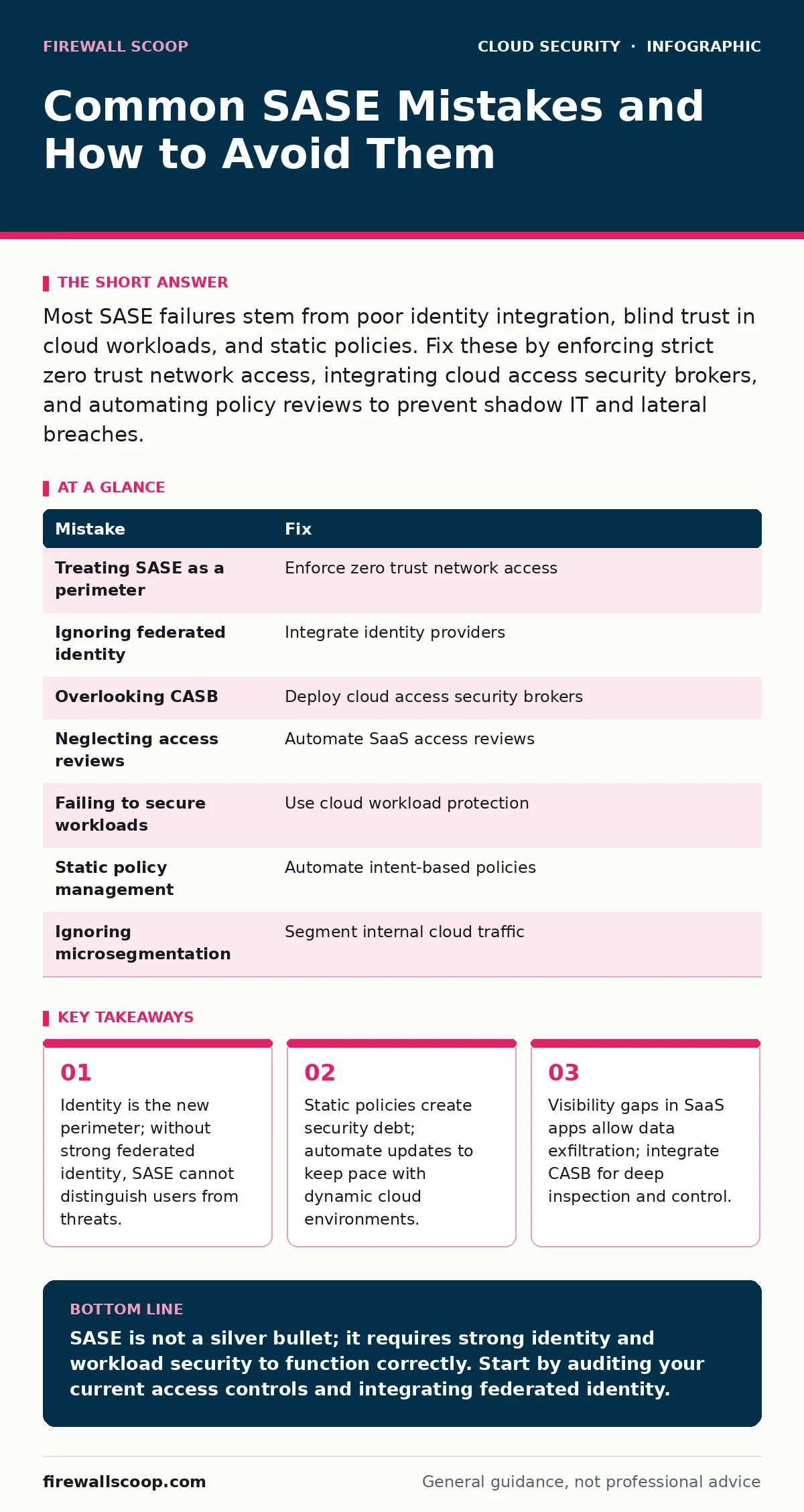
Most SASE failures stem from poor identity integration, blind trust in cloud workloads, and static policies. Fix these by enforcing strict zero trust network access, integrating cloud access security brokers, and automating policy reviews to prevent shadow IT and lateral breaches.
Mistake 1: Treating SASE as a Virtual Perimeter
Many organizations deploy secure access service edge expecting it to act like a traditional firewall sitting at the network edge. This mindset ignores the distributed nature of modern work. Users connect from everywhere, not just one gateway.
Why it hurts: When you rely on IP-based rules, you miss the context of the user. An attacker who steals credentials looks identical to a legitimate employee from the network perspective. The system grants access because the source IP is trusted, not because the user is verified. This leads to unauthorized access that bypasses security controls.
The fix: Shift your focus from network location to identity. Implement zero trust network access principles where every request is authenticated and authorized. Use continuous verification rather than one-time login checks. This ensures that access follows the user, not the network segment.
Mistake 2: Ignoring Federated Identity Integration
Some teams configure SASE to authenticate users directly against local directories without leveraging identity providers. This creates a siloed authentication process. It fragments the login experience and weakens security posture.
Why it hurts: Without federated identity, you cannot enforce single sign-on or multi-factor authentication consistently. Users may bypass security prompts, and administrators lose visibility into login attempts. Credential stuffing attacks succeed because the SASE layer does not challenge the identity properly. The system grants access based on weak or cached credentials.
The fix: Integrate your SASE platform with an identity provider that supports standard protocols. This allows you to enforce multi-factor authentication and adaptive access policies. The identity provider becomes the source of truth for user status. If an account is disabled, access stops immediately across all services.
Mistake 3: Overlooking Cloud Access Security Brokers
Organizations often connect SASE to SaaS applications without inspecting the traffic. They assume that because the connection is encrypted, it is safe. This leaves a blind spot for data exfiltration and malware.
Why it hurts: SASE provides connectivity, but it does not always understand application context. Without a cloud access security broker, you cannot see what users do inside a SaaS app. Shadow IT applications go undetected, and sensitive data leaves the organization through approved channels. You cannot enforce data loss prevention rules effectively.
The fix: Deploy a CASB within your SASE architecture. This tool inspects traffic to and from SaaS applications. It enforces policies based on user behavior and data sensitivity. It blocks unauthorized uploads and detects anomalous access patterns. This adds a layer of application-aware security on top of network security.
Mistake 4: Neglecting SaaS Access Reviews
Teams set up broad access permissions to reduce friction for employees. They rarely revisit these permissions. This leads to privilege creep and unnecessary exposure.
Why it hurts: Employees change roles, leave the company, or no longer need certain tools. If access is not reviewed, former employees or internal threats retain high-level privileges. This increases the attack surface significantly. Attackers exploit these orphaned accounts to move laterally within the environment.
The fix: Implement regular SaaS access reviews. Automate the process to ensure it happens consistently. Revoke access that is no longer needed. Align permissions with the principle of least privilege. This reduces the number of entry points available to attackers.
Mistake 5: Failing to Secure Cloud Workloads
Many assume that SASE protects all cloud resources. It primarily secures access from users to cloud services. It does not protect the workloads themselves from external attacks or internal compromises.
Why it hurts: If a cloud instance is compromised, SASE may not detect the malicious activity. The attacker operates from within the trusted cloud environment. Traditional SASE policies focus on inbound traffic from users, not east-west traffic between workloads. This leaves critical infrastructure vulnerable to ransomware and data theft.
The fix: Complement SASE with cloud workload protection platforms. These tools monitor the health and security of cloud instances. They detect anomalies in system calls and network behavior. They provide visibility into the workload itself, not just the access to it. This creates a defense-in-depth strategy.
See also: Kubernetes Admission Controllers: Enforce Policy Before Workloads Start · Firewalls in Cloud Computing: How They Work and Where They Fail
Mistake 6: Static Policy Management
Administrators write SASE policies once and rarely update them. They rely on manual adjustments when changes occur. This approach does not scale with dynamic cloud environments.
Why it hurts: Cloud environments change rapidly. New applications are deployed, and users move between locations. Static policies become outdated quickly. They either block legitimate traffic, causing productivity loss, or allow risky behavior due to overly broad rules. This creates security debt that is hard to manage.
The fix: Automate policy management using intent-based networking. Define security goals in plain language, and let the system generate and update the underlying rules. Monitor policy effectiveness and adjust based on real-time data. This ensures that security keeps pace with business changes.
Mistake 7: Ignoring Microsegmentation
Organizations treat the cloud as a flat network. They rely on SASE for perimeter security but do not segment internal traffic. This allows lateral movement if a breach occurs.
Why it hurts: If an attacker compromises one system, they can move freely to others. SASE controls access from the outside, but it does not restrict movement inside the cloud. This turns a single point of failure into a full network compromise. The blast radius of an attack becomes unmanageable.
The fix: Implement microsegmentation within your cloud environment. Define strict boundaries between workloads and services. Allow only necessary communication between segments. This limits the impact of a breach. Even if an attacker enters the network, they cannot move laterally to critical assets.
| Mistake | Fix |
|---|---|
| Treating SASE as a perimeter | Enforce zero trust network access |
| Ignoring federated identity | Integrate identity providers |
| Overlooking CASB | Deploy cloud access security brokers |
| Neglecting access reviews | Automate SaaS access reviews |
| Failing to secure workloads | Use cloud workload protection |
| Static policy management | Automate intent-based policies |
| Ignoring microsegmentation | Segment internal cloud traffic |
Key takeaways
- Identity is the new perimeter; without strong federated identity, SASE cannot distinguish users from threats.
- Static policies create security debt; automate updates to keep pace with dynamic cloud environments.
- Visibility gaps in SaaS apps allow data exfiltration; integrate CASB for deep inspection and control.
SASE is not a silver bullet; it requires strong identity and workload security to function correctly. Start by auditing your current access controls and integrating federated identity.
Frequently asked questions
Does SASE replace a traditional firewall?
No, SASE complements firewalls by extending security to distributed users. It focuses on identity and cloud access, while firewalls often handle on-premises network traffic.
Is SASE suitable for small businesses?
Yes, SASE can be cost-effective for small businesses. It eliminates the need for complex on-premises hardware and scales easily with user growth.
How does SASE handle encrypted traffic?
SASE decrypts and inspects traffic at the edge. This allows it to detect threats hidden in encrypted communications. Ensure you have the legal right to inspect this traffic.
Can SASE protect against insider threats?
SASE helps detect insider threats by monitoring user behavior. It enforces least privilege access and logs all activities. However, it works best when combined with user behavior analytics.
How this guide was produced: written by the Firewall Scoop editorial team with AI assistance, checked against the public references listed below, and reviewed when the facts change. See our editorial policy or report an error.