How Zero Trust Network Access Works: The Step-by-Step Mechanism
Zero Trust Network Access replaces network perimeter trust with continuous, granular identity verification for every single request.

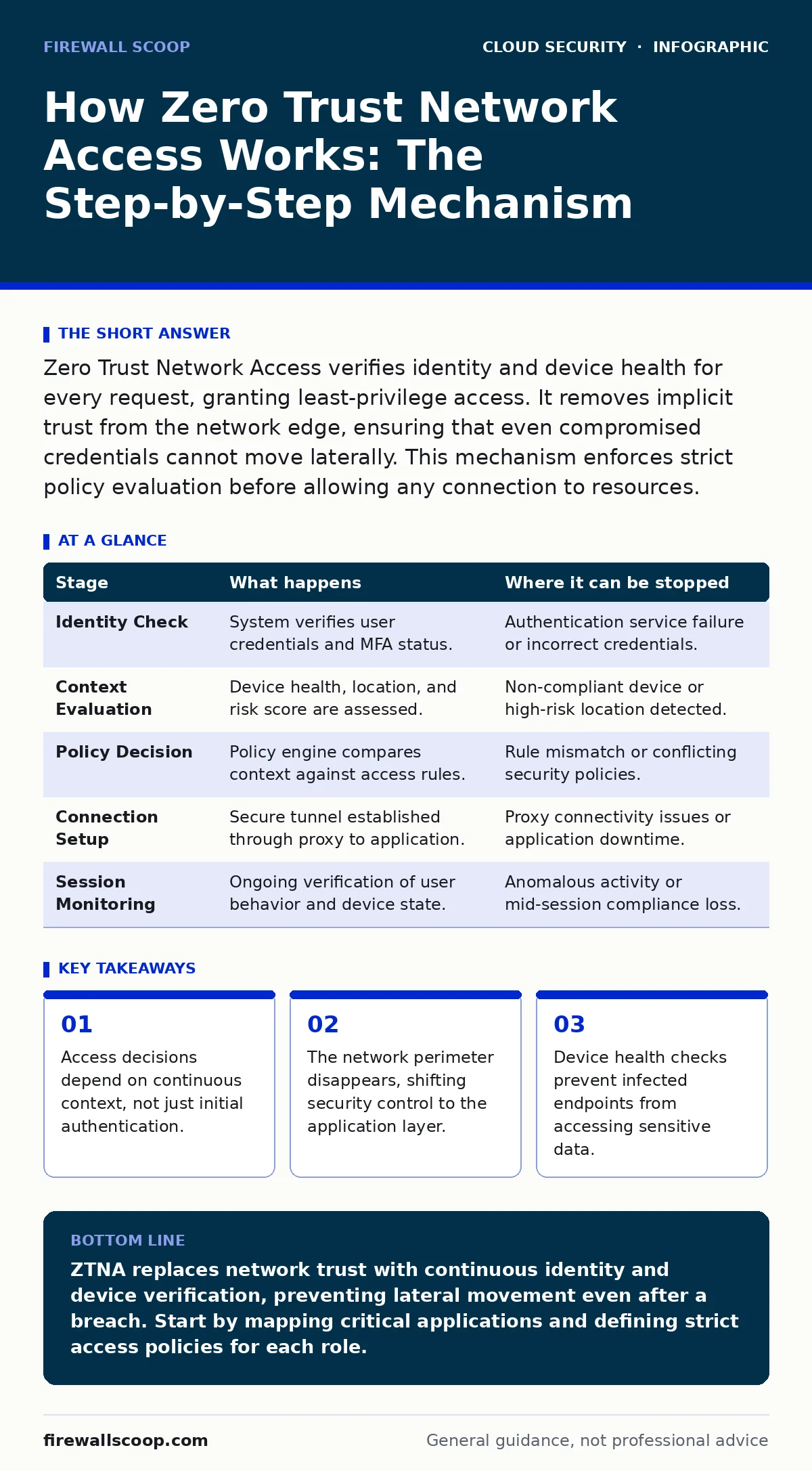
Zero Trust Network Access verifies identity and device health for every request, granting least-privilege access. It removes implicit trust from the network edge, ensuring that even compromised credentials cannot move laterally. This mechanism enforces strict policy evaluation before allowing any connection to resources.
The End of Implicit Trust
Traditional security models rely on a castle-and-moat approach. Once you cross the outer wall, the interior is considered safe. This assumption fails when attackers breach the perimeter or when users work from unsecured networks. Zero Trust Network Access (ZTNA) discards this premise entirely. It assumes breach and verifies every request as if it originates from an untrusted network.
This shift changes how you design access. You no longer ask if a user is inside the network. You ask if the specific identity, device, and context of that user allow access to a specific resource at this exact moment. This granular focus reduces the attack surface significantly.
Architecture and Policy Engine
At the core of ZTNA is a policy engine. This component evaluates access requests against defined rules. These rules consider multiple factors, including user identity, device status, location, and time of access. The engine does not store data; it makes decisions. It acts as the brain of the operation, determining whether traffic should flow or be blocked.
The policy engine communicates with identity providers and device compliance tools. It aggregates this data to form a complete picture of the request. If any factor fails to meet the threshold, access is denied. This continuous evaluation happens in milliseconds, often before the user perceives any delay.
Identity and Context Verification
Access begins with authentication. This is not merely a username and password check. Modern ZTNA implementations require multi-factor authentication to confirm identity. Beyond who the user is, the system verifies the context. It checks the device operating system version, patch level, and presence of security agents.
Imagine a user attempting to access a financial database from a personal tablet. The system identifies the user correctly but notes the device lacks encryption. The policy engine denies access, regardless of the correct password. This prevents data leakage from compromised or non-compliant devices. This step ensures that only trusted identities on trusted devices proceed.
The Access Proxy and Tunneling
Once verified, the user does not connect directly to the application server. Instead, the connection routes through a ZTNA proxy or connector. This proxy sits between the user and the application. It terminates the external connection and initiates a new, internal connection to the resource. This process creates a secure tunnel.
This tunnel hides the application from the public internet. The application server sees only the proxy, not the end user. This concealment protects the application from direct scanning and attacks. It also allows the proxy to inspect traffic for anomalies. If the traffic pattern changes mid-session, the proxy can terminate the connection immediately.
Least Privilege Enforcement
ZTNA enforces the principle of least privilege. Users receive only the access necessary for their current task. They cannot see or interact with other resources, even if they are on the same network segment. This isolation prevents lateral movement. An attacker who compromises one account cannot pivot to other systems.
The system grants access to specific applications or APIs, not entire networks. This granular control reduces the risk of accidental exposure. It also simplifies auditing, as every action is tied to a specific identity and resource. This precision makes it easier to detect unauthorized activities.
See also: Common SASE Mistakes and How to Avoid Them · Man-in-the-Middle Attacks: How They Work and How to Stop Them
Continuous Monitoring and Revocation
Access is not a one-time grant. ZTNA systems continuously monitor sessions. If a user’s context changes, such as a sudden location jump or a detected malware signature, the system re-evaluates the session. It can revoke access instantly without waiting for a timeout. This dynamic response minimizes the window of opportunity for attackers.
The system logs every decision and action. These logs provide visibility into user behavior and system health. They enable security teams to identify patterns and anomalies. This ongoing scrutiny ensures that trust remains conditional and temporary.
| Stage | What happens | Where it can be stopped |
|---|---|---|
| Identity Check | System verifies user credentials and MFA status. | Authentication service failure or incorrect credentials. |
| Context Evaluation | Device health, location, and risk score are assessed. | Non-compliant device or high-risk location detected. |
| Policy Decision | Policy engine compares context against access rules. | Rule mismatch or conflicting security policies. |
| Connection Setup | Secure tunnel established through proxy to application. | Proxy connectivity issues or application downtime. |
| Session Monitoring | Ongoing verification of user behavior and device state. | Anomalous activity or mid-session compliance loss. |
Integration with Broader Security
ZTNA does not operate in isolation. It integrates with other security frameworks to provide depth. For instance, it works alongside federated identity to manage access across multiple cloud providers seamlessly. This integration ensures consistent identity management without creating silos.
It also complements microsegmentation by enforcing strict boundaries within the network. While ZTNA controls access to applications, microsegmentation controls traffic between workloads. Together, they create a layered defense that limits blast radius. This combined approach addresses both external and internal threats.
Furthermore, ZTNA policies can inform SaaS access reviews. By tracking which applications users actually access, organizations can refine their permissions. This data-driven approach reduces unnecessary access rights. It also helps identify shadow IT usage that might bypass security controls.
Limitations and Operational Costs
Implementing ZTNA introduces complexity. It requires detailed knowledge of user roles and application dependencies. Mapping these relationships takes significant effort and ongoing maintenance. If policies are too restrictive, they hinder productivity. If too loose, they fail to provide adequate security.
The system also relies heavily on accurate device telemetry. If device health checks are incomplete or unreliable, the security model weakens. Organizations must ensure their endpoint management tools provide consistent data. Without this foundation, ZTNA decisions become guesswork.
Finally, ZTNA does not protect the application itself. It controls access, but it does not fix vulnerabilities in the code. You still need cloud workload protection to secure the underlying infrastructure. ZTNA is a gatekeeper, not a fix for broken applications. Understanding this distinction prevents false confidence in the security posture.
Conclusion of Mechanism
Zero Trust Network Access transforms security from a perimeter-based model to an identity-centric one. By verifying every request and enforcing least privilege, it reduces the impact of breaches. It requires careful planning and continuous monitoring to balance security and usability. When implemented correctly, it provides a resilient defense against modern threats.
Key takeaways
- Access decisions depend on continuous context, not just initial authentication.
- The network perimeter disappears, shifting security control to the application layer.
- Device health checks prevent infected endpoints from accessing sensitive data.
ZTNA replaces network trust with continuous identity and device verification, preventing lateral movement even after a breach. Start by mapping critical applications and defining strict access policies for each role.
Frequently asked questions
Does ZTNA replace a traditional firewall?
No, ZTNA focuses on identity and application access, while firewalls control network traffic based on IP addresses and ports. They serve different purposes and should work together.
How does ZTNA handle remote workers?
ZTNA treats all users as external, regardless of location. It establishes secure tunnels to applications, providing the same security for remote and on-site workers.
Is ZTNA difficult to implement?
Implementation complexity depends on existing infrastructure and policy clarity. It requires detailed mapping of users and applications, which can be time-consuming but is necessary for effective security.
Can ZTNA prevent all cyber attacks?
No security measure prevents all attacks. ZTNA reduces the attack surface and limits damage, but it does not replace other security controls like endpoint protection or vulnerability management.
How this guide was produced: written by the Firewall Scoop editorial team with AI assistance, checked against the public references listed below, and reviewed when the facts change. See our editorial policy or report an error.