Cloud Privilege Escalation: How Attackers Steal Admin Rights
A single misconfigured role can turn a read-only service account into a full administrator within minutes.

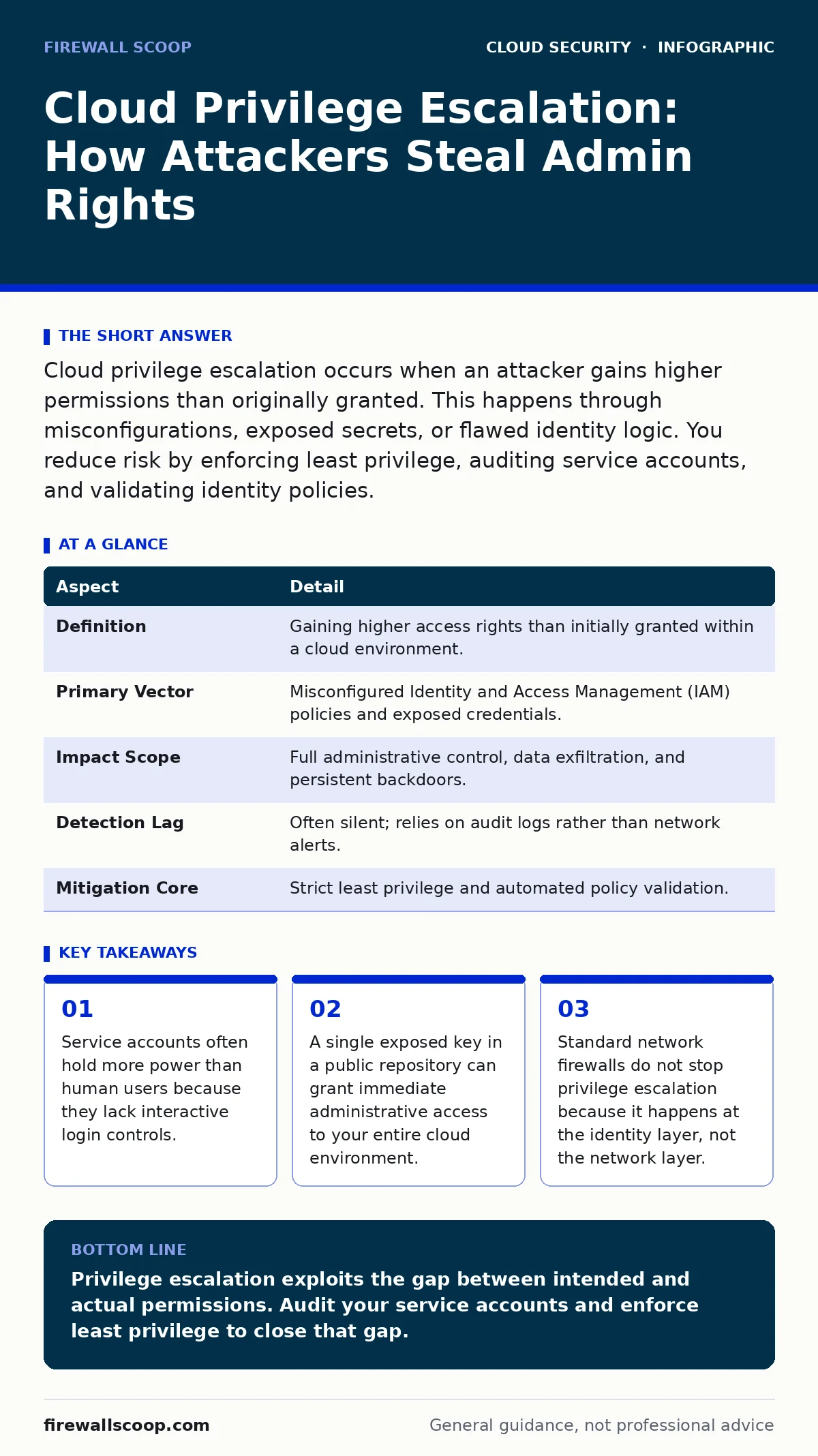
Cloud privilege escalation occurs when an attacker gains higher permissions than originally granted. This happens through misconfigurations, exposed secrets, or flawed identity logic. You reduce risk by enforcing least privilege, auditing service accounts, and validating identity policies.
The Digital Keycard Analogy
Imagine a hotel where guests receive a keycard for their room. Most guests can only enter their room and the lobby. However, a housekeeping staff member has a master key that opens every door. If a guest steals that master key, they no longer need to guess room numbers. They can walk into the manager’s office, change the locks, and kick out the real staff.
In cloud environments, the guest is a standard application or user. The housekeeping staff is a service account with elevated permissions. The master key is the credential or policy that grants those permissions. Privilege escalation is the act of stealing or abusing that master key to gain control over systems you were never meant to touch.
You do not need to break into the hotel to cause damage. You just need to find where the master key is left on a counter. Most organizations leave these keys in plain sight through poor configuration.
| Aspect | Detail |
|---|---|
| Definition | Gaining higher access rights than initially granted within a cloud environment. |
| Primary Vector | Misconfigured Identity and Access Management (IAM) policies and exposed credentials. |
| Impact Scope | Full administrative control, data exfiltration, and persistent backdoors. |
| Detection Lag | Often silent; relies on audit logs rather than network alerts. |
| Mitigation Core | Strict least privilege and automated policy validation. |
How the Escalation Chain Forms
Privilege escalation rarely happens in one step. It usually follows a chain of small failures. An attacker starts with a low-level account, such as a developer’s access to a code repository. They look for files containing secrets like API keys or private certificates.
If they find a secret, they use it to authenticate as a service account. This account might have permission to read logs or manage a specific database. The attacker then scans the cloud provider’s documentation for known privilege escalation paths. These paths are logical flaws in how permissions are granted.
For example, a policy might allow any user who can list buckets to also read the contents of those buckets. If the attacker can list buckets, they can now read sensitive data. They use that data to find another key. That key belongs to an account that can create new users. Now they can create an admin user and lock you out.
The Hidden Cost of Convenience
Developers and operators often grant broad permissions to avoid friction. It is faster to give a service account full access to a storage service than to write a policy that grants access to only three specific folders. This convenience creates a hidden attack surface.
The problem is that service accounts do not expire. Human employees leave the company, and their accounts are disabled. Service accounts often remain active for years. They accumulate permissions as projects change. A tool that once needed only read access might gain write access for a temporary fix. That fix is never removed.
Over time, these accounts become superusers. They are not protected by multi-factor authentication because machines cannot answer a security question. They are not monitored by user behavior analytics because their activity is expected to be automated. They are the perfect target for privilege escalation.
Common Forms of Escalation
There are several standard patterns attackers use to climb the privilege ladder. Understanding these patterns helps you recognize the signs before it is too late.
- Metadata Service Abuse: Cloud instances have a local endpoint that returns identity information. If an application does not restrict access to this endpoint, an attacker who compromises the application can retrieve temporary credentials. These credentials often have broad permissions.
- Role Assumption: In many cloud models, one identity can assume the role of another. If a low-privilege identity is allowed to assume a high-privilege role, the attacker simply asks the cloud provider to switch hats. The provider grants the request because the policy allows it.
- Policy Injection: Some services allow users to define their own access rules. If an attacker can modify these rules, they can grant themselves admin rights. This often happens in container environments where security policies are stored as configuration files.
- Secret Harvesting: Attackers search for hard-coded credentials in configuration files, environment variables, and code repositories. Once found, these secrets are used to authenticate as privileged accounts.
What People Usually Get Wrong
Many security teams focus on the perimeter. They build strong firewalls and encrypt data in transit. They believe that if the network is secure, the cloud is secure. This is a dangerous misconception.
Privilege escalation happens inside the network. It happens at the identity layer. Firewalls do not stop a user from using their own valid credentials to access a restricted folder. Encryption does not stop an admin from decrypting the data they are authorized to read.
Another common mistake is treating service accounts like human users. You cannot enforce password rotation on a machine. You cannot enable multi-factor authentication for a script. You must use different controls for machines, such as short-lived tokens and strict scope limitations.
See also: Cloud Metadata Service Attack Mistakes and How to Stop Them · Kubernetes Admission Controllers: Enforce Policy Before Workloads Start
Reducing the Risk
You cannot prevent every attempt, but you can make escalation difficult and noisy. The goal is to limit the damage if an account is compromised.
- Enforce Least Privilege: Grant only the permissions required for a specific task. Review these permissions regularly. Remove access that is no longer needed.
- Use Federated Identity: Connect cloud accounts to an identity provider. This allows you to centralize authentication and enable multi-factor authentication for human users. It also allows you to revoke access instantly when an employee leaves.
- Audit Service Accounts: Identify all service accounts. Remove unnecessary ones. Restrict their permissions to the minimum required. Monitor their activity for anomalies.
- Implement Microsegmentation: Divide your cloud environment into small zones. Limit communication between zones. If an attacker escalates privileges in one zone, they cannot easily move to others.
- Scan for Secrets: Use tools to scan code repositories and configuration files for hard-coded credentials. Rotate any secrets you find.
Monitoring for Silent Escalation
Privilege escalation is often silent. There is no network intrusion. There is no malware. The attacker simply uses valid credentials to do something they should not.
You must look at identity logs. Watch for unusual patterns. A service account that suddenly accesses a new resource is a red flag. A user who assumes a role they have never used before is suspicious.
Set alerts for high-privilege actions. These include creating new admin users, modifying IAM policies, and exporting large amounts of data. When these events occur, investigate immediately.
Integrate these logs into your cloud access security brokers (CASB) or security information and event management systems. Correlate identity events with network and workload data. This gives you a complete picture of what is happening.
Remember that detection is only half the battle. You must have a response plan. Know how to revoke credentials quickly. Know how to isolate compromised accounts. Practice this process regularly.
The Role of Policy as Code
Manual configuration is error-prone. People make mistakes. They forget to remove permissions. They copy-paste policies without reading them.
Treat your cloud configuration as code. Define your policies in version-controlled files. Use automated tools to validate these policies before they are applied. This prevents misconfigurations from reaching production.
You can also use policy engines to enforce rules in real-time. If someone tries to grant overly broad permissions, the system can block the request. This adds a layer of protection against accidental or malicious escalation.
Review your policies regularly. Permissions drift over time. What was necessary last year may not be necessary today. Remove stale permissions. Simplify complex policies. The simpler the policy, the easier it is to audit.
By combining strict policy management with continuous monitoring, you reduce the risk of privilege escalation. You make it harder for attackers to climb the ladder. You make it easier to spot them when they try.
Key takeaways
- Service accounts often hold more power than human users because they lack interactive login controls.
- A single exposed key in a public repository can grant immediate administrative access to your entire cloud environment.
- Standard network firewalls do not stop privilege escalation because it happens at the identity layer, not the network layer.
Privilege escalation exploits the gap between intended and actual permissions. Audit your service accounts and enforce least privilege to close that gap.
Frequently asked questions
Can privilege escalation happen if I use strong passwords?
Yes, because attackers often use stolen or misconfigured service account credentials that do not rely on passwords.
Does zero trust network access prevent privilege escalation?
It reduces risk by verifying every request, but it does not stop an attacker from using valid high-privilege credentials to perform authorized actions.
How do I find misconfigured IAM policies?
Use automated cloud security posture management tools to scan for policies that grant excessive permissions or allow public access.
What is the difference between privilege escalation and lateral movement?
Escalation is gaining higher permissions within an account, while lateral movement is moving from one account or system to another.
How this guide was produced: written by the Firewall Scoop editorial team with AI assistance, checked against the public references listed below, and reviewed when the facts change. See our editorial policy or report an error.