How Security Misconfigurations Work: Step-by-Step Exploitation Path
Default settings and forgotten permissions create open doors that attackers exploit without needing to break encryption or inject malicious code into your software.

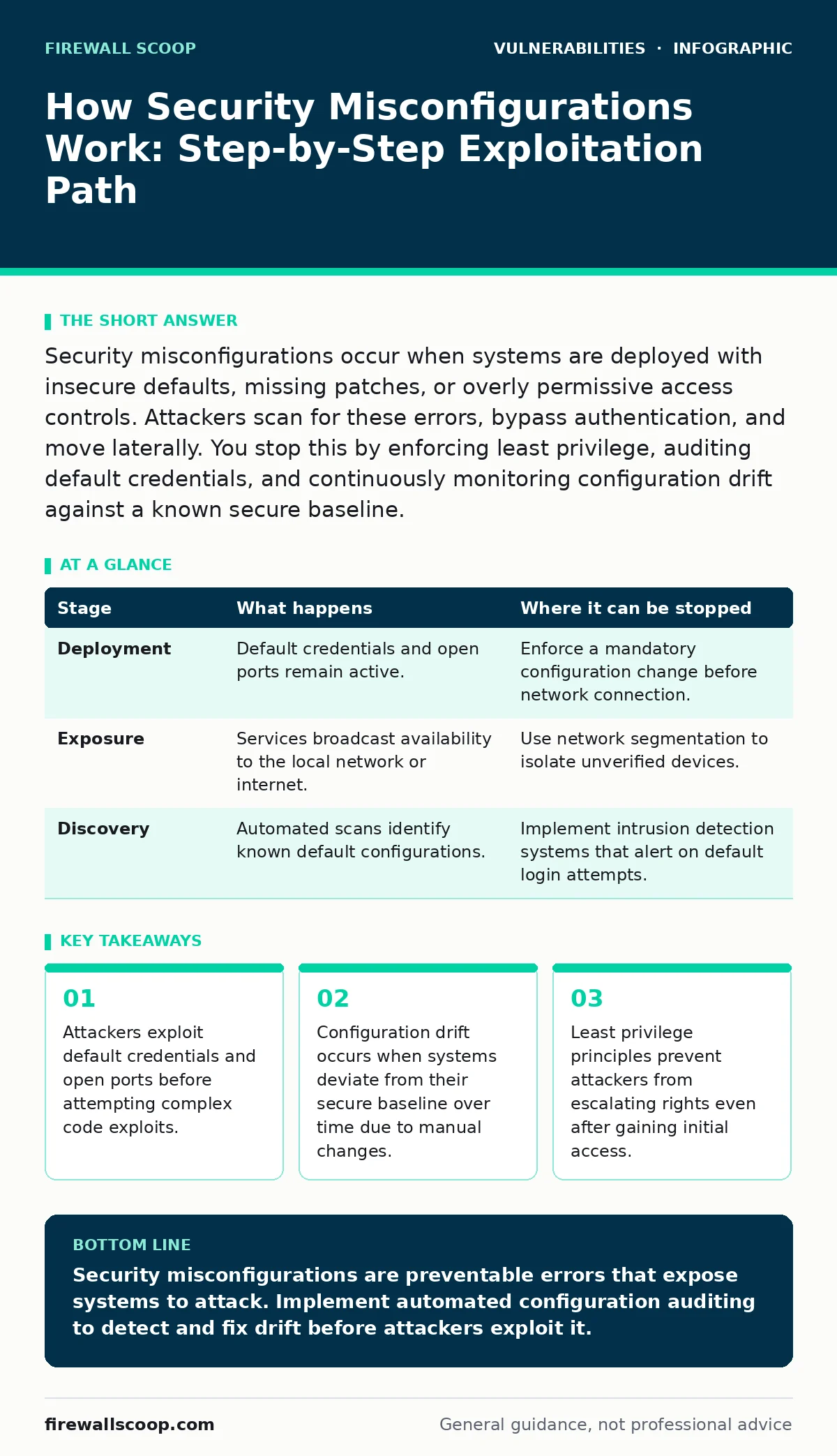
Security misconfigurations occur when systems are deployed with insecure defaults, missing patches, or overly permissive access controls. Attackers scan for these errors, bypass authentication, and move laterally. You stop this by enforcing least privilege, auditing default credentials, and continuously monitoring configuration drift against a known secure baseline.
The Anatomy of a Configuration Error
Security misconfigurations represent the gap between how a system is built and how it is deployed. Developers create software with secure defaults, but administrators often change these settings to prioritize convenience or functionality. This creates a hidden attack surface. Unlike a buffer overflow vulnerability that requires a specific code bug, a misconfiguration relies on human error or negligence. The system itself may be perfectly functional and patched, yet it remains vulnerable because it exposes more than necessary.
Imagine a web server installed with default administrative credentials. The software is secure, but the configuration is not. An attacker does not need to find a zero-day flaw. They simply log in with the known username and password. This simplicity makes misconfigurations one of the most common entry points for breaches. The flaw lies in the setup, not the code.
Stage 1: Insecure Default Deployment
The lifecycle of a misconfiguration begins at deployment. Manufacturers ship products with default usernames, passwords, and open ports to facilitate initial setup. Administrators frequently fail to change these defaults. They assume the network is isolated or that the service is temporary. This assumption is dangerous. Internet-facing services are often scanned by automated bots looking for these specific default credentials.
When a device connects to the network, it broadcasts its services. If the administrator did not disable unnecessary services, the device advertises its presence. This stage relies on the attacker recognizing standard default configurations. Many industrial control systems and network devices still use factory defaults. The attacker relies on the administrator’s failure to perform a pre-deployment security checklist.
| Stage | What happens | Where it can be stopped |
|---|---|---|
| Deployment | Default credentials and open ports remain active. | Enforce a mandatory configuration change before network connection. |
| Exposure | Services broadcast availability to the local network or internet. | Use network segmentation to isolate unverified devices. |
| Discovery | Automated scans identify known default configurations. | Implement intrusion detection systems that alert on default login attempts. |
Stage 2: Unnecessary Service Exposure
Once deployed, systems often run more services than required. A database server might also run a web interface for management. If that web interface is accessible from the public internet, it becomes a target. Attackers use port scanning to identify which services are listening. They look for uncommon ports or services that should not be publicly accessible.
This stage exploits the principle of least privilege violation. Every open port is a potential door. If a service is not needed for the core business function, it should be disabled. Leaving it on increases the attack surface. The attacker relies on the administrator’s assumption that "firewalls will handle it." Firewalls are not a substitute for disabling unnecessary services. If the firewall rule is misconfigured, the service is exposed.
Stage 3: Excessive Permissions and Privilege Escalation
Attackers often gain initial access with low-level privileges. They then look for misconfigured permissions that allow them to escalate their rights. This is known as privilege escalation. A common misconfiguration is giving application accounts administrative rights. If an attacker compromises a web application, they inherit those administrative rights.
This stage relies on the lack of separation of duties. Systems should run with the minimum permissions required to function. If a process needs read access, it should not have write access. Attackers exploit these excess permissions to modify system files, install malware, or access sensitive data. The flaw here is not a bug in the code, but a flaw in the access control policy.
Stage 4: Configuration Drift Over Time
Systems are not static. Administrators make changes to fix issues or add features. These changes often deviate from the original secure baseline. This deviation is called configuration drift. A temporary open port for debugging might be forgotten and left open. A user might be granted temporary access that is never revoked.
This stage is insidious because it happens gradually. The system was secure at deployment, but it is no longer secure today. Attackers exploit this drift by finding the recent changes that introduced vulnerabilities. They rely on the lack of continuous monitoring. Without regular audits, drift accumulates until a critical vulnerability is exposed. This is why patch management is not enough. You must also manage configuration changes.
Stage 5: Exploitation and Lateral Movement
With elevated privileges and access to internal services, the attacker moves laterally. They use the misconfigured system as a pivot point to reach other systems. If password reuse is common, they try the same credentials on other servers. If network segmentation is weak, they move freely across the network.
This stage relies on the initial misconfiguration providing a foothold. The attacker does not need to break into the core systems directly. They use the misconfigured peripheral system to reach the target. The flaw here is the lack of network isolation. Even if one system is compromised, it should not have access to sensitive internal resources.
Interrupting the Attack Chain
You can interrupt this chain at any stage. The most effective method is prevention. Enforce secure defaults during deployment. Use automated tools to check configurations against a known secure baseline. This is often part of software composition analysis, which checks not just code but also dependencies and configurations.
Monitoring is the second line of defense. Detect unauthorized changes to configurations. Alert on login attempts with default credentials. Isolate systems that show signs of compromise. Regular audits ensure that configuration drift is identified and corrected. This reduces the window of opportunity for attackers.
The Role of Policy and Automation
Human error is inevitable. Policies must account for this. Automation reduces the risk of manual misconfiguration. Infrastructure as code allows you to define secure configurations in version control. Any change to the configuration is reviewed and tested. This ensures that drift is minimized.
Training is also necessary. Administrators must understand the risk of default settings and unnecessary services. They must know how to apply the principle of least privilege. Security bulletins often highlight common misconfigurations. Following these recommendations helps prevent known issues.
Final Recommendations for Security Teams
Focus on the basics. Default credentials and open ports are easy to fix. Implement a process for reviewing configurations before deployment. Use automated scanning to detect misconfigurations continuously. Monitor for configuration drift and revert unauthorized changes.
Remember that security is a process, not a product. Misconfigurations will occur. Your goal is to detect and remediate them quickly. By following these steps, you reduce the attack surface and make it harder for attackers to exploit your systems.
Key takeaways
- Attackers exploit default credentials and open ports before attempting complex code exploits.
- Configuration drift occurs when systems deviate from their secure baseline over time due to manual changes.
- Least privilege principles prevent attackers from escalating rights even after gaining initial access.
Security misconfigurations are preventable errors that expose systems to attack. Implement automated configuration auditing to detect and fix drift before attackers exploit it.
Frequently asked questions
How do I find misconfigurations in my network?
Use automated scanning tools that check for default credentials, open ports, and excessive permissions. Compare current settings against a secure baseline.
What is the difference between a vulnerability and a misconfiguration?
A vulnerability is a flaw in the code or design. A misconfiguration is an error in setup or deployment. Both can be exploited, but misconfigurations are often easier to fix.
Can firewalls prevent misconfiguration attacks?
Firewalls can block access to exposed services, but they do not fix the underlying misconfiguration. Disabling unnecessary services is more effective.
How often should I audit configurations?
Audit configurations continuously. Use automated tools to monitor for changes and alert on deviations from the secure baseline.
How this guide was produced: written by the Firewall Scoop editorial team with AI assistance, checked against the public references listed below, and reviewed when the facts change. See our editorial policy or report an error.