IP Spoofing Prevention Checklist: Stop Source Address Forgery
Most network defenses assume incoming packets are honest, allowing spoofed addresses to bypass perimeter checks and mask the true origin of an attack.

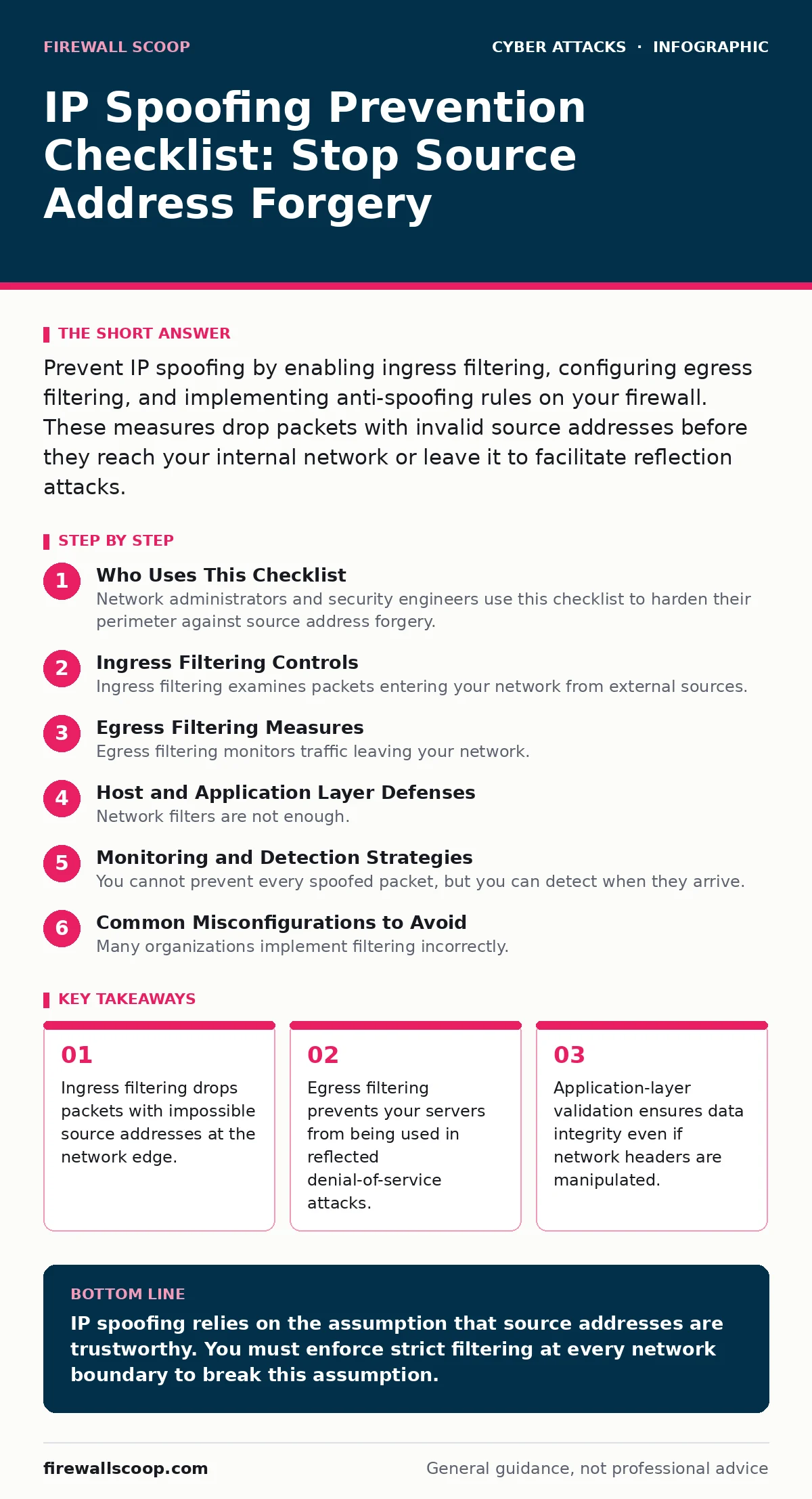
Prevent IP spoofing by enabling ingress filtering, configuring egress filtering, and implementing anti-spoofing rules on your firewall. These measures drop packets with invalid source addresses before they reach your internal network or leave it to facilitate reflection attacks.
Who Uses This Checklist
Network administrators and security engineers use this checklist to harden their perimeter against source address forgery. You apply these controls to routers, firewalls, and host-based security software. The goal is to create multiple layers of verification that make it difficult for an attacker to hide their identity or amplify traffic toward your systems.
Ingress Filtering Controls
Ingress filtering examines packets entering your network from external sources. You configure your edge router to drop any packet that claims to originate from your own internal address space. This stops attackers from pretending to be your own servers. You also drop packets with reserved or private IP addresses that should never appear on the public internet.
- Enable RFC 2827 filtering on edge routers: Drops packets with source addresses that do not match the incoming interface’s expected range.
- Block private address ranges on public interfaces: Prevents attackers from using internal IP ranges to bypass firewall rules that trust local traffic.
- Drop bogon prefixes: Removes traffic from IP blocks that are not assigned to any organization, reducing noise and potential abuse.
Egress Filtering Measures
Egress filtering monitors traffic leaving your network. Attackers often compromise internal machines to send spoofed packets outward. If your network allows these packets to leave, you become part of a larger attack chain. Egress filtering ensures that outgoing traffic only carries source addresses that actually belong to your infrastructure. This protects your reputation and prevents your bandwidth from being weaponized.
- Verify source IPs on outbound traffic: Ensures that only legitimate internal addresses are used in packets leaving your network boundary.
- Rate limit outbound DNS queries: Limits the volume of responses your servers can generate, reducing the impact of DNS amplification attacks.
- Monitor for asymmetric routing anomalies: Detects when return traffic takes a different path than expected, which can indicate spoofing or routing hijacks.
Host and Application Layer Defenses
Network filters are not enough. An attacker might bypass your perimeter or launch an attack from within. You must validate data at the application level. Use cryptographic signatures to verify the origin of important messages. This approach is similar to how you defend against CEO fraud by verifying identity through secondary channels. You do not trust the network header alone. You trust the cryptographic proof inside the payload.
- Implement TLS for all external services: Encrypts traffic and verifies the server identity, preventing man-in-the-middle attacks that rely on IP trust.
- Use digital signatures for API calls: Ensures that requests have not been altered and originate from an authorized client, regardless of the source IP.
- Enable session fixation protections: Prevents attackers from hijacking valid sessions by forcing new session IDs after authentication events.
Monitoring and Detection Strategies
You cannot prevent every spoofed packet, but you can detect when they arrive. Your monitoring systems should flag unusual patterns. A sudden spike in traffic from a single source IP that does not match normal behavior is a red flag. You also look for packets with impossible TTL (Time To Live) values. These anomalies help you identify active spoofing attempts even if your filters missed them.
- Configure alerts for high-volume single-source traffic: Identifies potential denial-of-service attacks where the attacker spoofs the source to hide their identity.
- Log dropped packets for analysis: Provides visibility into attempted spoofing, helping you refine your filtering rules over time.
- Correlate logs with intrusion prevention systems: Combines network data with deep packet inspection to catch sophisticated attacks that evade simple filters.
See also: What Is Intrusion Prevention: How IPS Stops Attacks Before They Land · Lateral Movement Prevention Checklist for Network Security
Common Misconfigurations to Avoid
Many organizations implement filtering incorrectly. A common mistake is allowing all traffic from trusted partners without verification. This creates a blind spot. Another error is failing to update blackhole routes. When you detect a source of spoofed traffic, you need to block it globally. You also must ensure that your internal network design does not allow lateral movement that bypasses edge filters.
- Audit trust relationships regularly: Ensures that partners and vendors still meet your security requirements and do not introduce spoofed traffic.
- Update blackhole routes promptly: Blocks known malicious sources at the network edge, preventing them from consuming your resources.
- Segment internal network zones: Limits the damage if an attacker bypasses perimeter filters and gains access to internal systems.
Integrating with Broader Security
IP spoofing is often a precursor to more complex attacks. Attackers use spoofed addresses to hide their identity while launching phishing campaigns or spear phishing attacks. They may also use spoofing to facilitate invoice fraud by making fraudulent requests appear to come from legitimate suppliers. You must integrate your network defenses with your application security. A strong firewall is useless if your users click on malicious links. You need a holistic approach that covers both network and human factors.
Validating Your Controls
You must test your filtering rules regularly. Send test packets with spoofed source addresses to your edge router. Verify that they are dropped. You also need to test your egress filters. Try to send a packet from an internal machine with an external source IP. The router should block it. If it does not, you have a configuration error. Regular testing ensures that your defenses remain effective as your network evolves.
- Perform penetration testing on edge devices: Validates that filtering rules are correctly applied and cannot be bypassed.
- Conduct tabletop exercises for spoofing scenarios: Prepares your team to respond quickly when a spoofing attack is detected.
- Review firewall logs for false positives: Ensures that legitimate traffic is not being blocked by overly aggressive filtering rules.
Key takeaways
- Ingress filtering drops packets with impossible source addresses at the network edge.
- Egress filtering prevents your servers from being used in reflected denial-of-service attacks.
- Application-layer validation ensures data integrity even if network headers are manipulated.
IP spoofing relies on the assumption that source addresses are trustworthy. You must enforce strict filtering at every network boundary to break this assumption.
Frequently asked questions
Can IP spoofing be completely stopped?
No, because the IP protocol itself does not verify source addresses. You can mitigate the impact and make attacks much harder, but you cannot eliminate the possibility entirely.
Does encryption prevent IP spoofing?
Encryption protects the data payload, not the network header. An attacker can still spoof the IP address to deliver encrypted malicious traffic, so you need both filtering and encryption.
Why is egress filtering important?
Egress filtering prevents your network from being used as a source for reflected attacks. It protects your reputation and ensures you are not contributing to attacks on others.
How do I know if I am under a spoofing attack?
Look for sudden spikes in traffic, packets with impossible source addresses, or alerts from your intrusion detection systems. Correlate these signs with your firewall logs.
How this guide was produced: written by the Firewall Scoop editorial team with AI assistance, checked against the public references listed below, and reviewed when the facts change. See our editorial policy or report an error.