Bot Protection: How to Stop Automated Abuse Without Blocking Users
Bot protection works by analyzing behavior patterns rather than just checking credentials, allowing systems to distinguish human intent from automated scripts.

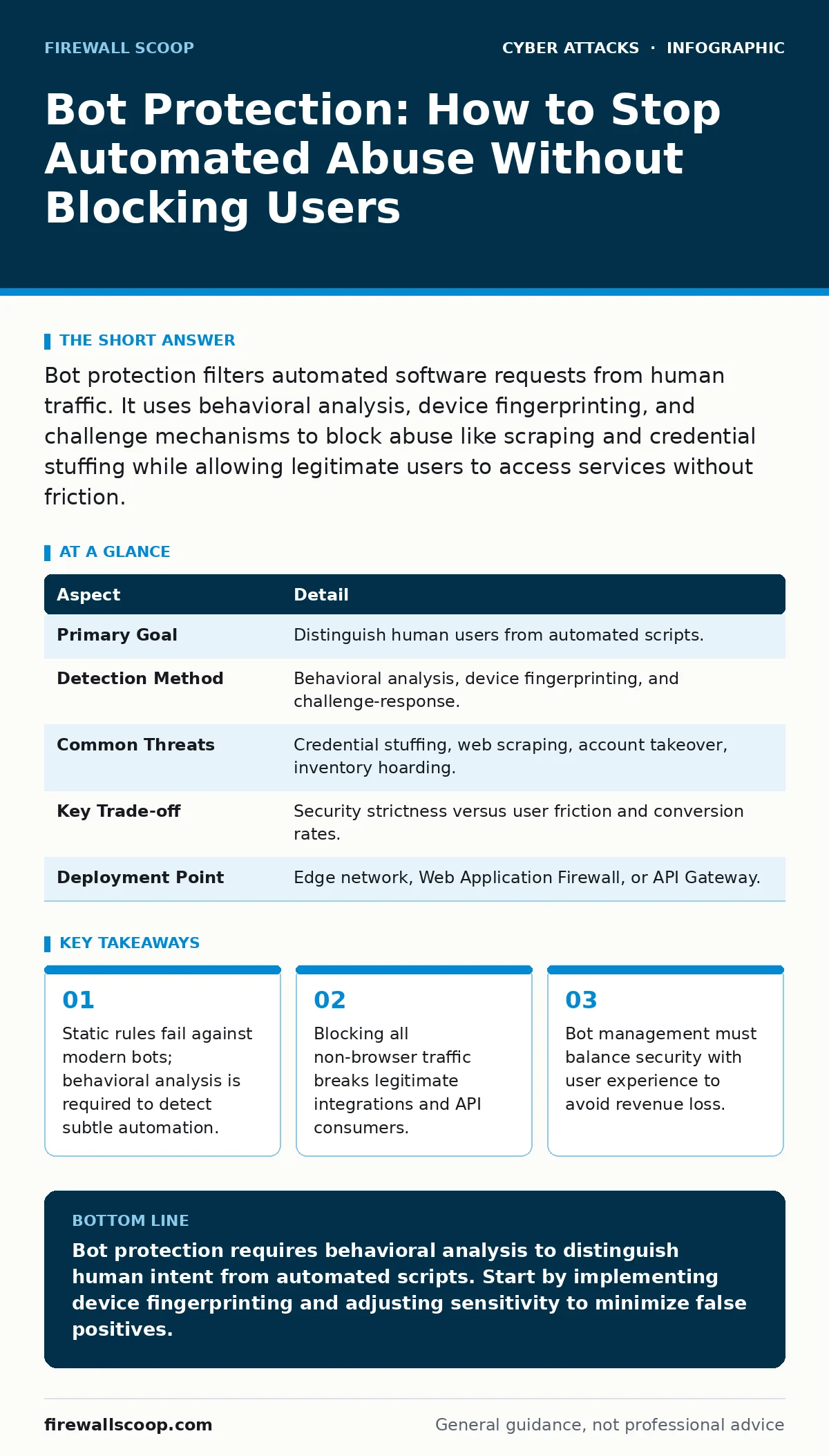
Bot protection filters automated software requests from human traffic. It uses behavioral analysis, device fingerprinting, and challenge mechanisms to block abuse like scraping and credential stuffing while allowing legitimate users to access services without friction.
The Digital Doorman Analogy
Imagine a popular club with a strict dress code. The bouncer checks IDs and ensures no one wears jeans. This is traditional access control. Now imagine thousands of robots dressed in suits, all holding valid IDs, trying to enter simultaneously to steal the bar’s inventory. The bouncer cannot stop them by checking IDs alone. You need a system that observes how they move, how they interact with staff, and whether their behavior matches human norms. Bot protection is that observation layer. It sits between the user and the application, analyzing the request before it reaches your data.
Most people think of bots as malicious. In reality, bots are simply automated scripts. Search engine crawlers are bots. Monitoring tools are bots. The problem arises when these scripts operate at scale or with malicious intent. They scrape pricing data, book tickets for resale, or attempt to guess passwords. Your infrastructure must handle this traffic without collapsing under the weight of automated requests.
At a Glance: Bot Protection Mechanics
| Aspect | Detail |
|---|---|
| Primary Goal | Distinguish human users from automated scripts. |
| Detection Method | Behavioral analysis, device fingerprinting, and challenge-response. |
| Common Threats | Credential stuffing, web scraping, account takeover, inventory hoarding. |
| Key Trade-off | Security strictness versus user friction and conversion rates. |
| Deployment Point | Edge network, Web Application Firewall, or API Gateway. |
The Problem It Solves
Automated abuse costs organizations more than just server bandwidth. It distorts data, depletes inventory, and compromises accounts. Consider credential stuffing, where attackers use leaked username-password pairs from other breaches to try logging into your service. A human can only try a few combinations. A bot can try millions per second. Without protection, your login page becomes a target for mass exploitation.
Another significant issue is data scraping. Competitors or data brokers use bots to harvest your product listings, prices, or user-generated content. This undermines your competitive advantage and can lead to copyright violations. Additionally, bots can participate in drive-by downloads by exploiting vulnerabilities in server-side applications that are not meant to handle high-volume automated requests. They can also facilitate typosquatting campaigns by registering domain names that look like yours, directing confused users to malicious sites.
How Detection Works
Effective bot protection does not rely on a single signal. It uses a combination of techniques to build a profile of the visitor. The first layer is often device fingerprinting. This process collects data about the browser, operating system, screen resolution, and installed fonts. Humans have unique device signatures. Bots often have generic or inconsistent signatures. If a browser claims to be Chrome on Windows but reports a screen resolution that does not exist, the system flags it.
The second layer is behavioral analysis. This looks at mouse movements, scroll patterns, and keystroke dynamics. Humans move their cursors in smooth, curved paths. Bots often move cursors in straight lines or jump between coordinates instantly. Humans type with variable speed and occasional errors. Bots type at uniform speeds with perfect accuracy. These subtle differences help the system identify automation that tries to mimic a browser.
The third layer is challenge-response mechanisms. When the system detects suspicious activity, it presents a challenge. This is not always a CAPTCHA with distorted text. Modern challenges are invisible. They might require the browser to execute a specific JavaScript function or solve a simple cryptographic puzzle. Humans do not notice this. Bots that do not execute JavaScript or cannot solve the puzzle are blocked.
Integration With Other Defenses
Bot protection does not replace other security measures. It complements them. For instance, multi-factor authentication adds a layer of security to user accounts, but it does not stop bots from attempting to log in. If a bot successfully guesses a password, it will still be challenged by the second factor. However, without bot protection, the login system may become overwhelmed by the volume of attempts, causing legitimate users to experience downtime. Bot protection reduces the noise, allowing MFA to function effectively.
It also interacts with DNS security. Attackers often use DNS spoofing to redirect users to malicious sites that host botnets. By ensuring your DNS infrastructure is secure, you reduce the likelihood of users being directed to sites that generate bot traffic against your services. Furthermore, bot protection can help mitigate replay attacks by ensuring that requests are unique and time-bound, preventing attackers from recording and reusing valid requests.
See also: Stop Directory Listing Exposure: Configuration Fixes That Work
What People Usually Get Wrong
A common misconception is that blocking all bot traffic is the safest approach. This is incorrect. Many legitimate services rely on bots. Search engines need to crawl your site to index your content. Partner APIs may use automated scripts to exchange data. Blocking these bots can damage your SEO and break business partnerships. The goal is not to block all bots, but to manage them. You must allow good bots and block bad ones.
Another mistake is relying solely on IP reputation. Attackers use residential proxies to hide behind legitimate IP addresses. An IP address that belongs to a home user can be used to launch a bot attack. If you block based only on IP reputation, you risk blocking legitimate users who share IP addresses with attackers, such as those on large corporate networks or public Wi-Fi. Behavioral analysis is more reliable than IP reputation alone.
Balancing Security and Experience
The hardest part of bot protection is tuning the sensitivity. If you set the thresholds too high, you block legitimate users. This leads to lost sales and frustrated customers. If you set them too low, bots slip through. You must monitor the false positive rate. Look at the traffic that is blocked and determine if it includes legitimate users. Adjust the rules accordingly.
Regularly review the types of bots that are interacting with your site. Update your allowlists to include new search engine crawlers or partner bots. Remove old or unused bots from the allowlist. This ongoing maintenance ensures that your protection remains effective without hindering business operations.
The Edge Cases
Some applications require high-frequency automated access. Trading platforms, for example, rely on bots to execute trades in milliseconds. In these cases, you cannot use standard bot protection. You must create a separate API gateway with specific authentication and rate-limiting rules. This allows legitimate automated traffic while keeping the main application protected from abuse.
Another edge case is mobile applications. Mobile apps do not have browsers in the traditional sense. They use native code to communicate with servers. Bot protection for mobile apps requires different techniques, such as certificate pinning and root detection. Ensure your protection strategy covers all entry points to your application, including web, mobile, and API interfaces.
Key takeaways
- Static rules fail against modern bots; behavioral analysis is required to detect subtle automation.
- Blocking all non-browser traffic breaks legitimate integrations and API consumers.
- Bot management must balance security with user experience to avoid revenue loss.
Bot protection requires behavioral analysis to distinguish human intent from automated scripts. Start by implementing device fingerprinting and adjusting sensitivity to minimize false positives.
Frequently asked questions
Does bot protection stop DDoS attacks?
Bot protection can mitigate application-layer DDoS attacks by blocking malicious bots, but it does not replace network-level DDoS mitigation services.
How do I allow search engine bots?
Maintain an allowlist of known search engine user-agents and IP ranges, and verify their identity using reverse DNS lookups.
Is bot protection enough to prevent account takeover?
No. Bot protection reduces the volume of attempts, but you also need multi-factor authentication and anomaly detection to prevent account takeover.
Can bots bypass behavioral analysis?
Sophisticated bots can mimic human behavior, but they often leave subtle inconsistencies. Continuous monitoring and machine learning models help detect these advanced threats.
How this guide was produced: written by the Firewall Scoop editorial team with AI assistance, checked against the public references listed below, and reviewed when the facts change. See our editorial policy or report an error.